• About
  • Privacy Policy
  • Terms of Use
  • Donation
  • Contact
No Result
View All Result
Archaeology News
  • Home
  • News
    • Archaeology
    • Anthropology
    • Paleontology
  • Academic
    • Books
    • Conferences
    • Universities
  • Articles
  • VR Tours
  • Quiz & Game
  • Download
  • Encyclopedia
  • Forum
Archaeology News
No Result
View All Result
Home News Anthropology

100,000-year-old Homo sapiens bones from Ethiopia may preserve earliest evidence of human cremation

by Dario Radley
May 24, 2026

Researchers studying Ethiopia’s Afar Rift have reported what could be the oldest known evidence of human cremation. The finding comes from sediments about 100,000 years old in the Middle Awash region, an area with one of Africa’s richest records of early Homo sapiens life.
100,000-year-old Homo sapiens bones from Ethiopia may preserve earliest evidence of human cremation
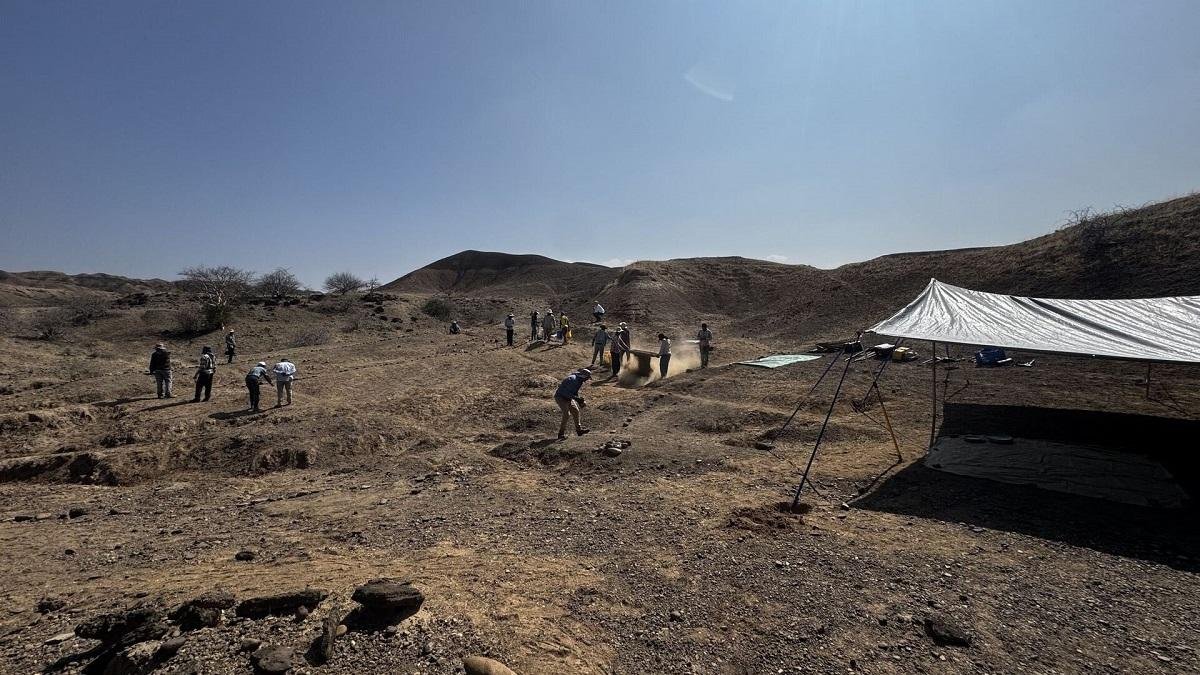
Surveying, sieving, and fossil recovery at the research site. Credit: Ferhat Kaya

The study focused on the Faro Daba beds in the lower Halibee Member of the Dawaitoli Formation. These deposits hold fossils, stone tools, and environmental traces from a time before modern human groups spread into Eurasia. Field teams working in the region since 1981 recovered thousands of artifacts and animal remains, along with fossil material from at least three Homo sapiens individuals.

Some human bones showed traces of burning at high temperatures. Researchers suggest such evidence could point to cremation. If confirmed, the practice would push back the known history of human cremation by tens of thousands of years. Other bones carried predator bite marks. Signs of rapid burial appeared as well. The remains point to different postmortem histories among the individuals found at the site.

The location stands out because much of the archaeological material stayed where ancient people left or dropped it. Many African sites from this period come from caves or rock shelters with thin deposits. Open-air sites with intact layers remain rare. At Faro Daba, fossils and tools survived with limited disturbance from water flow, erosion, or geological activity.

Thousands of Middle Stone Age stone artifacts were recovered from the sediments. Researchers found evidence for repeated short-term visits to the area rather than long-lasting settlement. Tool production and discard took place on a floodplain linked to the ancient Awash River.
RelatedStories

Neanderthals gathered shellfish like modern humans 115,000 years ago, study finds

Neanderthals gathered shellfish like modern humans 115,000 years ago, study finds

May 21, 2026
Homo erectus in Java: 140,000-year-old fossils found in submerged river valley

400,000-year-old Homo erectus proteins reveal genetic links to Denisovans and modern humans

May 14, 2026

Environmental evidence paints a picture of a wooded landscape shaped by seasonal flooding. Sediment data, animal remains, and combustion traces place human activity away from the main river channel. The research team argues local water conditions shaped daily life more strongly than broad climate trends.

More than 3,000 animal fossils helped reconstruct the surrounding ecosystem. The faunal record includes monkeys, rodents, and large mammals. Such remains offer a detailed view of the habitats early Homo sapiens used in East Africa.

Some stone artifacts came from obsidian, a volcanic glass sourced from distant locations. Those materials point to long-distance movement across the landscape. Early human groups in the region appear to have traveled widely and returned repeatedly to familiar places.

The Middle Stone Age marks a major phase in African human history tied to the rise of Homo sapiens. Evidence from open-air contexts remains limited, which gives added weight to the Afar Rift findings. By combining geology, archaeology, fossil evidence, and environmental data, the study builds a detailed record of how human groups lived on a seasonally flooded plain 100,000 years ago. Water availability, mobility, tool making, and shifting local habitats all played a role in shaping life along the ancient Awash River.

Publication: Beyene, Y., Asfaw, B., White, T. D., WoldeGabriel, G., Bernor, R., Bibi, F., … Sánchez-Romero, L. (2026). Halibee member archaeology: Middle Stone Age environment, technology, and postmortem modifications. Proceedings of the National Academy of Sciences of the United States of America, 123(17), e2534441123. doi:10.1073/pnas.2534441123
More information: University of Oulu

Share:

Share on Facebook Share on X (Twitter) Share on LinkedIn Share on Pinterest Share on WhatsApp Share on Email

You May Also Like...

Ancient Peruvian hairless dogs buried with Wari elites 1,200 years ago
Archaeology

Ancient Peruvian hairless dogs buried with Wari elites 1,200 years ago

May 24, 2026
4,000-year-old Mohenjo-daro study finds ancient city grew more equal over time
Archaeology

4,000-year-old Mohenjo-daro study finds ancient city grew more equal over time

May 24, 2026
Bronze Age towers in Sardinia remained centers of worship and ritual in the Iron Age
Archaeology

Bronze Age towers in Sardinia remained centers of worship and ritual in the Iron Age

May 23, 2026
Rare 19th-century bone dental bridge found in Portugal points to early cosmetic tooth replacement
Anthropology

Rare 19th-century bone dental bridge found in Portugal points to early cosmetic tooth replacement

May 23, 2026
Medieval well hidden beneath Sheffield Castle surveyed with drone technology
Archaeology

Medieval well hidden beneath Sheffield Castle surveyed with drone technology

May 23, 2026
Nondestructive DNA sampling uncovers 1,300 years of history preserved in ancient parchments
Archaeology

Nondestructive DNA sampling uncovers 1,300 years of history preserved in ancient parchments

May 22, 2026

Comments 0

  1. Editorial Team says:
    1 second ago

    Disclaimer: This website is a science-focused magazine that welcomes both academic and non-academic audiences. Comments are written by users and may include personal opinions or unverified claims. They do not necessarily reflect the views of our editorial team or rely on scientific evidence.

    Comment Policy: We kindly ask all commenters to engage respectfully. Comments that contain offensive, insulting, degrading, discriminatory, or racist content will be automatically removed.

    Reply

Leave a Reply Cancel reply

Your email address will not be published. Required fields are marked *

Follow us


Instagram
242K

Facebook
117K

Threads
46K

LinkedIn
14K

Twitter
6K

YouTube
1K
100,000-year-old Homo sapiens bones from Ethiopia may preserve earliest evidence of human cremation

100,000-year-old Homo sapiens bones from Ethiopia may preserve earliest evidence of human cremation

May 24, 2026
Ancient Peruvian hairless dogs buried with Wari elites 1,200 years ago

Ancient Peruvian hairless dogs buried with Wari elites 1,200 years ago

May 24, 2026
4,000-year-old Mohenjo-daro study finds ancient city grew more equal over time

4,000-year-old Mohenjo-daro study finds ancient city grew more equal over time

May 24, 2026
Bronze Age towers in Sardinia remained centers of worship and ritual in the Iron Age

Bronze Age towers in Sardinia remained centers of worship and ritual in the Iron Age

May 23, 2026

Archaeology News online magazine

Archaeology News is an international online magazine that covers all aspects of archaeology.


Categories

  • Academics
    • Books
    • Conferences
    • Universities
  • Articles
  • Download
  • Game
  • News
    • Anthropology
    • Archaeology
    • Paleontology
  • Quiz
  • Tours

Subscribe to our newsletter

© 2024 - Archaeology News Online Magazine. All Rights Reserved.

  • About
  • Privacy Policy
  • Terms of Use
  • Donation
  • Contact

Manage Consent
To provide the best experiences, we use technologies like cookies to store and/or access device information. Consenting to these technologies will allow us to process data such as browsing behavior or unique IDs on this site. Not consenting or withdrawing consent, may adversely affect certain features and functions.
Functional Always active
The technical storage or access is strictly necessary for the legitimate purpose of enabling the use of a specific service explicitly requested by the subscriber or user, or for the sole purpose of carrying out the transmission of a communication over an electronic communications network.
Preferences
The technical storage or access is necessary for the legitimate purpose of storing preferences that are not requested by the subscriber or user.
Statistics
The technical storage or access that is used exclusively for statistical purposes. The technical storage or access that is used exclusively for anonymous statistical purposes. Without a subpoena, voluntary compliance on the part of your Internet Service Provider, or additional records from a third party, information stored or retrieved for this purpose alone cannot usually be used to identify you.
Marketing
The technical storage or access is required to create user profiles to send advertising, or to track the user on a website or across several websites for similar marketing purposes.
  • Manage options
  • Manage services
  • Manage {vendor_count} vendors
  • Read more about these purposes
View preferences
  • {title}
  • {title}
  • {title}
  • Home
  • News
    • Archaeology
    • Anthropology
    • Paleontology
  • Academic
    • Books
    • Conferences
    • Universities
  • Articles
  • VR Tours
  • Quiz & Game
  • Download
  • Encyclopedia
  • Forum

About  .  Contact  .  Donation

© 2024 - Archaeology News Online Magazine. All Rights Reserved