
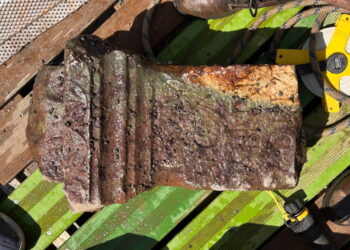
Volunteer divers have recovered a rare Bronze Age sword from the protected Salcombe Cannon and Moor Sand wreck sites off the coast of Devon, England. The find adds fresh evidence to one of the most important prehistoric maritime sites in northwestern Europe and adds another piece to the story of Bronze Age trade across the Atlantic.

The sword was found earlier this year by Becky Gill and Catherine Gill, members of the South West Maritime Archaeological Group, or SWMAG. The discovery came during work funded by Historic England through the SWMAG: The Next Generation of Affiliated Volunteers project, delivered with MSDS Marine. The program trains new volunteer divers while passing skills from long-time members to a new generation of maritime archaeologists.
The weapon came from an area first examined in the late 1970s by maritime archaeologist Keith Muckelroy. His work helped establish Salcombe as a site of major prehistoric importance. Even after decades of study, the seabed continues to produce new finds.

Experts believe the sword dates to the Middle or Late Bronze Age, between about 1300 and 800 BCE. Heavy erosion has worn away many of its features, making a more exact type hard to identify. Researchers expect further study after conservation to provide a clearer picture of its age and design.

The Salcombe wreck sites have already produced a large collection of Bronze Age objects, including tools and weapons. Earlier finds point to the remains of at least two separate Bronze Age shipwrecks resting on the seabed. These objects show links between communities in Britain and mainland Europe more than 3,000 years ago, offering evidence of active trade and long-distance sea travel.
Neil Wilkin of the British Museum said the sword adds another chapter to the story of the Salcombe site. He noted that earlier finds from the area have helped shape exhibitions and research on Bronze Age Britain and its links with continental Europe. He added that each new object helps build a better picture of ancient trade, travel, and exchange along Britain’s coast.

The sword is now undergoing conservation by MSDS Marine before moving to the British Museum, where researchers will study it and make it available for future research.
Researchers hope ongoing analysis of the sword will add more detail to the history of Bronze Age seafaring, trade routes, and the movement of metal objects in the waters off southwestern England.
More information: MSDS Marine / SWMAG








Disclaimer: This website is a science-focused magazine that welcomes both academic and non-academic audiences. Comments are written by users and may include personal opinions or unverified claims. They do not necessarily reflect the views of our editorial team or rely on scientific evidence.
Comment Policy: We kindly ask all commenters to engage respectfully. Comments that contain offensive, insulting, degrading, discriminatory, or racist content will be automatically removed.