
Archaeologists have found the remains of an 800-year-old medieval bridge beneath Chester Castle in northwest England, and they did it without digging a single trench.

The find came during a digital survey led by the University of Chester. The team used laser scanners, drones, and detailed 3D models to record the castle above and below ground. While exploring underground passages beneath Chester Crown Court, Professor Stewart Ainsworth spotted a section of stonework that looked very different from the surrounding 18th century walls.
The underground passages lie beneath the former prison built as part of architect Thomas Harrison’s redesign of Chester Castle in the late 1700s. Historians long believed Harrison removed this part of the medieval castle during the project. The newly found wall tells a different story.
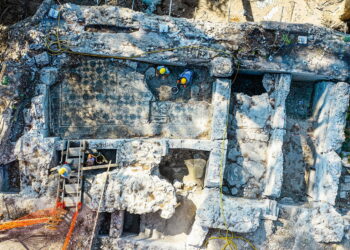
Ainsworth compared the stonework with surviving parts of the Norman castle and identified the wall as medieval. The structure stands almost three meters high, showing that large sections of the earlier castle survived Harrison’s redevelopment. The team thinks more medieval remains still lie beneath the castle complex and nearby parking area.

High-resolution digital scans helped pinpoint the wall’s exact position. Researchers then matched the scans with old maps and historic plans. The evidence showed the wall formed part of a bridge crossing the deep defensive ditch around the castle’s inner ward.
Archaeologists date the bridge to about 1260 to 1280. Builders constructed the crossing when a heavily fortified gatehouse replaced an older entrance. Harrison later removed the gatehouse, though part of the bridge stayed hidden below ground for centuries.
The bridge closely matches remains at Beeston Castle in Cheshire, where visitors still see part of a medieval crossing over a defensive ditch. Archaeologists think Chester Castle once had a similar drawbridge system, allowing defenders to block access during an attack.

The find also adds to the story of Chester Castle, one of England’s major Norman strongholds. Its original stone entrance, known today as the Agricola Tower, still stands nearby. The tower contains the Chapel of St Mary de Castro, where rare wall paintings from the 1240s survive.
The discovery formed part of Digital Dimensions, a joint project involving the University of Chester, Cheshire Constabulary, English Heritage, Historic England, SCCS North, and the Hartree National Center for Digital Innovation. The project creates detailed digital records of historic sites while helping protect them from theft, vandalism, and other damage.
Researchers say the bridge shows how digital surveys reach far beyond recording old buildings. By studying hidden spaces with modern technology, archaeologists found part of Chester Castle’s medieval past without disturbing the ground, giving historians a clearer picture of how the fortress changed over the centuries.
More information: University of Chester






Disclaimer: This website is a science-focused magazine that welcomes both academic and non-academic audiences. Comments are written by users and may include personal opinions or unverified claims. They do not necessarily reflect the views of our editorial team or rely on scientific evidence.
Comment Policy: We kindly ask all commenters to engage respectfully. Comments that contain offensive, insulting, degrading, discriminatory, or racist content will be automatically removed.
This is so amazing – every aspect of the discoveries and now links much of the past to life as we live it now. Keep up the great work.