
Genetic information from an ancient human relative has been extracted, making it the oldest such data recovered to date.
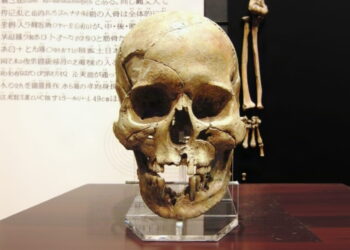
This remarkable discovery involved analyzing protein sequences from several Paranthropus robustus tooth fossils found in a South African cave, dating back to around two million years ago.
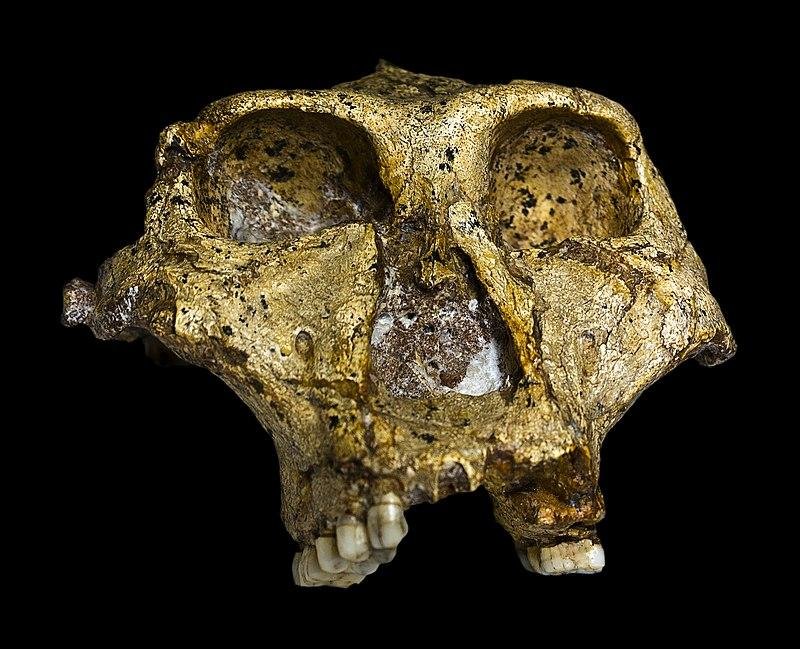
The genetic data retrieved from these fossils are the oldest ever collected from any hominin, pushing back the genetic record to previously unimaginable times and places, according to scientists.
The study, led by Enrico Capellini from the University of Copenhagen, involved the use of mass spectrometry to analyze proteins in the enamel of the teeth.
One of the proteins they identified, called amelogenin-Y, indicated that two of the teeth belonged to males, while the other two teeth were likely from females based on the presence of the X-chromosome version of the protein.
Using the data from 400 sequenced amino acids, the researchers constructed a simple evolutionary tree, which confirmed that Homo sapiens, Neanderthals, and Denisovans are more closely related to each other than they are to the two-million-year-old Paranthropus robustus.
This new genetic data from ancient proteins is considered a transformative breakthrough for palaeoanthropology, potentially aiding in understanding the evolutionary lineage of early hominins.
Proteins, being more resilient than DNA, allow researchers to push back the molecular record and provide insights into hominin relationships that were previously challenging to determine. However, some experts remain cautious about the extent to which ancient proteins can provide clarity compared to DNA analysis.
The preservation of the teeth’s genetic material is attributed to the arid area being affected by flash floods, ensuring exceptional preservation. While this may limit the number of similar fossils found in this particular location, the techniques used in this study can potentially be applied in other geological sites.
This groundbreaking research has opened new possibilities for understanding ancient evolutionary lineages and the complex family tree of human beings.
Paranthropus robustus is an extinct hominin species that lived approximately 1.2 to 2 million years ago in Southern Africa, particularly in present-day South Africa.






Disclaimer: This website is a science-focused magazine that welcomes both academic and non-academic audiences. Comments are written by users and may include personal opinions or unverified claims. They do not necessarily reflect the views of our editorial team or rely on scientific evidence.
Comment Policy: We kindly ask all commenters to engage respectfully. Comments that contain offensive, insulting, degrading, discriminatory, or racist content will be automatically removed.
Im interested in the information about evidence if any to the cave man era how many diffrent types of sculls there are and how old such a thing would be thank you please get back to me if you would its very interesting.
many people are making comments on my comments, but they won’t open, I have no idea what they are saying.
What was their diet?
OK, “human relative” — what species, animal etc. — chimp, etc. I tried to “extract” (no pun) this info from your article but couldn’t find it. Tx.
Paranthropus robustus. The article states it.
last paragraph reads, “Paranthropus robustus is an extinct hominin species that lived approximately 1.2 to 2 million years ago in Southern Africa, particularly in present-day South Africa”
I am a keen learner of Egyptology also the assyrian empire I am also fairly keen on English history also dinosaurs 4 million year old first human beings etc. My problem is that nobody seems to fit into any equations is if man evolved from apes then keeps on thriving why are apes still apes also biblically speaking where does Adam and Eve also fit into these equations these issues are still not explained in any programs that I eagerly watch on youtube is there any answers to these questions if so where can I find them.
Dear Victor
Humans did not evolve directly from modern monkeys. Instead, both humans and modern monkeys share a common ancestor that lived millions of years ago. The theory of evolution explains that all living organisms, including humans and monkeys, share a common ancestry and have evolved through gradual changes over a long period of time.
Around 6 to 8 million years ago, a population of primates that was ancestral to both humans and modern monkeys diverged. One lineage eventually led to the evolution of humans, while the other lineage led to the evolution of modern monkeys. This divergence occurred due to various environmental factors, natural selection, and genetic mutations over millions of years.
why are apes still apes if mankind evolved from then . and 4 million year old early man where does Adam and Eve fit into the equations nobody seems to want to put these questions into any prospections with the exception of Charles Darwin with his origins of the species and he was ridiculed for his beliefs when can we see a tv program which puts these questions into a prespective.
Adam and Eve doesn’t fit because it’s a fairy tale. Purely a mythological story. Mankind and modern apes evolved from a shared ancestor millions of years ago that likely was very different from either modern species.
Humans and monkeys are both primates. But humans are not descended from monkeys or any other primate living today. We do share a common ape ancestor with chimpanzees. It lived between 8 and 6 million years ago. But humans and chimpanzees evolved differently from that same ancestor. All apes and monkeys share a more distant relative, which lived about 25 million years ago.
You are incorrect. Adam and Eve are not a fairy tale.
What cave in South Africa? Thank you
There’s supposed to be a genetic “Eve” from central Africa from which all of us are descendants. I watched a film recently about the DNA research put in to finding this information. If I can find the link, I will comment again, later.
How was Eve born?
Adam was put into a deep sleep by God. God then took a rib from Adam and made Eve to be his companion.
How can a fossil contain DNA? A fossil is just minerals and rock.
Seriously, if you believe in God before science and fantasy like Adam & Evelyn go study the 6 books allegedly written on the theory.
Leave us fact believers to ourselves.