• About
  • Privacy Policy
  • Terms of Use
  • Donation
  • Contact
No Result
View All Result
Archaeology News
  • Home
  • News
    • Archaeology
    • Anthropology
    • Paleontology
  • Academic
    • Books
    • Conferences
    • Universities
  • Articles
  • VR Tours
  • Quiz & Game
  • Download
  • Encyclopedia
  • Forum
Archaeology News
No Result
View All Result
Home News Archaeology

New study reveals earthquake contributed to Pompeii’s destruction amid Vesuvius eruption

by Dario Radley
July 23, 2024

The catastrophic eruption of Mount Vesuvius in 79 CE, which led to the complete burial of the ancient Roman city of Pompeii under volcanic ash, is well-documented. Recent research, however, reveals that a simultaneous earthquake played a significant role in the city’s destruction and the death of its inhabitants.
New study reveals earthquake contributed to Pompeii's destruction amid Vesuvius eruption
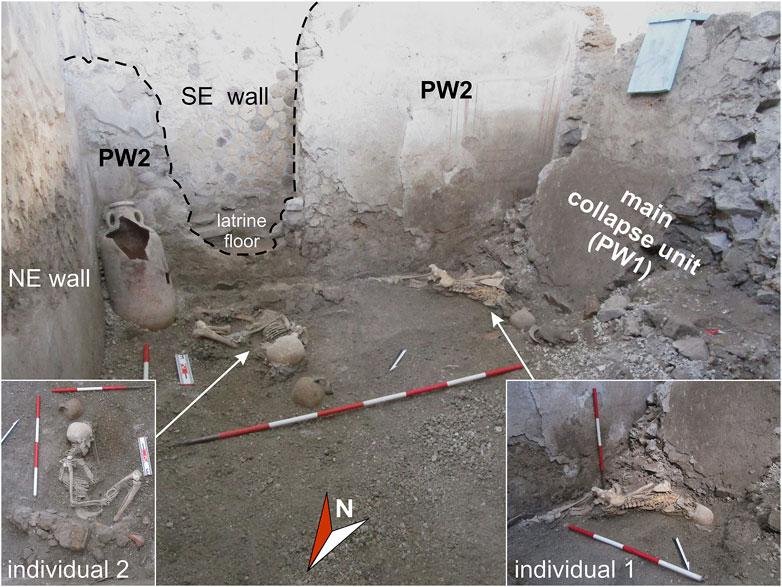
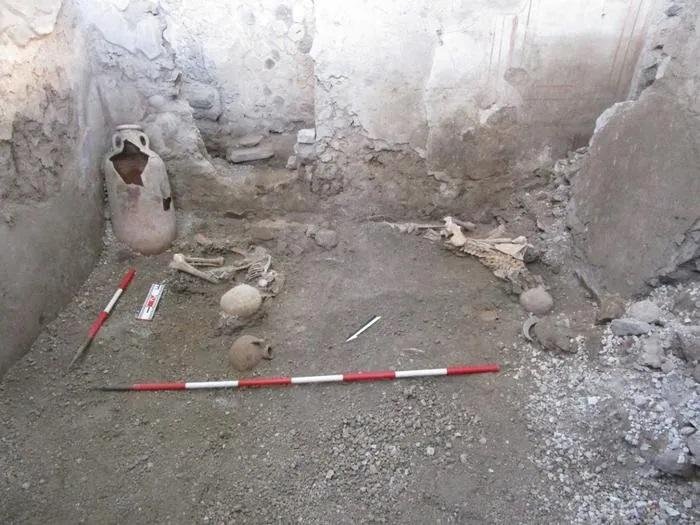
View from the north of the northern sector of room A during the excavation. The skeletons of two individuals lay in the south-western (individual 1) and south-eastern corner (individual 2). Credit: Sparice et al., Frontiers in Earth Science (2024)

Published in the journal Frontiers in Earth Science, this study offers compelling evidence that seismic activity occurred concurrently with the volcanic eruption, leading to the collapse of buildings and additional fatalities. This new perspective challenges the long-standing belief that the majority of Pompeii’s residents died solely from the volcanic fallout.

The notion of seismic activity during Vesuvius’s eruption isn’t entirely new. Pliny the Younger, a Roman author who witnessed the event from a nearby town, described violent tremors accompanying the eruption in his letters. Despite his accounts, modern scholars had not found concrete evidence to support this until now.

Domenico Sparice, a volcanologist at Italy’s National Institute of Geophysics and Volcanology and lead author of the study, explains that previous excavations in Pompeii lacked input from archaeoseismologists—experts who study the impact of earthquakes on ancient structures. By involving such specialists, the research team uncovered significant evidence of earthquake-induced damage.
New study reveals earthquake contributed to Pompeii's destruction amid Vesuvius eruption
The remains of two people recently uncovered at Pompeii. Courtesy of the Archaeological Park of Pompeii

The team’s investigation centered on the Insula of the Chaste Lovers, a well-preserved area in Pompeii that includes a bakery and a house. Here, archaeologists discovered the skeletons of two men buried under collapsed walls. Their analysis revealed that these individuals likely died from injuries consistent with those caused by seismic activity.


RelatedStories

Pompeii victim identified as Roman physician killed while fleeing Vesuvius eruption

Pompeii victim identified as Roman physician killed while fleeing Vesuvius eruption

May 17, 2026
AI reconstructs face of Pompeii victim killed in Mount Vesuvius eruption

AI reconstructs face of Pompeii victim killed in Mount Vesuvius eruption

April 28, 2026

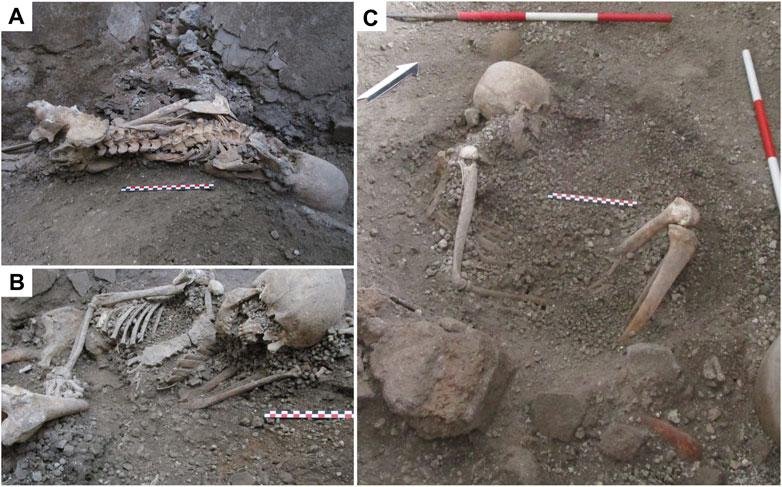
One of the victims was found with over 20 rib fractures, crush injuries to the facial bones, pelvis, and limbs, indicating he was struck by a large falling wall. The other victim, buried up to his legs, had fewer fractures but was found in a defensive posture, suggesting an awareness of the impending collapse.
New study reveals earthquake contributed to Pompeii's destruction amid Vesuvius eruption
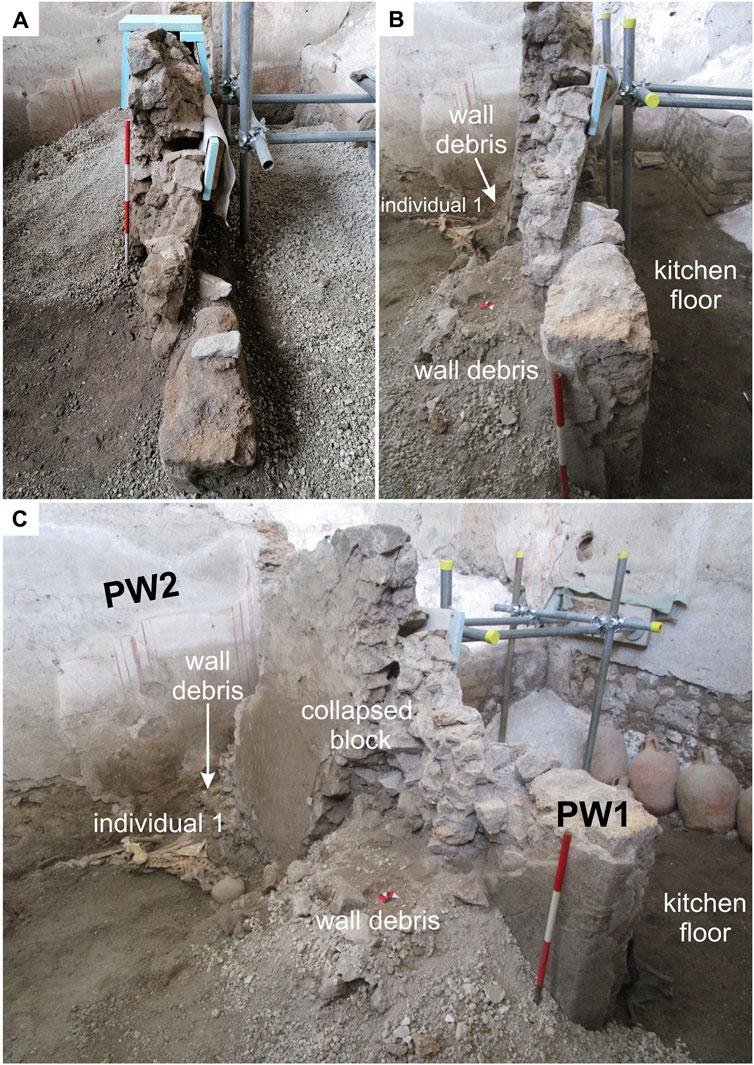
Photographs of the major collapse unit in Pompei. Credit: Sparice et al., Frontiers in Earth Science (2024)

Dr. Sparice and his team ruled out volcanic debris as the cause of the wall’s collapse. Instead, they linked the destruction to seismic shocks, supported by stratigraphic and structural evidence from the site. This discovery aligns with modern earthquake trauma patterns, providing a new lens through which to view the disaster.

The findings propose an updated sequence of events for the 79 CE catastrophe. Initially, the city was bombarded with volcanic lapilli (small stones) for about 18 hours, causing many roofs to cave in. Following this, an earthquake—triggered by the ongoing eruption—shook the city, leading to further destruction and deaths. Finally, pyroclastic flows of ash and gas swept through Pompeii, sealing its fate.
New study reveals earthquake contributed to Pompeii's destruction amid Vesuvius eruption
Details of the skeletons found in the northern sector of Room A. Credit: Sparice et al., Frontiers in Earth Science (2024)

Dr. Sparice and his colleagues plan to extend their research to other areas within Pompeii, aiming to identify additional instances of earthquake-induced damage. This research also opens avenues for investigating the impact of seismic activity on other ancient cities affected by Vesuvius, such as Herculaneum and Stabiae.

More information: Sparice, D., Amoretti, V., Galadini, F., Di Vito, M. A., Terracciano, A., Scarpati, G., & Zuchtriegel, G. (2024). A novel view of the destruction of Pompeii during the 79 CE eruption of Vesuvius (Italy): syn-eruptive earthquakes as an additional cause of building collapse and deaths. Frontiers in Earth Science, 12. doi:10.3389/feart.2024.1386960

Share:

Share on Facebook Share on X (Twitter) Share on LinkedIn Share on Pinterest Share on WhatsApp Share on Email

You May Also Like...

2,300-year-old Iron Age riverside structure discovered beneath German city astonishes archaeologists
Archaeology

2,300-year-old Iron Age riverside structure discovered beneath German city

May 22, 2026
100 Abbasid-era gold jewelry pieces found at ancient Dariyah site in Saudi Arabia
Archaeology

100 Abbasid-era gold jewelry pieces found at ancient Dariyah site in Saudi Arabia

May 22, 2026
Neanderthals gathered shellfish like modern humans 115,000 years ago, study finds
Anthropology

Neanderthals gathered shellfish like modern humans 115,000 years ago, study finds

May 21, 2026
Ancient pigeons were already living alongside humans 3,400 years ago, study finds
Archaeology

Ancient pigeons were already living alongside humans 3,400 years ago, study finds

May 21, 2026
Ancient Venetic sanctuary with rare inscriptions unearthed beneath road project in Italy
Archaeology

Ancient Venetic sanctuary with rare inscriptions unearthed beneath road project in Italy

May 21, 2026
1,000-year-old dingo burial in Australia reveals deep ties between Barkindji people and dingoes
Archaeology

1,000-year-old ritually buried dingo in Australia reveals deep ties between Barkindji people and dingoes

May 20, 2026

Follow us


Instagram
242K

Facebook
117K

Threads
46K

LinkedIn
14K

Twitter
6K

YouTube
1K
2,300-year-old Iron Age riverside structure discovered beneath German city astonishes archaeologists

2,300-year-old Iron Age riverside structure discovered beneath German city

May 22, 2026
100 Abbasid-era gold jewelry pieces found at ancient Dariyah site in Saudi Arabia

100 Abbasid-era gold jewelry pieces found at ancient Dariyah site in Saudi Arabia

May 22, 2026
Neanderthals gathered shellfish like modern humans 115,000 years ago, study finds

Neanderthals gathered shellfish like modern humans 115,000 years ago, study finds

May 21, 2026
Ancient pigeons were already living alongside humans 3,400 years ago, study finds

Ancient pigeons were already living alongside humans 3,400 years ago, study finds

May 21, 2026

Archaeology News online magazine

Archaeology News is an international online magazine that covers all aspects of archaeology.


Categories

  • Academics
    • Books
    • Conferences
    • Universities
  • Articles
  • Download
  • Game
  • News
    • Anthropology
    • Archaeology
    • Paleontology
  • Quiz
  • Tours

Subscribe to our newsletter

© 2024 - Archaeology News Online Magazine. All Rights Reserved.

  • About
  • Privacy Policy
  • Terms of Use
  • Donation
  • Contact

Manage Consent
To provide the best experiences, we use technologies like cookies to store and/or access device information. Consenting to these technologies will allow us to process data such as browsing behavior or unique IDs on this site. Not consenting or withdrawing consent, may adversely affect certain features and functions.
Functional Always active
The technical storage or access is strictly necessary for the legitimate purpose of enabling the use of a specific service explicitly requested by the subscriber or user, or for the sole purpose of carrying out the transmission of a communication over an electronic communications network.
Preferences
The technical storage or access is necessary for the legitimate purpose of storing preferences that are not requested by the subscriber or user.
Statistics
The technical storage or access that is used exclusively for statistical purposes. The technical storage or access that is used exclusively for anonymous statistical purposes. Without a subpoena, voluntary compliance on the part of your Internet Service Provider, or additional records from a third party, information stored or retrieved for this purpose alone cannot usually be used to identify you.
Marketing
The technical storage or access is required to create user profiles to send advertising, or to track the user on a website or across several websites for similar marketing purposes.
  • Manage options
  • Manage services
  • Manage {vendor_count} vendors
  • Read more about these purposes
View preferences
  • {title}
  • {title}
  • {title}
  • Home
  • News
    • Archaeology
    • Anthropology
    • Paleontology
  • Academic
    • Books
    • Conferences
    • Universities
  • Articles
  • VR Tours
  • Quiz & Game
  • Download
  • Encyclopedia
  • Forum

About  .  Contact  .  Donation

© 2024 - Archaeology News Online Magazine. All Rights Reserved