• About
  • Privacy Policy
  • Terms of Use
  • Donation
  • Contact
No Result
View All Result
Archaeology News
  • Home
  • News
    • Archaeology
    • Anthropology
    • Paleontology
  • Academic
    • Books
    • Conferences
    • Universities
  • Articles
  • VR Tours
  • Quiz & Game
  • Download
  • Encyclopedia
  • Forum
Archaeology News
No Result
View All Result
Home News Archaeology

1,720-year-old Roman boundary stone discovered in Galilee reveals names of two lost villages

by Dario Radley
January 24, 2025

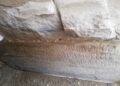
A team of the Hebrew University of Jerusalem and international archaeologists has uncovered a rare 1,720-year-old Roman boundary stone at the Tel Abel Beth Maacah dig near Metula in northern Israel. The basalt slab, which is inscribed in Greek, provides a very rare glimpse into the administrative organization of the Roman Empire during the Tetrarchy period (293–306 CE), when the empire was governed by two senior emperors, Augusti, and two junior colleagues, Caesares.

1,720-year-old Roman boundary stone discovered in Galilee reveals names of two lost villages
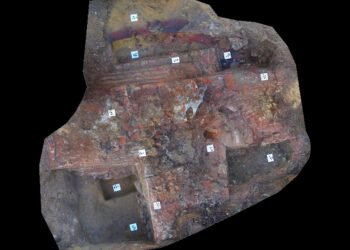
Tel Abel Beth Maacah, aerial view of Area A. Tel Abel Beth Maacah Excavations

The inscription reads as follows: “Diocletian and Maximian, the Augusti, and Constantius and Maximian, the Caesars, ordered the placement of this stone marking the boundaries of the fields of the settlements of Tirathas and Golgol. Made under the supervision of Basiliakos.” Scholars have stated that the inscription introduces two new village names, Tirathas and Golgol, and mentions for the first time Basiliakos, an imperial tax official.

This stone was repurposed, having been reused in a structure of the Mamluk period, as a grave covering. Despite its secondary use, it remains well-preserved and measures 101 centimeters high. According to scholars, its original purpose was to delineate agrarian borders between villages, part of the reforms by Emperor Diocletian, aimed at standardizing taxation and establishing clarity regarding land ownership.

The Tirathas and Golgol villages named in the inscription are equated with places recorded in the 19th-century surveys of Western Palestine; their presence on the stone testifies to the reach of Roman administrative control in the northern Hula Valley, where more than 20 similar boundary stones have been found.

The concentration of such markers in the region suggests that the Roman Empire brought an elaborate mechanism of administrative control into the region, especially to the areas of the small independent landowners’ districts. Such reforms eased the mechanism of taxation and introduced stability to this area but also placed economic pressure on the rural population. The local populations suffered because of these reforms, as attested by the Jerusalem Talmud, compiled in Galilee during this time.

RelatedStories

The “Princess” of Bagicz re-dated: tree rings resolve the mystery of a rare Roman-era log coffin

The “Princess” of Bagicz re-dated: tree rings resolve the mystery of a rare Roman-era log coffin

February 20, 2026
New study reveals how Londoners used weekly death data to Survive the Great Plague of 1665

New study reveals how Londoners used weekly death data to survive the Great Plague of 1665

February 18, 2026

The excavation at Tel Abel Beth Maacah is being conducted under the direction of Professors Naama Yahalom-Mack and Nava Panitz-Cohen of the Hebrew University Institute of Archaeology and Professor Robert Mullins of Azusa Pacific University. The site, located atop an Iron Age fortress, has yielded artifacts from various periods.

The Roman Tetrarchy, instituted by Diocletian, was his response to the growing size and complexity of the empire. By dividing governance among four rulers, the system sought to enforce fiscal and territorial reforms, which included the creation of boundary stones as a means of regulating land ownership.

The findings have been published in the Palestine Exploration Quarterly, cementing the significance of the discovery in the historical geography and socioeconomic history of the Roman Near East.


More information: Ecker, A., & Leibner, U. (2025). ‘Diocletian oppressed the inhabitants of Paneas’ (ySheb. 9:2): A New Tetrarchic boundary stone from Abel Beth Maacah. Palestine Exploration Quarterly, 1–13. doi:10.1080/00310328.2024.2435218
Share2Tweet2ShareShareSend

You May Also Like...

2,000-year-old human and animal footprints discovered at Lunan Bay, Scotland
Archaeology

2,000-year-old human and animal footprints discovered at Lunan Bay, Scotland

February 20, 2026
The “Princess” of Bagicz re-dated: tree rings resolve the mystery of a rare Roman-era log coffin
Anthropology

The “Princess” of Bagicz re-dated: tree rings resolve the mystery of a rare Roman-era log coffin

February 20, 2026
1.77-million-year-old Homo erectus skulls in China show early humans reached Asia sooner than believed
Anthropology

1.77-million-year-old Homo erectus skulls in China show early humans reached Asia sooner than believed

February 19, 2026
Hidden 17th-century bastion fort discovered in Świerże, eastern Poland
Archaeology

Hidden 17th-century bastion fort discovered in Świerże, eastern Poland

February 19, 2026
Seabird guano fueled the rise of Peru’s Chincha Kingdom, isotope study finds
Archaeology

Seabird guano fueled the rise of Peru’s Chincha Kingdom, isotope study finds

February 19, 2026
Historic cannon unearthed during Hull’s Queen’s Gardens restoration in the UK
Archaeology

Historic cannon unearthed during Hull’s Queen’s Gardens restoration in England

February 18, 2026

Follow us


Instagram
244K

Facebook
118K

Threads
45K

LinkedIn
14K

Twitter
6K

YouTube
1K
  • Trending
  • Comments
  • Latest
Shipwreck Salvage. Credit: rawpixel.com / Public Domain

2,000-year-old shipwreck discovered off Turkish coast with remarkably preserved stacked ceramics

July 2, 2025
Viking age DNA reveals 9,000-year-old HIV-resistant gene originating near the Black Sea

Viking age DNA reveals 9,000-year-old HIV-resistant gene originating near the Black Sea

May 18, 2025
A new study suggests the mysterious Voynich Manuscript may be a medieval cipher

A new study suggests the mysterious Voynich Manuscript may be a medieval cipher

January 3, 2026
Moses may be named in ancient Egyptian mine inscriptions, sparking debate over earliest biblical references

Moses may be named in ancient Egyptian mine inscriptions, sparking debate over earliest biblical references

July 31, 2025
Mystery of Armenia’s 6,000-year-old dragon stones solved

Mystery of Armenia’s 6,000-year-old dragon stones solved

September 23, 2025
3D analysis reveals Shroud of Turin image likely came from sculpture, not Jesus’ body

3D analysis reveals Shroud of Turin image likely came from sculpture, not Jesus’ body

Moses may be named in ancient Egyptian mine inscriptions, sparking debate over earliest biblical references

Moses may be named in ancient Egyptian mine inscriptions, sparking debate over earliest biblical references

$1 million prize offered to decipher 5,300-year-old Indus Valley script

$1 million prize offered to decipher 5,300-year-old Indus Valley script

Oldest ever genetic data from a human relative found in 2-million-year-old fossilized teeth

Oldest ever genetic data from a human relative found in 2-million-year-old fossilized teeth

Exceptionally large Roman shoes discovered at Magna fort near Hadrian’s Wall

Exceptionally large Roman shoes discovered at Magna fort near Hadrian’s Wall

2,000-year-old human and animal footprints discovered at Lunan Bay, Scotland

2,000-year-old human and animal footprints discovered at Lunan Bay, Scotland

February 20, 2026
The “Princess” of Bagicz re-dated: tree rings resolve the mystery of a rare Roman-era log coffin

The “Princess” of Bagicz re-dated: tree rings resolve the mystery of a rare Roman-era log coffin

February 20, 2026
1.77-million-year-old Homo erectus skulls in China show early humans reached Asia sooner than believed

1.77-million-year-old Homo erectus skulls in China show early humans reached Asia sooner than believed

February 19, 2026
Hidden 17th-century bastion fort discovered in Świerże, eastern Poland

Hidden 17th-century bastion fort discovered in Świerże, eastern Poland

February 19, 2026
Seabird guano fueled the rise of Peru’s Chincha Kingdom, isotope study finds

Seabird guano fueled the rise of Peru’s Chincha Kingdom, isotope study finds

February 19, 2026

Archaeology News online magazine

Archaeology News is an international online magazine that covers all aspects of archaeology.


Categories

  • Academics
    • Books
    • Conferences
    • Universities
  • Articles
  • Download
  • Game
  • News
    • Anthropology
    • Archaeology
    • Paleontology
  • Quiz
  • Tours

Subscribe to our newsletter

© 2024 - Archaeology News Online Magazine. All Rights Reserved.

  • About
  • Privacy Policy
  • Terms of Use
  • Donation
  • Contact

Manage Consent
To provide the best experiences, we use technologies like cookies to store and/or access device information. Consenting to these technologies will allow us to process data such as browsing behavior or unique IDs on this site. Not consenting or withdrawing consent, may adversely affect certain features and functions.
Functional Always active
The technical storage or access is strictly necessary for the legitimate purpose of enabling the use of a specific service explicitly requested by the subscriber or user, or for the sole purpose of carrying out the transmission of a communication over an electronic communications network.
Preferences
The technical storage or access is necessary for the legitimate purpose of storing preferences that are not requested by the subscriber or user.
Statistics
The technical storage or access that is used exclusively for statistical purposes. The technical storage or access that is used exclusively for anonymous statistical purposes. Without a subpoena, voluntary compliance on the part of your Internet Service Provider, or additional records from a third party, information stored or retrieved for this purpose alone cannot usually be used to identify you.
Marketing
The technical storage or access is required to create user profiles to send advertising, or to track the user on a website or across several websites for similar marketing purposes.
  • Manage options
  • Manage services
  • Manage {vendor_count} vendors
  • Read more about these purposes
View preferences
  • {title}
  • {title}
  • {title}
  • Home
  • News
    • Archaeology
    • Anthropology
    • Paleontology
  • Academic
    • Books
    • Conferences
    • Universities
  • Articles
  • VR Tours
  • Quiz & Game
  • Download
  • Encyclopedia
  • Forum

About  .  Contact  .  Donation

© 2024 - Archaeology News Online Magazine. All Rights Reserved