• About
  • Privacy Policy
  • Terms of Use
  • Donation
  • Contact
No Result
View All Result
Archaeology News
  • Home
  • News
    • Archaeology
    • Anthropology
    • Paleontology
  • Academic
    • Books
    • Conferences
    • Universities
  • Articles
  • VR Tours
  • Quiz & Game
  • Download
  • Encyclopedia
  • Forum
Archaeology News
No Result
View All Result
Home News Archaeology

3,400-year-old hoards found on Hungary’s Somló Hill reveal ancient secrets

by Dario Radley
May 4, 2025

Archaeologists excavating Somló Hill in western Hungary have unearthed six extraordinary hoards of metal artifacts over 3,000 years old, offering new information on the social and ritual life of Bronze and Iron Age communities in the area. The finds, which were made between 2023 and 2025, were detailed in a recent paper published in the journal Antiquity.

3,400-year-old hoards found on Hungary’s Somló Hill reveal ancient secrets
Some of the metal artifacts from the Early Iron Age discovered on Somló Hill, Hungary (photograph by László György). Credit: Bence Soós et al., Antiquity (2025)

Somló Hill, a 1,400-foot-high extinct volcanic butte in Veszprém County, now encircled by vineyards, has interested scholars for a while. Discoveries excavated from the area as early as the 19th century indicated the importance of the site, but systematic archaeological investigation had been limited until recent years. Now, an excavation team led by archaeologist Bence Soós and affiliated with the Hungarian National Museum’s Public Collection Center has revealed the site as one of the richest sources of Late Bronze Age (1450–800 BCE) and Early Iron Age (800–450 BCE) material in the region.

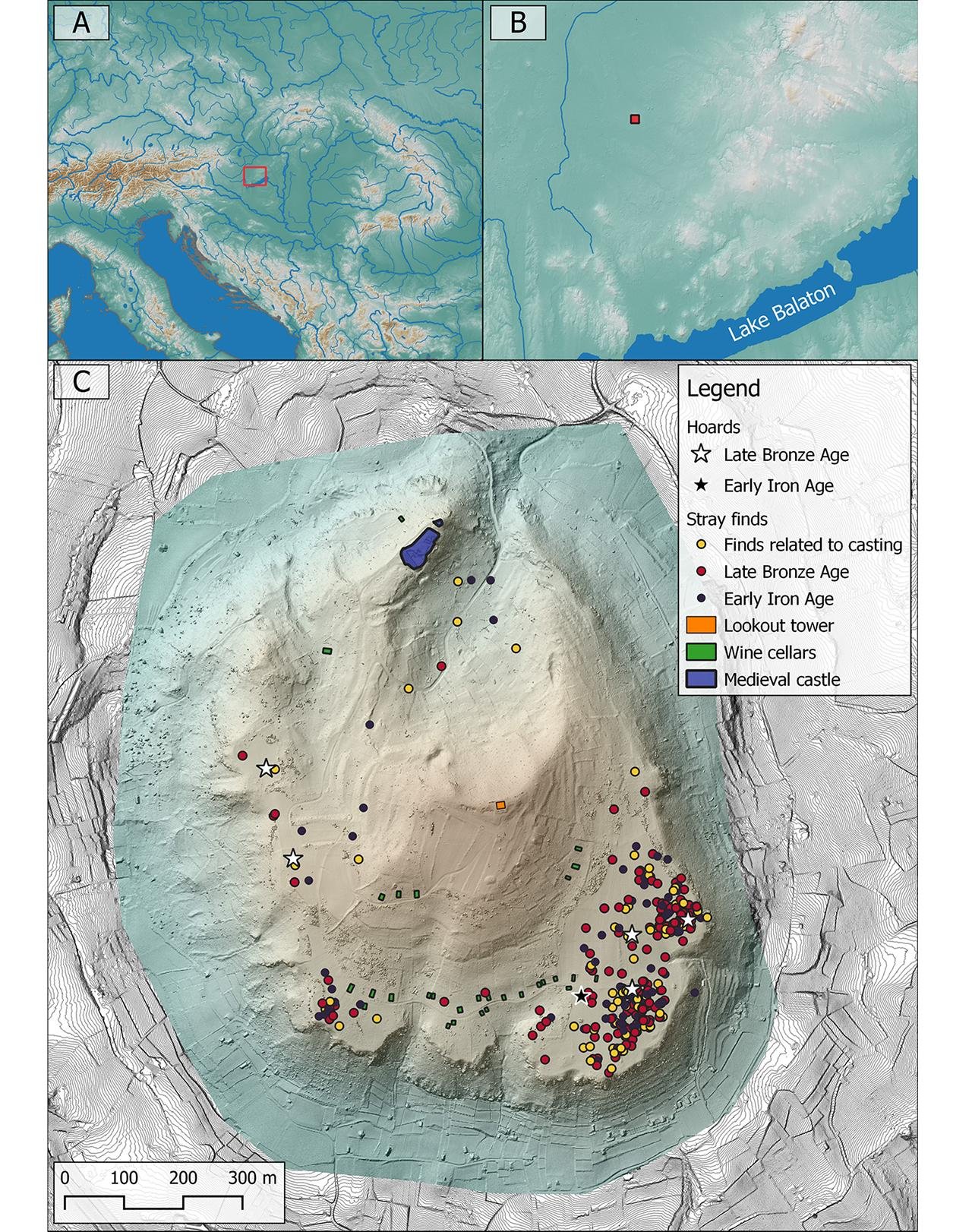
The team used a range of advanced survey techniques, including metal detecting, field-walking surveys, magnetic prospection, and airborne laser scanning (lidar), to map and study the site. The work revealed over 900 metal objects, largely concentrated on the southeastern plateau of the hill. Importantly, five of the six hoards are dated to the Late Bronze Age, with one from the Early Iron Age. They include jewelry, brooches, decorative discs believed to be military adornments, and a rare Alpine-type spearhead from Hoard I.

The preservation and the conditions of the discoveries make these finds absolutely exceptional. Two of the hoards (III and V) were buried in ceramic pots—a practice long hypothesized but never confirmed for this period in western Hungary. The pots were carefully excavated and sent to the University of Pannonia, where they were subjected to computed tomography (CT) scanning to analyze the internal arrangement of the objects. Researchers also performed neutron tomography on some of the objects to uncover manufacturing techniques and flaws.
3,400-year-old hoards found on Hungary’s Somló Hill reveal ancient secrets
Location of the research area (A) and Somló Hill (B). A digital terrain model of Somló Hill (C) shows the locations of nearthed artifacts. Credit: Bence Soós et al., Antiquity (2025)

Soós emphasized the significance of Hoard V in particular, noting that it provides “the first evidence of local metal deposition customs during the transition between the Late Bronze and Early Iron Ages.” Along with metalwork, this hoard contained amber beads, pig and boar tusks, and fragments of textiles and leather, underscoring the ritual complexity of the deposit.

According to the authors of the study, the continuous settlement of the hilltop during this period of transition contradicts prevailing assumptions regarding settlement patterns in the region. Typo-chronological and radiocarbon dating—particularly of organic materials such as the bones in Hoard I—are expected to establish a more precise chronology of occupation.
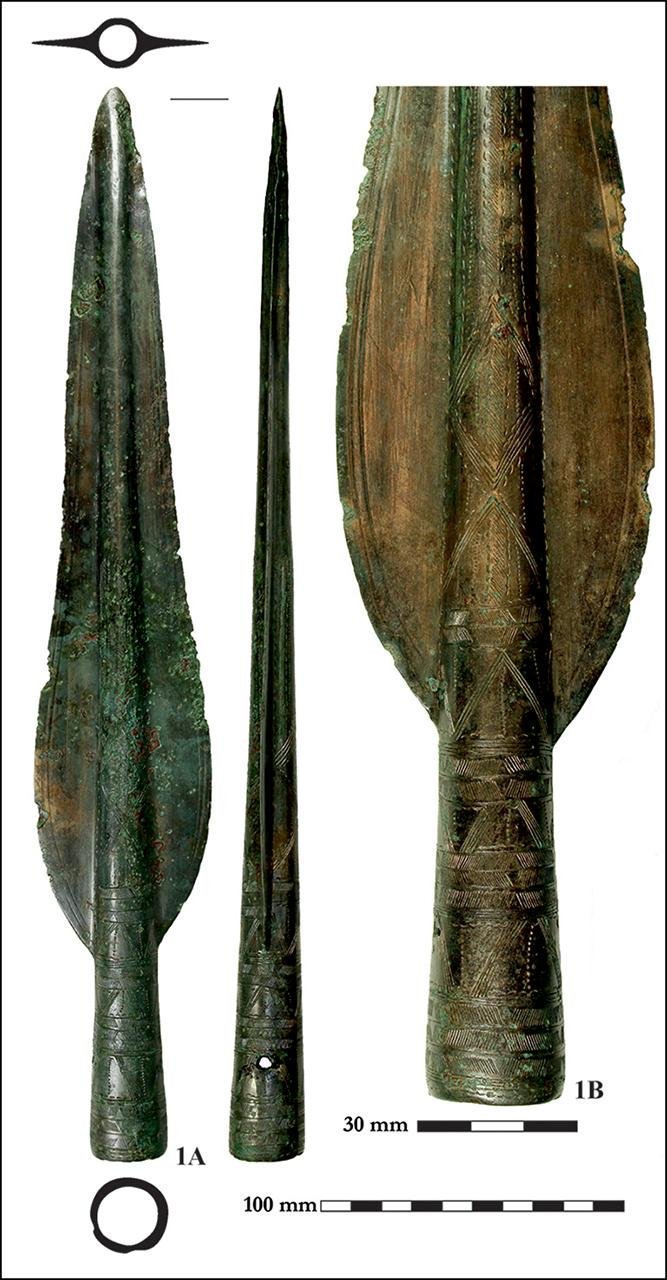
3,400-year-old hoards found on Hungary’s Somló Hill reveal ancient secrets
Alpine-style spearhead from Hoard I on Somló Hill in Hungary. Credit: Bence Soós et al., Antiquity (2025)

The organization and layering of the objects within the hoards suggest a sophisticated ritual and symbolic behavior system, possibly tied to an elite warrior class. Soós and his colleagues noted that Somló Hill offers a unique chance to redefine our understanding of hoarding traditions during the Hallstatt B period in Transdanubia.

The research also refers to Somló Hill’s potential role as a central place in the Late Bronze Age settlement network, serving perhaps as a power seat for tribal or clan societies. This is supported by earlier findings of monumental burial mounds in the area, indicating the presence of high-status individuals.
More information: Soós, B., Péterváry, T., Mesterházy, G., Látos, T., Pető, Á., Pethe, M., … Tarbay, J. G. (2025). Later prehistoric hoarding and habitation on Somló Hill, western Hungary. Antiquity, 1–8. doi:10.15184/aqy.2025.44

Share:

Share on Facebook Share on X (Twitter) Share on LinkedIn Share on Pinterest Share on WhatsApp Share on Email

You May Also Like...

Roman altar dedicated to Jupiter emerges from Danube as record-low water levels expose riverbed in Hungary
Archaeology

Roman altar dedicated to Jupiter emerges from Danube as record-low water levels expose riverbed in Hungary

August 9, 2026
6,000-year-old necropolis and ancient settlement found in Egypt’s eastern Delta
Anthropology

6,000-year-old necropolis and ancient settlement found in Egypt’s eastern Delta

August 9, 2026
Shackled men in ancient Athens mass grave were locals, not foreign invaders, study reveals
Anthropology

Shackled men in ancient Athens mass grave were locals, not foreign invaders, study reveals

August 8, 2026
Two ancient genomes reveal how migration and diet shaped the ancestors of modern Japanese people
Anthropology

Ancient genomes reveal how migration and diet shaped the ancestors of modern Japanese people

August 8, 2026
Ancient drainage network found beneath Roman theater in Catania, Italy
Archaeology

Ancient drainage network found beneath Roman theater in Catania, Italy

August 8, 2026
Roman-era building with colorful mosaics and frescoes found beneath Rome's Villa Celimontana
Archaeology

Roman-era building with colorful mosaics and frescoes found beneath Rome’s Villa Celimontana

August 7, 2026

Follow us

Instagram Instagram
243K
Facebook Facebook
117K
Threads Threads
50K
LinkedIn LinkedIn
15K
X X
6K
YouTube YouTube
1K
Archaeology News online magazine

Archaeology News is an international online magazine that covers all aspects of archaeology.

WhatsApp Telegram Mastodon Pinterest Flipboard RSS

Categories

  • Academics
    • Books
    • Conferences
    • Universities
  • Articles
  • Download
  • Game
  • News
    • Anthropology
    • Archaeology
    • Paleontology
  • Quiz
  • Tours

Subscribe to our newsletter

© 2024 - Archaeology News Online Magazine. All Rights Reserved.

  • About
  • Privacy Policy
  • Terms of Use
  • Donation
  • Contact
Manage Consent
To provide the best experiences, we use technologies like cookies to store and/or access device information. Consenting to these technologies will allow us to process data such as browsing behavior or unique IDs on this site. Not consenting or withdrawing consent, may adversely affect certain features and functions.
Functional Always active
The technical storage or access is strictly necessary for the legitimate purpose of enabling the use of a specific service explicitly requested by the subscriber or user, or for the sole purpose of carrying out the transmission of a communication over an electronic communications network.
Preferences
The technical storage or access is necessary for the legitimate purpose of storing preferences that are not requested by the subscriber or user.
Statistics
The technical storage or access that is used exclusively for statistical purposes. The technical storage or access that is used exclusively for anonymous statistical purposes. Without a subpoena, voluntary compliance on the part of your Internet Service Provider, or additional records from a third party, information stored or retrieved for this purpose alone cannot usually be used to identify you.
Marketing
The technical storage or access is required to create user profiles to send advertising, or to track the user on a website or across several websites for similar marketing purposes.
  • Manage options
  • Manage services
  • Manage {vendor_count} vendors
  • Read more about these purposes
View preferences
  • {title}
  • {title}
  • {title}
  • Home
  • News
    • Archaeology
    • Anthropology
    • Paleontology
  • Academic
    • Books
    • Conferences
    • Universities
  • Articles
  • VR Tours
  • Quiz & Game
  • Download
  • Encyclopedia
  • Forum

About  .  Contact  .  Donation

Instagram Facebook Threads X LinkedIn YouTube

© 2024 - Archaeology News Online Magazine. All Rights Reserved