• About
  • Privacy Policy
  • Terms of Use
  • Donation
  • Contact
No Result
View All Result
Archaeology News
  • Home
  • News
    • Archaeology
    • Anthropology
    • Paleontology
  • Academic
    • Books
    • Conferences
    • Universities
  • Articles
  • VR Tours
  • Quiz & Game
  • Download
  • Encyclopedia
  • Forum
Archaeology News
No Result
View All Result
Home News Anthropology

Ancient DNA reveals 20,000-year-old pendant’s owner

by Dario Radley
May 3, 2023

Artifacts crafted from stone, bones, or teeth offer valuable insights into the survival strategies, conduct, and customs of early humans. Nonetheless, identifying the individuals associated with these artifacts has posed challenges due to the scarcity of burials and accompanying possessions during the Paleolithic era.
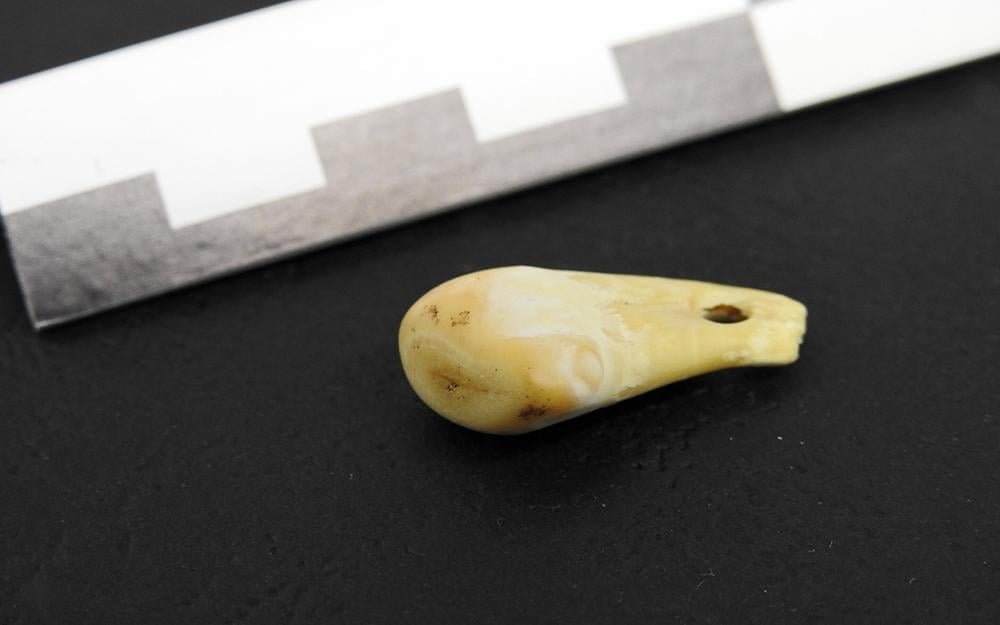
Ancient DNA reveals 20,000-year-old pendant’s owner
Pierced deer tooth discovered from Denisova Cave in southern Siberia. Credit: Max Planck Institute for Evolutionary Anthropology

In 2019, a tooth pendant that dates back 20,000 years was discovered in Siberia’s Denisova Cave. The tooth, which had a drilled hole, indicating its potential use as a bracelet or headband adornment, has now been subjected to a novel technique enabling the extraction of DNA from porous artifacts.

As a result, researchers have determined that the last person to wear the pendant was a woman or girl from a region approximately 1,200 miles away.

The new technique holds significant potential for researchers in extracting ancient DNA from exceptionally old objects, with the possibility of even identifying the individuals who touched or wore them.

While scientists have achieved remarkable success in extracting and studying DNA from ancient remains like teeth and bones, their attempts to do the same with items such as jewelry, tools, and ornaments have proven unsuccessful due to the risk of damage.


RelatedStories

Homo erectus in Java: 140,000-year-old fossils found in submerged river valley

400,000-year-old Homo erectus proteins reveal genetic links to Denisovans and modern humans

May 14, 2026
146,000-year-old Ice Age humans used advanced stone tools for butchery and survival

146,000-year-old Ice Age humans used advanced stone tools for butchery and survival

May 8, 2026

Determined to overcome this challenge, scientists at the Max Planck Institute for Evolutionary Anthropology (MPI-EVA) in Leipzig, Germany, dedicated years to experimenting with various techniques for extracting human DNA, specifically from porous materials like teeth or bones, where traces of DNA can be left behind in skin cells or sweat.

While artifacts crafted from skeletal elements are less common compared to stone tools, the researchers specifically focused on these items due to their porous nature, making them more likely to retain DNA found in skin cells, sweat, and other bodily fluids.

However, before working with actual artifacts, the team had to ensure that these precious objects would remain undamaged.

They discovered that by immersing the entire artifact in a sodium phosphate solution and gradually heating the liquid to approximately 194 degrees Fahrenheit, they could gradually extract ancient DNA that was trapped within the porous material. This method preserved the artifact’s integrity.

During the refinement of the technique, the researchers determined that it was ineffective when artifacts were contaminated with DNA from contemporary archaeologists or when they were buried in specific types of soil.

However, the tooth pendant in question was still enveloped in dirt from its original burial site, and the archaeologists who excavated it had taken precautions by wearing protective coveralls, masks, and gloves. These measures minimized contamination, ensuring the successful completion of the DNA extraction process. According to Elena Essel, a molecular biologist at MPI-EVA and the study’s primary author, the quantity of human DNA recovered from the pendant was remarkable, comparable to sampling a human tooth.

While some of the DNA originated from the tooth itself, which belonged to an elk, the pendant also contained DNA from a human female closely related to a group of hunter-gatherers known as the Maltinsko-buretskaya, who resided near Lake Baikal east of the cave.

Matthias Meyer, an evolutionary geneticist at MPI-EVA and co-author of the study, expressed that forensic scientists would not be surprised by the ability to isolate human DNA from extensively handled objects. However, he noted the astonishing fact that this was still achievable even after 20,000 years.

The research findings have been published in the journal Nature.


More information: Essel, E., Zavala, E.I., Schulz-Kornas, E. et al. (2023). Ancient human DNA recovered from a Palaeolithic pendant. Nature 618, 328–332. https://doi.org/10.1038/s41586-023-06035-2
ShareTweetShareShareSend

You May Also Like...

Ancient texts reveal how Persian and Greek rule shaped language in Central Asia
Archaeology

Ancient texts reveal how Persian and Greek rule shaped language in Central Asia

May 20, 2026
World War II mass grave in Poland reveals remains of German officer killed during Battle of Lauban
Anthropology

World War II mass grave in Poland reveals remains of German officer killed during Battle of Lauban

May 19, 2026
massive jar in Laos contained remains of 37 people, revealing ancient burial rituals and Asian trade links
Anthropology

Massive jar in Laos contained remains of 37 people, revealing ancient burial rituals and Asian trade links

May 19, 2026
6,000-year-old necropolis in Spain rewrites origins of Europe’s first megalithic tombs
Archaeology

6,000-year-old necropolis in Spain rewrites origins of Europe’s first megalithic tombs

May 18, 2026
Ancient settlement with weaving workshop and longhouses uncovered in Germany gravel pit
Archaeology

Ancient settlement with weaving workshop and longhouses uncovered in Germany gravel pit

May 17, 2026
Pompeii victim identified as Roman physician killed while fleeing Vesuvius eruption
Anthropology

Pompeii victim identified as Roman physician killed while fleeing Vesuvius eruption

May 17, 2026

Follow us


Instagram
242K

Facebook
117K

Threads
46K

LinkedIn
14K

Twitter
6K

YouTube
1K
Ancient texts reveal how Persian and Greek rule shaped language in Central Asia

Ancient texts reveal how Persian and Greek rule shaped language in Central Asia

May 20, 2026
World War II mass grave in Poland reveals remains of German officer killed during Battle of Lauban

World War II mass grave in Poland reveals remains of German officer killed during Battle of Lauban

May 19, 2026
massive jar in Laos contained remains of 37 people, revealing ancient burial rituals and Asian trade links

Massive jar in Laos contained remains of 37 people, revealing ancient burial rituals and Asian trade links

May 19, 2026
6,000-year-old necropolis in Spain rewrites origins of Europe’s first megalithic tombs

6,000-year-old necropolis in Spain rewrites origins of Europe’s first megalithic tombs

May 18, 2026

Archaeology News online magazine

Archaeology News is an international online magazine that covers all aspects of archaeology.


Categories

  • Academics
    • Books
    • Conferences
    • Universities
  • Articles
  • Download
  • Game
  • News
    • Anthropology
    • Archaeology
    • Paleontology
  • Quiz
  • Tours

Subscribe to our newsletter

© 2024 - Archaeology News Online Magazine. All Rights Reserved.

  • About
  • Privacy Policy
  • Terms of Use
  • Donation
  • Contact

Manage Consent
To provide the best experiences, we use technologies like cookies to store and/or access device information. Consenting to these technologies will allow us to process data such as browsing behavior or unique IDs on this site. Not consenting or withdrawing consent, may adversely affect certain features and functions.
Functional Always active
The technical storage or access is strictly necessary for the legitimate purpose of enabling the use of a specific service explicitly requested by the subscriber or user, or for the sole purpose of carrying out the transmission of a communication over an electronic communications network.
Preferences
The technical storage or access is necessary for the legitimate purpose of storing preferences that are not requested by the subscriber or user.
Statistics
The technical storage or access that is used exclusively for statistical purposes. The technical storage or access that is used exclusively for anonymous statistical purposes. Without a subpoena, voluntary compliance on the part of your Internet Service Provider, or additional records from a third party, information stored or retrieved for this purpose alone cannot usually be used to identify you.
Marketing
The technical storage or access is required to create user profiles to send advertising, or to track the user on a website or across several websites for similar marketing purposes.
  • Manage options
  • Manage services
  • Manage {vendor_count} vendors
  • Read more about these purposes
View preferences
  • {title}
  • {title}
  • {title}
  • Home
  • News
    • Archaeology
    • Anthropology
    • Paleontology
  • Academic
    • Books
    • Conferences
    • Universities
  • Articles
  • VR Tours
  • Quiz & Game
  • Download
  • Encyclopedia
  • Forum

About  .  Contact  .  Donation

© 2024 - Archaeology News Online Magazine. All Rights Reserved