• About
  • Privacy Policy
  • Terms of Use
  • Donation
  • Contact
No Result
View All Result
Archaeology News
  • Home
  • News
    • Archaeology
    • Anthropology
    • Paleontology
  • Academic
    • Books
    • Conferences
    • Universities
  • Articles
  • VR Tours
  • Quiz & Game
  • Download
  • Encyclopedia
  • Forum
Archaeology News
No Result
View All Result
Home News Anthropology

Archaeologists reconstruct largest genetic family tree for Neolithic people in France

by Dario Radley
August 10, 2023

As per a Live Science report, archaeologists in France have pieced together two elaborate Neolithic family trees that span multiple generations, using ancient DNA. This achievement stands as the largest ancestral human record ever reconstructed.
Archaeologists reconstruct largest genetic family tree for Neolithic people in France
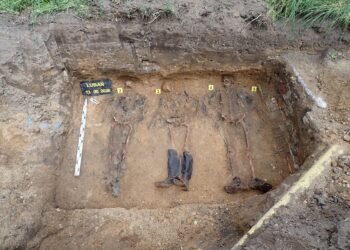
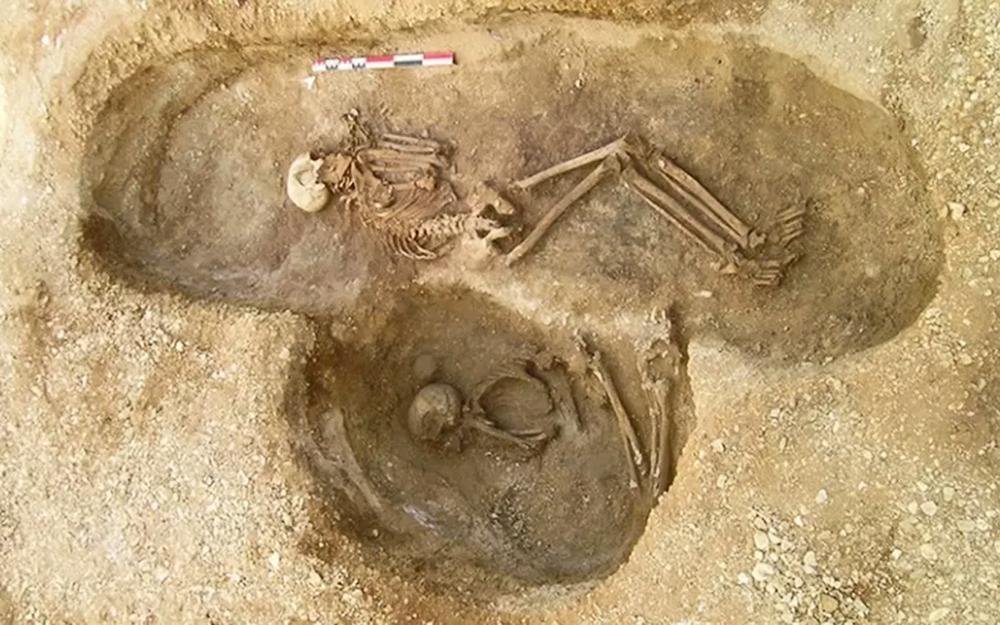
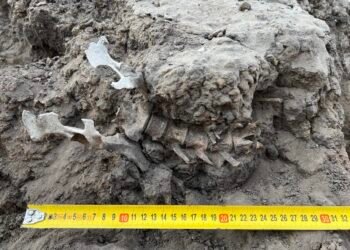
An adult man (top skeleton) buried some 6,000 years ago in what is now France was a son of the man from whom dozens of people also buried at the site are descended. Credit: Stéphane Rottier

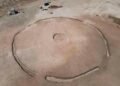
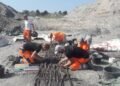
The family trees are based on a 6,700-year-old funerary site known as Gurgy, which is located in the Paris Basin region of northern France.

The Gurgy site, initially excavated in the mid-2000s, took on renewed significance due to advancements in ancient DNA analysis techniques. Among the 128 individuals, comprising both children and adults, whose remains were recovered from the site, researchers meticulously studied the genomes of 94 individuals, leveraging cutting-edge methods to unlock the secrets held within the ancient genetic material.

The Neolithic epoch marked a pivotal transition in human history around 12,000 years ago, as societies shifted from nomadic hunting and gathering to settled farming communities. Gurgy’s burial ground, a testament to this transformation, serves as a compelling testament to the enduring ties that bound families across generations.

Notably, the research unveiled a remarkable discovery: the progeny of this ancient community traced their lineage back to a solitary “founding father.” His remains, originally interred at an undisclosed location, were subsequently reburied in proximity to his kin at Gurgy.
RelatedStories

6,000-year-old necropolis in Spain rewrites origins of Europe’s first megalithic tombs

6,000-year-old necropolis in Spain rewrites origins of Europe’s first megalithic tombs

May 18, 2026
Ancient Danes kept fishing for millennia after farming arrived, study finds

Ancient Danes kept fishing for millennia after farming arrived, study finds

May 14, 2026

Through meticulous analysis of mitochondrial DNA (maternal lineage) and Y-chromosome data (paternal lineage), coupled with details regarding age and genetic sex, the researchers constructed two intricate family trees.

The first family tree connected an astonishing 64 individuals across an impressive span of seven generations, cementing its status as the most extensive ancestral record of its kind. The second family tree featured 12 individuals spanning five generations.

A notable trend emerged as the researchers delved into the data: a distinct “patrilineal pattern” indicated that successive generations were intricately linked through the male lineage. An intriguing observation also came to light: while men typically remained within their birth communities, women seemed to migrate from external locales, a phenomenon evidenced by the genetic disparities between genders.

“The women who were buried there weren’t related and came from somewhere else,” said Maïté Rivollat, the lead author of the study and a postdoctoral fellow in the Department of Archaeology at Ghent University in Belgium. She further postulated that this strategic movement of females may have served to prevent inbreeding within the community.

Equally captivating was the absence of half-siblings among the buried individuals, indicating a practice of monogamy rather than polygamy within this ancient society. The shared parentage between sons and daughters underscored the strong familial cohesion prevalent in Gurgy’s community.

As Rivollat pointed out, “The closer they were buried together, the closer they were related.”

The research represents a collaborative effort, reflecting the dedication of the archaeological community in piecing together fragments of history to illuminate the complex dynamics of ancient societies.

The research was published in the journal Nature on July 26.
More information: Rivollat, M., Rohrlach, A.B., Ringbauer, H. et al. (2023). Extensive pedigrees reveal the social organization of a Neolithic community. Nature 620, 600–606. https://doi.org/10.1038/s41586-023-06350-8
ShareTweetShareShareSend

You May Also Like...

1,000-year-old dingo burial in Australia reveals deep ties between Barkindji people and dingoes
Archaeology

1,000-year-old ritually buried dingo in Australia reveals deep ties between Barkindji people and dingoes

May 20, 2026
Ancient texts reveal how Persian and Greek rule shaped language in Central Asia
Archaeology

Ancient texts reveal how Persian and Greek rule shaped language in Central Asia

May 20, 2026
World War II mass grave in Poland reveals remains of German officer killed during Battle of Lauban
Anthropology

World War II mass grave in Poland reveals remains of German officer killed during Battle of Lauban

May 19, 2026
massive jar in Laos contained remains of 37 people, revealing ancient burial rituals and Asian trade links
Anthropology

Massive jar in Laos contained remains of 37 people, revealing ancient burial rituals and Asian trade links

May 19, 2026
6,000-year-old necropolis in Spain rewrites origins of Europe’s first megalithic tombs
Archaeology

6,000-year-old necropolis in Spain rewrites origins of Europe’s first megalithic tombs

May 18, 2026
Ancient settlement with weaving workshop and longhouses uncovered in Germany gravel pit
Archaeology

Ancient settlement with weaving workshop and longhouses uncovered in Germany gravel pit

May 17, 2026

Follow us


Instagram
242K

Facebook
117K

Threads
46K

LinkedIn
14K

Twitter
6K

YouTube
1K
1,000-year-old dingo burial in Australia reveals deep ties between Barkindji people and dingoes

1,000-year-old ritually buried dingo in Australia reveals deep ties between Barkindji people and dingoes

May 20, 2026
Ancient texts reveal how Persian and Greek rule shaped language in Central Asia

Ancient texts reveal how Persian and Greek rule shaped language in Central Asia

May 20, 2026
World War II mass grave in Poland reveals remains of German officer killed during Battle of Lauban

World War II mass grave in Poland reveals remains of German officer killed during Battle of Lauban

May 19, 2026
massive jar in Laos contained remains of 37 people, revealing ancient burial rituals and Asian trade links

Massive jar in Laos contained remains of 37 people, revealing ancient burial rituals and Asian trade links

May 19, 2026

Archaeology News online magazine

Archaeology News is an international online magazine that covers all aspects of archaeology.


Categories

  • Academics
    • Books
    • Conferences
    • Universities
  • Articles
  • Download
  • Game
  • News
    • Anthropology
    • Archaeology
    • Paleontology
  • Quiz
  • Tours

Subscribe to our newsletter

© 2024 - Archaeology News Online Magazine. All Rights Reserved.

  • About
  • Privacy Policy
  • Terms of Use
  • Donation
  • Contact

Manage Consent
To provide the best experiences, we use technologies like cookies to store and/or access device information. Consenting to these technologies will allow us to process data such as browsing behavior or unique IDs on this site. Not consenting or withdrawing consent, may adversely affect certain features and functions.
Functional Always active
The technical storage or access is strictly necessary for the legitimate purpose of enabling the use of a specific service explicitly requested by the subscriber or user, or for the sole purpose of carrying out the transmission of a communication over an electronic communications network.
Preferences
The technical storage or access is necessary for the legitimate purpose of storing preferences that are not requested by the subscriber or user.
Statistics
The technical storage or access that is used exclusively for statistical purposes. The technical storage or access that is used exclusively for anonymous statistical purposes. Without a subpoena, voluntary compliance on the part of your Internet Service Provider, or additional records from a third party, information stored or retrieved for this purpose alone cannot usually be used to identify you.
Marketing
The technical storage or access is required to create user profiles to send advertising, or to track the user on a website or across several websites for similar marketing purposes.
  • Manage options
  • Manage services
  • Manage {vendor_count} vendors
  • Read more about these purposes
View preferences
  • {title}
  • {title}
  • {title}
  • Home
  • News
    • Archaeology
    • Anthropology
    • Paleontology
  • Academic
    • Books
    • Conferences
    • Universities
  • Articles
  • VR Tours
  • Quiz & Game
  • Download
  • Encyclopedia
  • Forum

About  .  Contact  .  Donation

© 2024 - Archaeology News Online Magazine. All Rights Reserved