• About
  • Privacy Policy
  • Terms of Use
  • Donation
  • Contact
No Result
View All Result
Archaeology News
  • Home
  • News
    • Archaeology
    • Anthropology
    • Paleontology
  • Academic
    • Books
    • Conferences
    • Universities
  • Articles
  • VR Tours
  • Quiz & Game
  • Download
  • Encyclopedia
  • Forum
Archaeology News
No Result
View All Result
Home News Archaeology

Archaeologists uncover a Stone Age settlement in mid-Norway

by Dario Radley
August 23, 2023

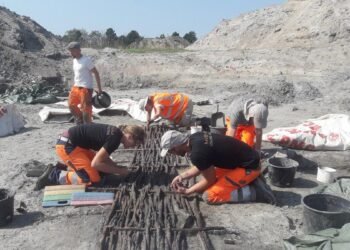
In a recent archaeological excavation at Vinjeøra in southern Trøndelag County, researchers made an astonishing discovery that exceeded their expectations.
Archaeologists uncover a Stone Age settlement in mid-Norway
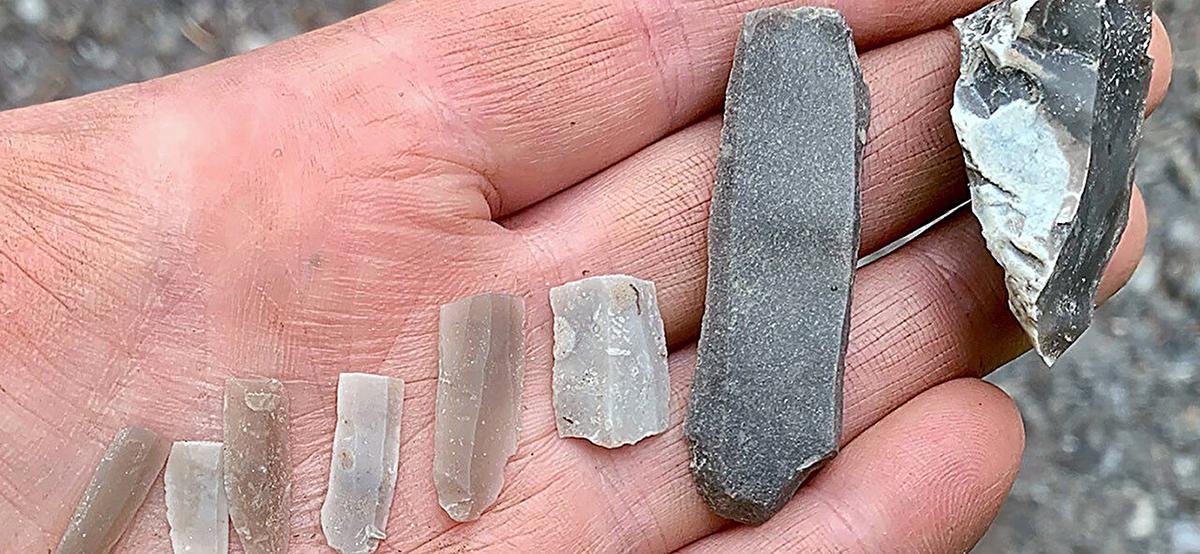
These flint objects with completely straight and parallel side edges suggest precision akin to that of tools crafted with a ruler. Credit: Silje Elisabeth Fretheim

Led by archaeologist and Project Manager Silje Elisabeth Fretheim, the team embarked on a quest to uncover a Stone Age settlement dating back to around 11,500 to 10,000 years ago, during the first human settlements along the Norwegian coast.

Initial findings hinted at the presence of large flint pieces, reminiscent of early pioneer settlements. However, the true nature of their discovery turned out to be even more captivating.

Upon delving deeper into the excavation at Vinjeøra, the researchers stumbled upon artifacts that defied conventional expectations. Rather than resembling the artifacts associated with pioneer settlements, they uncovered small and medium-sized flint objects known as lithics and microlithics. These lithics exhibited remarkably straight and parallel edges, suggesting precision akin to that of tools crafted with a ruler.

This revelation challenged the initial hypothesis of pioneer culture. Instead, the evidence pointed to a different group of people who had arrived in Finnmark from the east around 9000 BC.

RelatedStories

146,000-year-old Ice Age humans used advanced stone tools for butchery and survival

146,000-year-old Ice Age humans used advanced stone tools for butchery and survival

May 8, 2026
Earliest evidence of cereal harvesting by ancient Canarians discovered in Gran Canaria

Earliest evidence of cereal harvesting by ancient Canarians discovered in Gran Canaria

May 6, 2026

Scandinavia, with its prolonged ice cover during the last Ice Age, presented a unique backdrop for human migration. The Norwegian coast had only become ice-free approximately 12,500 years ago, with the first human settlers arriving nearly a thousand years later.

Skeletal analyses had previously revealed two significant waves of migration in Scandinavia following the retreat of the ice. The first wave originated from the southwest, comprising individuals who had inhabited Spain and Portugal during the last Ice Age. These early settlers, known for their dark skin and blue eyes, swiftly populated the entire Norwegian coast up to Finnmark.

A thousand years later, a second wave of migration emerged from the northeast. These migrants had journeyed from regions near the Black Sea or Ukraine, traversing north through Russia and Finland to reach the Finnmark coast. Distinguished by lighter skin and varying eye colors, they brought with them a distinct technique for crafting stone tools. This technique eventually gained ascendancy over the methods employed by southern migrants.

The meeting of these two cultures resulted in a mutual exchange of knowledge. The eastern migrants introduced novel technology, while the southern settlers possessed a deep understanding of the coastal landscape and way of life. This synergy allowed the eastern group to adapt to the local lifestyle. During the initial centuries, they adopted a nomadic existence, dwelling in lightweight structures, possibly tents, and relying on the sea for sustenance, much like the southern pioneers.

DNA studies corroborated the interaction between these two groups. Nevertheless, the scarcity of artifacts directly tied to the eastern immigrants in the outer coastal regions of Central Norway posed a unique challenge. Changes in sea levels following the Ice Age had washed away or buried evidence of settlements between Finnmark and Eastern Norway, rendering few discoveries.

Deep within fjords, however, uplift processes had preserved settlements. Archaeologists’ ability to target specific areas for excavation depended on the circumstances, often determined by infrastructure or building projects. In the case of Vinjeøra, the Norwegian Public Roads Administration’s construction of the new E39 road provided the opportunity for archaeological excavation.

Share3Tweet2ShareShareSend

You May Also Like...

Mysterious ancient tunnel discovered in Jerusalem puzzles archaeologists
Archaeology

Mysterious ancient tunnel discovered in Jerusalem puzzles archaeologists

May 15, 2026
Horse domestication began centuries earlier than thought, study reveals early riding and management in 4th millennium BCE
Archaeology

Horse domestication began centuries earlier than thought, study reveals early riding and management in 4th millennium BCE

May 15, 2026
Ancient Danes kept fishing for millennia after farming arrived, study finds
Archaeology

Ancient Danes kept fishing for millennia after farming arrived, study finds

May 14, 2026
Oldest known dental treatment found in 59,000-year-old Neanderthal tooth from Siberia
Anthropology

Oldest known dental treatment found in 59,000-year-old Neanderthal tooth from Siberia

May 14, 2026
Homo erectus in Java: 140,000-year-old fossils found in submerged river valley
Anthropology

400,000-year-old Homo erectus proteins reveal genetic links to Denisovans and modern humans

May 14, 2026
Cut marks on 1.6-million-year-old bones reveal early humans moved and processed meat in Kenya
Anthropology

Cut marks on 1.6-million-year-old bones reveal early humans moved and processed meat in Kenya

May 13, 2026

Follow us


Instagram
242K

Facebook
117K

Threads
46K

LinkedIn
14K

Twitter
6K

YouTube
1K
  • Trending
  • Comments
  • Latest
Shipwreck Salvage. Credit: rawpixel.com / Public Domain

2,000-year-old shipwreck discovered off Turkish coast with remarkably preserved stacked ceramics

July 2, 2025
A new study suggests the mysterious Voynich Manuscript may be a medieval cipher

A new study suggests the mysterious Voynich Manuscript may be a medieval cipher

January 3, 2026
Viking age DNA reveals 9,000-year-old HIV-resistant gene originating near the Black Sea

Viking age DNA reveals 9,000-year-old HIV-resistant gene originating near the Black Sea

May 18, 2025
3D analysis reveals Shroud of Turin image likely came from sculpture, not Jesus’ body

3D analysis reveals Shroud of Turin image likely came from sculpture, not Jesus’ body

August 3, 2025
Moses may be named in ancient Egyptian mine inscriptions, sparking debate over earliest biblical references

Moses may be named in ancient Egyptian mine inscriptions, sparking debate over earliest biblical references

July 31, 2025
3D analysis reveals Shroud of Turin image likely came from sculpture, not Jesus’ body

3D analysis reveals Shroud of Turin image likely came from sculpture, not Jesus’ body

Moses may be named in ancient Egyptian mine inscriptions, sparking debate over earliest biblical references

Moses may be named in ancient Egyptian mine inscriptions, sparking debate over earliest biblical references

$1 million prize offered to decipher 5,300-year-old Indus Valley script

$1 million prize offered to decipher 5,300-year-old Indus Valley script

Oldest ever genetic data from a human relative found in 2-million-year-old fossilized teeth

Oldest ever genetic data from a human relative found in 2-million-year-old fossilized teeth

Exceptionally large Roman shoes discovered at Magna fort near Hadrian’s Wall

Exceptionally large Roman shoes discovered at Magna fort near Hadrian’s Wall

Mysterious ancient tunnel discovered in Jerusalem puzzles archaeologists

Mysterious ancient tunnel discovered in Jerusalem puzzles archaeologists

May 15, 2026
Horse domestication began centuries earlier than thought, study reveals early riding and management in 4th millennium BCE

Horse domestication began centuries earlier than thought, study reveals early riding and management in 4th millennium BCE

May 15, 2026
Ancient Danes kept fishing for millennia after farming arrived, study finds

Ancient Danes kept fishing for millennia after farming arrived, study finds

May 14, 2026
Oldest known dental treatment found in 59,000-year-old Neanderthal tooth from Siberia

Oldest known dental treatment found in 59,000-year-old Neanderthal tooth from Siberia

May 14, 2026
Homo erectus in Java: 140,000-year-old fossils found in submerged river valley

400,000-year-old Homo erectus proteins reveal genetic links to Denisovans and modern humans

May 14, 2026

Archaeology News online magazine

Archaeology News is an international online magazine that covers all aspects of archaeology.


Categories

  • Academics
    • Books
    • Conferences
    • Universities
  • Articles
  • Download
  • Game
  • News
    • Anthropology
    • Archaeology
    • Paleontology
  • Quiz
  • Tours

Subscribe to our newsletter

© 2024 - Archaeology News Online Magazine. All Rights Reserved.

  • About
  • Privacy Policy
  • Terms of Use
  • Donation
  • Contact

Manage Consent
To provide the best experiences, we use technologies like cookies to store and/or access device information. Consenting to these technologies will allow us to process data such as browsing behavior or unique IDs on this site. Not consenting or withdrawing consent, may adversely affect certain features and functions.
Functional Always active
The technical storage or access is strictly necessary for the legitimate purpose of enabling the use of a specific service explicitly requested by the subscriber or user, or for the sole purpose of carrying out the transmission of a communication over an electronic communications network.
Preferences
The technical storage or access is necessary for the legitimate purpose of storing preferences that are not requested by the subscriber or user.
Statistics
The technical storage or access that is used exclusively for statistical purposes. The technical storage or access that is used exclusively for anonymous statistical purposes. Without a subpoena, voluntary compliance on the part of your Internet Service Provider, or additional records from a third party, information stored or retrieved for this purpose alone cannot usually be used to identify you.
Marketing
The technical storage or access is required to create user profiles to send advertising, or to track the user on a website or across several websites for similar marketing purposes.
  • Manage options
  • Manage services
  • Manage {vendor_count} vendors
  • Read more about these purposes
View preferences
  • {title}
  • {title}
  • {title}
  • Home
  • News
    • Archaeology
    • Anthropology
    • Paleontology
  • Academic
    • Books
    • Conferences
    • Universities
  • Articles
  • VR Tours
  • Quiz & Game
  • Download
  • Encyclopedia
  • Forum

About  .  Contact  .  Donation

© 2024 - Archaeology News Online Magazine. All Rights Reserved