• About
  • Privacy Policy
  • Terms of Use
  • Donation
  • Contact
No Result
View All Result
Archaeology News
  • Home
  • News
    • Archaeology
    • Anthropology
    • Paleontology
  • Academic
    • Books
    • Conferences
    • Universities
  • Articles
  • VR Tours
  • Quiz & Game
  • Download
  • Encyclopedia
  • Forum
Archaeology News
No Result
View All Result
Home News Archaeology

Cold war satellite images reveal nearly 400 Roman forts

by Dario Radley
November 1, 2023

Declassified Cold War-era spy satellite images have led researchers to identify 396 previously unknown Roman forts in Syria and Iraq.
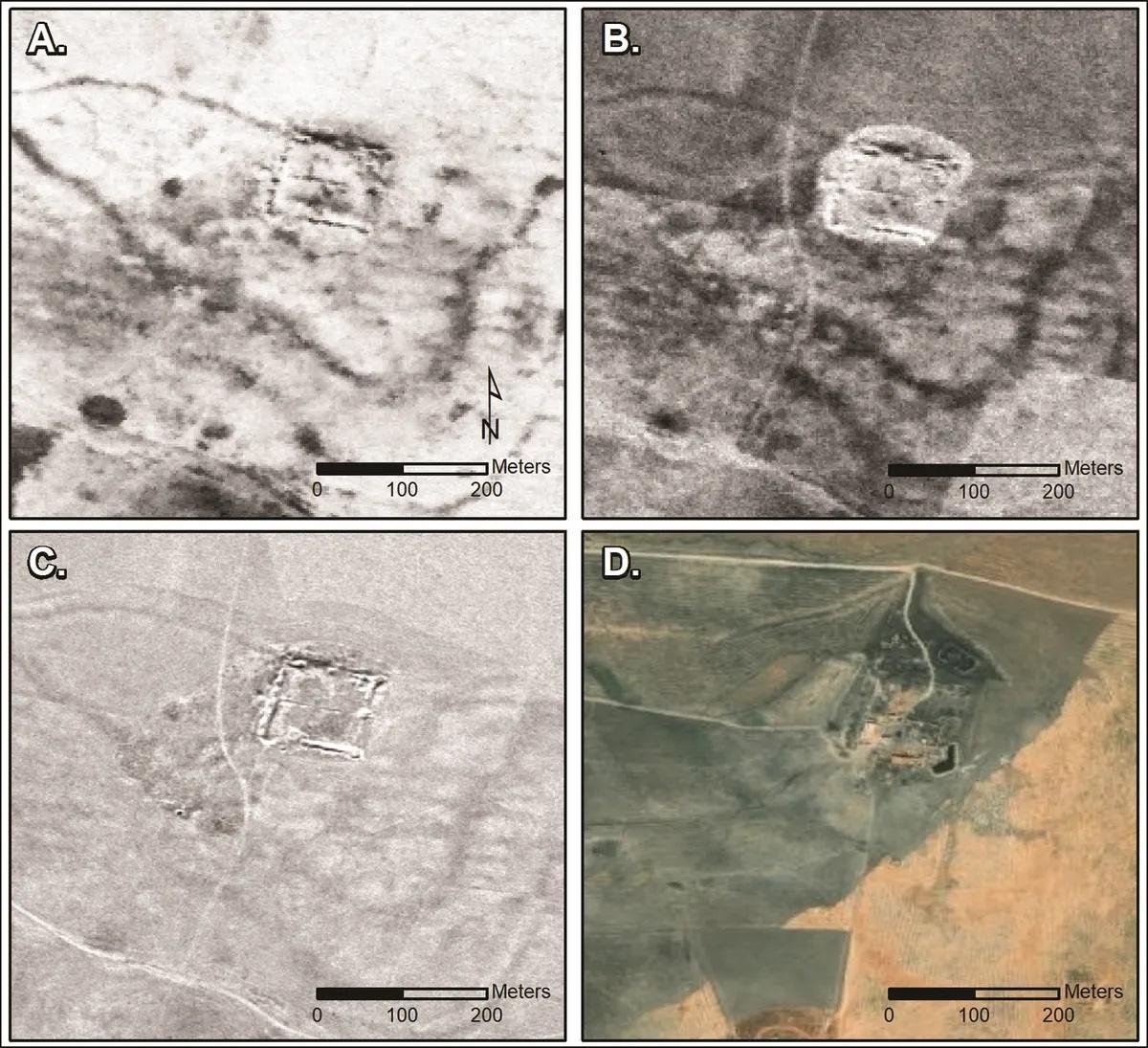
Cold war satellite images reveal nearly 400 Roman forts
Older and more modern satellite imagery of a fort at Tell Brak, northern Syria. Credit: Casana et al, Antiquity 2023 (CC BY 4.0)

The research, led by Professor Jesse Casana from Dartmouth College, challenges long-held assumptions about the purpose of these structures, pointing towards a vibrant network supporting trade and cultural exchange rather than a rigid border defense system.

The discovery builds upon the pioneering work of French Jesuit priest Father Antoine Poidebard, who, in the 1920s, conducted one of the world’s first aerial archaeological surveys, documenting 116 forts along what was believed to be the eastern boundary of the Roman Empire. However, the recent analysis, based on declassified imagery from the Corona and Hexagon spy satellite programs of the 1960s and 70s, challenges Poidebard’s interpretation.

Casana’s team identified 396 forts scattered across the Syrian steppe, far exceeding Poidebard’s count. The newfound forts, distributed both east-to-west and north-to-south, challenge the notion of a strict border and indicate a more fluid and interconnected Roman frontier.
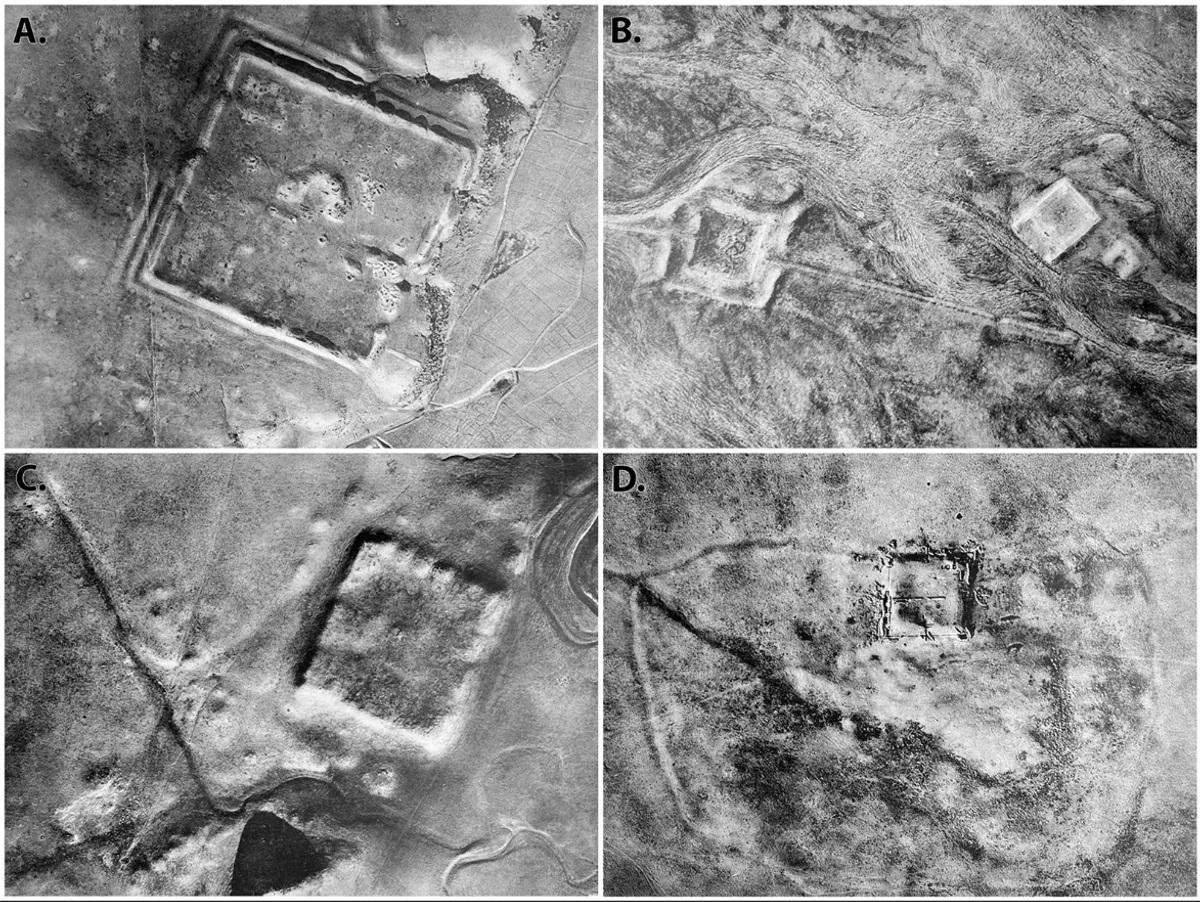
Cold war satellite images reveal nearly 400 Roman forts
Aerial photography from 1934 of select Roman forts in the region surveyed. Credit: Father Antoine Poidebard / Casana et al, Antiquity 2023 (CC BY 4.0)

The distinct square shape, typically 50-80 meters per side, classifies these structures as probable forts, distinguishable from modern buildings by their lower, eroded walls. The findings challenge the idea of a rigid Roman border, indicating that the empire’s eastern extent was more about facilitating commerce than strict territorial defense.

According to Professor Casana, “Historically, as an archaeologist, I can say that there have been many attempts by ancient states to build walls across borders, and it has been a universal failure. If there’s any way that archaeology contributes to modern discourse, I would hope it is that building giant walls to keep people out is a bad plan.”

The research emphasizes the importance of satellite imagery for recording archaeological features before they are lost due to urban development and agriculture. Unfortunately, many of the newly identified Roman forts have already been destroyed.

In the words of Professor Casana, “Careful analysis of these powerful data holds enormous potential for future discoveries in the Near East and beyond.” With more declassified imagery, such as U2 spy plane photographs, becoming available, the researchers anticipate additional archaeological revelations.

More information: Casana, J. et al, (2023), A wall or a road? A remote sensing-based investigation of fortifications on Rome’s eastern frontier, Antiquity. DOI: 10.15184/aqy.2023.153

Share:

Share on Facebook Share on X (Twitter) Share on LinkedIn Share on Pinterest Share on WhatsApp Share on Email

You May Also Like...

Archaeologists find Queen Elisenda’s remains among 25 medieval skeletons, including individuals with unexplained stab wounds
Anthropology

Archaeologists find Queen Elisenda’s remains among 25 medieval skeletons, including individuals with unexplained stab wounds

June 1, 2026
Copper Age children in Spain suffered widespread respiratory disease, skeletal study suggests
Anthropology

Copper Age children in Spain suffered widespread respiratory disease, skeletal study suggests

June 1, 2026
Unknown World War II mass grave with 14 German soldiers uncovered at quarry site in Poland
Anthropology

Unknown World War II mass grave with 14 German soldiers uncovered at quarry site in Poland

May 31, 2026
Volunteers restore England’s mysterious Cerne Abbas Giant as climate and erosion threaten ancient landmark
Archaeology

Volunteers restore England’s mysterious Cerne Abbas Giant as climate and erosion threaten ancient landmark

May 31, 2026
Buried church bell found in Poland after decades hidden beneath roadside
Archaeology

Buried church bell found in Poland after decades hidden beneath roadside

May 31, 2026
Stone Age humans built complex grass beds at Border Cave 200,000 years ago, study finds
Archaeology

Stone Age humans built complex grass beds at Border Cave 200,000 years ago, study finds

May 30, 2026

Follow us


Instagram
242K

Facebook
117K

Threads
47K

LinkedIn
15K

Twitter
6K

YouTube
1K

Archaeology News online magazine

Archaeology News is an international online magazine that covers all aspects of archaeology.


Categories

  • Academics
    • Books
    • Conferences
    • Universities
  • Articles
  • Download
  • Game
  • News
    • Anthropology
    • Archaeology
    • Paleontology
  • Quiz
  • Tours

Subscribe to our newsletter

© 2024 - Archaeology News Online Magazine. All Rights Reserved.

  • About
  • Privacy Policy
  • Terms of Use
  • Donation
  • Contact

Manage Consent
To provide the best experiences, we use technologies like cookies to store and/or access device information. Consenting to these technologies will allow us to process data such as browsing behavior or unique IDs on this site. Not consenting or withdrawing consent, may adversely affect certain features and functions.
Functional Always active
The technical storage or access is strictly necessary for the legitimate purpose of enabling the use of a specific service explicitly requested by the subscriber or user, or for the sole purpose of carrying out the transmission of a communication over an electronic communications network.
Preferences
The technical storage or access is necessary for the legitimate purpose of storing preferences that are not requested by the subscriber or user.
Statistics
The technical storage or access that is used exclusively for statistical purposes. The technical storage or access that is used exclusively for anonymous statistical purposes. Without a subpoena, voluntary compliance on the part of your Internet Service Provider, or additional records from a third party, information stored or retrieved for this purpose alone cannot usually be used to identify you.
Marketing
The technical storage or access is required to create user profiles to send advertising, or to track the user on a website or across several websites for similar marketing purposes.
  • Manage options
  • Manage services
  • Manage {vendor_count} vendors
  • Read more about these purposes
View preferences
  • {title}
  • {title}
  • {title}
  • Home
  • News
    • Archaeology
    • Anthropology
    • Paleontology
  • Academic
    • Books
    • Conferences
    • Universities
  • Articles
  • VR Tours
  • Quiz & Game
  • Download
  • Encyclopedia
  • Forum

About  .  Contact  .  Donation

© 2024 - Archaeology News Online Magazine. All Rights Reserved