• About
  • Privacy Policy
  • Terms of Use
  • Donation
  • Contact
No Result
View All Result
Archaeology News
  • Home
  • News
    • Archaeology
    • Anthropology
    • Paleontology
  • Academic
    • Books
    • Conferences
    • Universities
  • Articles
  • VR Tours
  • Quiz & Game
  • Download
  • Encyclopedia
  • Forum
Archaeology News
No Result
View All Result
Home News Archaeology

Exceptionally large Roman shoes discovered at Magna fort near Hadrian’s Wall

by Dario Radley
July 3, 2025

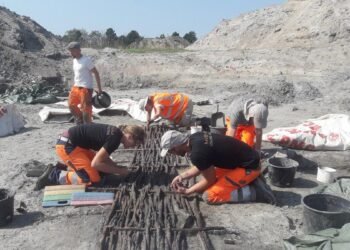
Archaeologists excavating at Magna, or Carvoran, a Roman fort near Hadrian’s Wall in Northumberland, England, have uncovered an amazing treasure trove of ancient leather shoes—many of them unusually large.

Exceptionally large Roman shoes discovered at Magna fort near Hadrian’s Wall
Close-up of Magna XXL Roman shoe. Credit: The Vindolanda Trust

Of the 32 shoes unearthed in the northern defensive ditches of Magna, 25 percent are more than 30 centimeters (11.8 inches) long, including a record-breaking 32.6 cm (12.8 inch) sole—the biggest yet recorded in the Vindolanda Trust’s vast collection of Roman shoes.

The Magna excavation is part of a five-year research project led by the Vindolanda Charitable Trust with funding from the National Lottery Heritage Fund. It is just 11 kilometers west of Vindolanda, which is famous for holding an extensive collection of well-preserved artifacts, including over 5,000 ancient shoes. Whereas the collection at Vindolanda ranges from baby booties to military boots, a total of 0.4% of its 3,704 measurable shoes are over 30 cm long. Magna’s findings reveal something different, though, with many extra-extra-large (XXL) shoes.

Exceptionally large Roman shoes discovered at Magna fort near Hadrian’s Wall
Complete Magna shoe. Credit: The Vindolanda Trust

The boots were recovered from oxygen-poor, waterlogged conditions at the base of Magna’s deep “ankle-breaker” trenches—defense ditches designed to trip and injure enemies. These anaerobic conditions are ideal for the preservation of organic materials like leather, and thus the find was made possible almost 2,000 years later.

Exceptionally large Roman shoes discovered at Magna fort near Hadrian’s Wall
Dr. Elizabeth Greene with large shoe featuring a wide toe box. Credit: The Vindolanda Trust

Dr. Elizabeth Greene, Associate Professor at the University of Western Ontario and a specialist on Roman footwear, said: “Even from this small sample uncovered, it is clear that these shoes are much larger on average than most of the Vindolanda collection. Although we are comparing this new Magna collection, which has not yet gone through the conservation process, even taking into account a maximum shrinkage of up to 1 cm (10 mm), it still means these shoes are very large indeed.”

RelatedStories

Rare Late Roman mosaic with Solomon’s Knot discovered beneath modern İzmir

Rare Late Roman mosaic with Solomon’s Knot discovered beneath modern İzmir

January 7, 2026
Archaeologists uncover 2,000-year-old workshops and Roman necropolis in Egypt’s western Nile Delta

Archaeologists uncover 2,000-year-old workshops and Roman necropolis in Egypt’s western Nile Delta

December 31, 2025

Magna fort, predating the construction of Hadrian’s Wall, housed a diverse military population consisting of Syrian archers, Dalmatians, Batavians, and legionaries from the Second Augusta and Twentieth Valeria Victrix legions. The variety of shoe sizes may indicate physical differences among these regiments or perhaps different provisioning or cultural practices.

Exceptionally large Roman shoes discovered at Magna fort near Hadrian’s Wall
Aerial photo of Magna fort. Credit: The Vindolanda Trust

Rachel Frame, Senior Archaeologist at the Magna Project, emphasized the importance of such organic finds: “They capture the imagination of visitors and volunteers alike, but they are also the most at risk from our changing climate.” She emphasized how important continued support is for preserving these artifacts.

Dr. Andrew Birley, Director of Excavations and CEO of the Vindolanda Trust, commented in a statement, “This really shows us what is at risk if climate change continues to rob us of such vital information. It reminds us that not every population was the same, and that wide variations between the regiments and people who served along Hadrian’s Wall could be cultural and physical.”

More information: Roman Arm Museum & Magna Fort

Share696Tweet435Share122ShareSend

You May Also Like...

60,000-year-old poison arrows from South Africa reveal the world’s earliest poisoned weapons and advanced hunting techniques
Archaeology

60,000-year-old poison arrows from South Africa reveal the world’s earliest poisoned weapons and advanced hunting techniques

January 8, 2026
Inscribed clay cylinders reveal Nebuchadnezzar II’s restoration of the Kish Ziggurat
Archaeology

Inscribed clay cylinders reveal Nebuchadnezzar II’s restoration of the Kish Ziggurat

January 7, 2026
Rare Late Roman mosaic with Solomon’s Knot discovered beneath modern İzmir
Archaeology

Rare Late Roman mosaic with Solomon’s Knot discovered beneath modern İzmir

January 7, 2026
1130 depiction of Saxons, Jutes, and Angles crossing the sea to Britain. Credit: Wikimedia / CC BY-SA 4.0. Roots of medieval migration into England uncovered by large-scale bioarchaeological study
Anthropology

Roots of medieval migration into England uncovered by large-scale bioarchaeological study

January 6, 2026
Rare Celtic gold coins found in Swiss bog may reveal ancient ritual offerings
Archaeology

Rare Celtic gold coins found in Swiss bog may reveal ancient ritual offerings

January 5, 2026
Rare medieval gold ring unearthed in Tønsberg
Archaeology

Rare medieval gold ring unearthed in Tønsberg reveals beliefs and craftsmanship of its time

January 5, 2026

Comments 16

  1. Editorial Team says:
    1 second ago

    Disclaimer: This website is a science-focused magazine that welcomes both academic and non-academic audiences. Comments are written by users and may include personal opinions or unverified claims. They do not necessarily reflect the views of our editorial team or rely on scientific evidence.

    Comment Policy: We kindly ask all commenters to engage respectfully. Comments that contain offensive, insulting, degrading, discriminatory, or racist content will be automatically removed.

    Reply
  2. EewiQ Ballsroff says:
    7 months ago

    Great info & well presented! Looking forward to next posting. Glad I found you!

    Reply
  3. Olivia Musarra says:
    7 months ago

    Wish I would have continued my love for discovery, found in archeology. To this day, I am captured with our past and wish I could have been able to discover our previous history. How wonderful it must have been to find such treasures, preserved until now. Saved beneath the oceans and have their history waiting to be discovered. What a thrill that had to be! The stories that they can tell us now. and give us a picture of our forgotten past. My hope is that man, will still continue to delve in what was, and not forgotten.

    Reply
    • Jeffrey Blair says:
      7 months ago

      It’s NEVER too late to fulfill this dream Olivia! You are the architect of your own life!

      Reply
  4. Maggie Potter says:
    7 months ago

    Loving reading this,so interesting and exciting.

    Reply
  5. Alfred Kowsky says:
    7 months ago

    In the past it was theorized that the average height of a Roman was 5 ft 4 in tall. A man wearing a shoe size of 12.8 in must have been a giant. Were the Romans using foreign mercenaries in their ranks who were much bigger than the Roman soldiers?

    Reply
  6. Kenn Lynch says:
    7 months ago

    A giant to them. My shoe length is 12 in, and I am 6 foot.

    Reply
  7. Tom says:
    7 months ago

    That normal foot size for the time, back in the early 70″s when i was 16 iam 5,9 and a size 10″ wide shoe, i was short the 12 grader many were 6 feet +. Now iam consider tall the average when down to 5.7

    Reply
  8. Tony says:
    7 months ago

    Maybe they were used as a short of “overshoe” to be worn over existing shoes or foot wrappings?

    Reply
  9. John McDonald says:
    7 months ago

    Perhaps all of the marching stretched their feet out. I used to take a size eight shoe until I was forty. I began running to lose weight at age forty two. I lost the weight, but my shoe size went up to a size ten. I have to say that I ran twenty eight marathons, countless shorter races between marathon and four miles. This continued until I was sixty eight and I believe pouring the pavements was responsible for my enlarged feet.

    Reply
  10. Raewyn Brockway says:
    7 months ago

    Fascinating stuff. I wonder if “climate change” is the explanation – the change in climate between Rome and Northumberland! Some clever woman may have realized that nice, thick sheepskin “socks” would be just the thing to keep the feet warm. Do the shoes have greater width and height as well as greater length?

    Reply
    • Johnny Fenton says:
      6 months ago

      On a very similar theme, Raewyn, I thought these could be winter shoes made for thick, thick woollen socks.

      Reply
  11. Chris H says:
    7 months ago

    Does the structure of the leather look ‘normal’ – eg could it simply be that conditions have swelled all the organic material?

    Reply
  12. Angie Shorten says:
    6 months ago

    Maybe they were made larger to make room for possibly insulating the feet with fur or other materials for warmth ?

    Reply
  13. Andy says:
    6 months ago

    The uniformity of the stitching holes in the upper look modern made. Please explain.

    Reply
  14. Dippypud says:
    6 months ago

    “look” modern made to you ? But not to an archaeologist…

    Reply
  15. Jim says:
    6 months ago

    This is not so perplexing. I’m of Italian descent and study Roman history as part of my heritage. I’m also a retired U.S. Marine grunt combat veteran. The Romans were a predominantly Mediterranean culture accustomed to warm, balmy weather. They did NOT like cold weather, whether it was Britain or the northern borders around Germania. These oversized shoes were most likely overshoes to be worn over their usual Caligae sandals while also wearing one or more layers of wool socks or footwraps made from their wool Focale scarves. They overshoes probably weren’t worn while marching but would have been worn when on watch while standing in one place as sentries on the walls and towers of their fort for hours on end in the freezing cold. The Romans were an adaptable and resourceful culture. They incorporated anything they found useful from the people and cultures they conquered. It was very much a part of their success. At the same time, elements of their culture sere sometimes cast aside when it was practical. Romans did NOT wear full length trousers. Instead, they sometimes wore knee length shorts or calf length Capri-style britches (braccae). It was normally considered effeminate for Roman males to wear anything resembling full length trousers that were worn by despised barbarian peoples. That attitude changed while stationed in the cold climates of northern Europe. Troops will do whatever is necessary to survive.

    Reply

Leave a Reply Cancel reply

Your email address will not be published. Required fields are marked *

Follow us


Instagram
244K

Facebook
118K

Threads
45K

LinkedIn
14K

Twitter
6K

YouTube
1K
  • Trending
  • Comments
  • Latest
Shipwreck Salvage. Credit: rawpixel.com / Public Domain

2,000-year-old shipwreck discovered off Turkish coast with remarkably preserved stacked ceramics

July 2, 2025
Viking age DNA reveals 9,000-year-old HIV-resistant gene originating near the Black Sea

Viking age DNA reveals 9,000-year-old HIV-resistant gene originating near the Black Sea

May 18, 2025
A new study suggests the mysterious Voynich Manuscript may be a medieval cipher

A new study suggests the mysterious Voynich Manuscript may be a medieval cipher

January 3, 2026
Moses may be named in ancient Egyptian mine inscriptions, sparking debate over earliest biblical references

Moses may be named in ancient Egyptian mine inscriptions, sparking debate over earliest biblical references

July 31, 2025
Mystery of Armenia’s 6,000-year-old dragon stones solved

Mystery of Armenia’s 6,000-year-old dragon stones solved

September 23, 2025
3D analysis reveals Shroud of Turin image likely came from sculpture, not Jesus’ body

3D analysis reveals Shroud of Turin image likely came from sculpture, not Jesus’ body

Moses may be named in ancient Egyptian mine inscriptions, sparking debate over earliest biblical references

Moses may be named in ancient Egyptian mine inscriptions, sparking debate over earliest biblical references

$1 million prize offered to decipher 5,300-year-old Indus Valley script

$1 million prize offered to decipher 5,300-year-old Indus Valley script

Oldest ever genetic data from a human relative found in 2-million-year-old fossilized teeth

Oldest ever genetic data from a human relative found in 2-million-year-old fossilized teeth

Exceptionally large Roman shoes discovered at Magna fort near Hadrian’s Wall

Exceptionally large Roman shoes discovered at Magna fort near Hadrian’s Wall

60,000-year-old poison arrows from South Africa reveal the world’s earliest poisoned weapons and advanced hunting techniques

60,000-year-old poison arrows from South Africa reveal the world’s earliest poisoned weapons and advanced hunting techniques

January 8, 2026
Inscribed clay cylinders reveal Nebuchadnezzar II’s restoration of the Kish Ziggurat

Inscribed clay cylinders reveal Nebuchadnezzar II’s restoration of the Kish Ziggurat

January 7, 2026
Rare Late Roman mosaic with Solomon’s Knot discovered beneath modern İzmir

Rare Late Roman mosaic with Solomon’s Knot discovered beneath modern İzmir

January 7, 2026
1130 depiction of Saxons, Jutes, and Angles crossing the sea to Britain. Credit: Wikimedia / CC BY-SA 4.0. Roots of medieval migration into England uncovered by large-scale bioarchaeological study

Roots of medieval migration into England uncovered by large-scale bioarchaeological study

January 6, 2026
Rare Celtic gold coins found in Swiss bog may reveal ancient ritual offerings

Rare Celtic gold coins found in Swiss bog may reveal ancient ritual offerings

January 5, 2026

Archaeology News online magazine

Archaeology News is an international online magazine that covers all aspects of archaeology.


Categories

  • Academics
    • Books
    • Conferences
    • Universities
  • Articles
  • Download
  • Game
  • News
    • Anthropology
    • Archaeology
    • Paleontology
  • Quiz
  • Tours

Subscribe to our newsletter

© 2024 - Archaeology News Online Magazine. All Rights Reserved.

  • About
  • Privacy Policy
  • Terms of Use
  • Donation
  • Contact

Welcome Back!

Login to your account below

Forgotten Password? Sign Up

Create New Account!

Fill the forms below to register

All fields are required. Log In

Retrieve your password

Please enter your username or email address to reset your password.

Log In

Add New Playlist

Manage Consent
To provide the best experiences, we use technologies like cookies to store and/or access device information. Consenting to these technologies will allow us to process data such as browsing behavior or unique IDs on this site. Not consenting or withdrawing consent, may adversely affect certain features and functions.
Functional Always active
The technical storage or access is strictly necessary for the legitimate purpose of enabling the use of a specific service explicitly requested by the subscriber or user, or for the sole purpose of carrying out the transmission of a communication over an electronic communications network.
Preferences
The technical storage or access is necessary for the legitimate purpose of storing preferences that are not requested by the subscriber or user.
Statistics
The technical storage or access that is used exclusively for statistical purposes. The technical storage or access that is used exclusively for anonymous statistical purposes. Without a subpoena, voluntary compliance on the part of your Internet Service Provider, or additional records from a third party, information stored or retrieved for this purpose alone cannot usually be used to identify you.
Marketing
The technical storage or access is required to create user profiles to send advertising, or to track the user on a website or across several websites for similar marketing purposes.
  • Manage options
  • Manage services
  • Manage {vendor_count} vendors
  • Read more about these purposes
View preferences
  • {title}
  • {title}
  • {title}
  • Home
  • News
    • Archaeology
    • Anthropology
    • Paleontology
  • Academic
    • Books
    • Conferences
    • Universities
  • Articles
  • VR Tours
  • Quiz & Game
  • Download
  • Encyclopedia
  • Forum

About  .  Contact  .  Donation

© 2024 - Archaeology News Online Magazine. All Rights Reserved