
For decades, Homo erectus has stood at the center of one of paleoanthropology’s biggest debates. The species was the first human ancestor to spread beyond Africa, reaching parts of Asia and Europe nearly 1.8 million years ago. Scientists have long questioned whether these early humans shared any genetic ties with later groups such as Denisovans or even modern humans. A new study from China now offers some of the clearest molecular evidence yet that such links existed.

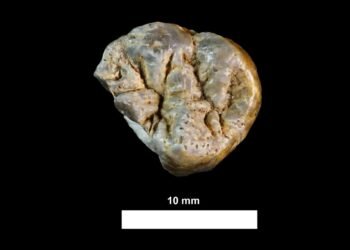
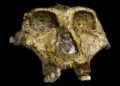
Researchers from the Institute of Vertebrate Paleontology and Paleoanthropology at the Chinese Academy of Sciences analyzed six Homo erectus teeth from three sites in China: Zhoukoudian, famous for the “Peking Man” fossils, along with Hexian and Sunjiadong. The fossils date to at least 400,000 years ago. Their findings appeared May 13 in the journal Nature.
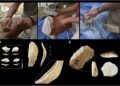
The team focused on proteins preserved inside dental enamel. Ancient DNA rarely survives for hundreds of thousands of years, especially in warmer regions, but proteins last much longer. Scientists extracted 11 enamel proteins and examined hundreds of amino acid positions within them.
Two amino acid variants drew immediate attention.
One variant appeared in all six Homo erectus individuals and has not been identified in any other known human lineage. Researchers described the mutation, called AMBN-A253G, as a possible molecular marker for these East Asian Homo erectus populations. The shared mutation also suggests the individuals from the three Chinese sites belonged to the same evolutionary population.
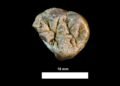
The second variant proved even more surprising. Known as AMBN-M273V, researchers previously believed the mutation belonged only to Denisovans, an extinct group of archaic humans that once lived across parts of Asia. The new study found the same variant in all six Homo erectus fossils.
The finding points to a genetic connection between East Asian Homo erectus and Denisovans. Researchers suggest the mutation entered the Denisovan lineage through interbreeding with Homo erectus populations and later reached some modern human groups in Southeast Asia and Oceania through Denisovan ancestry.
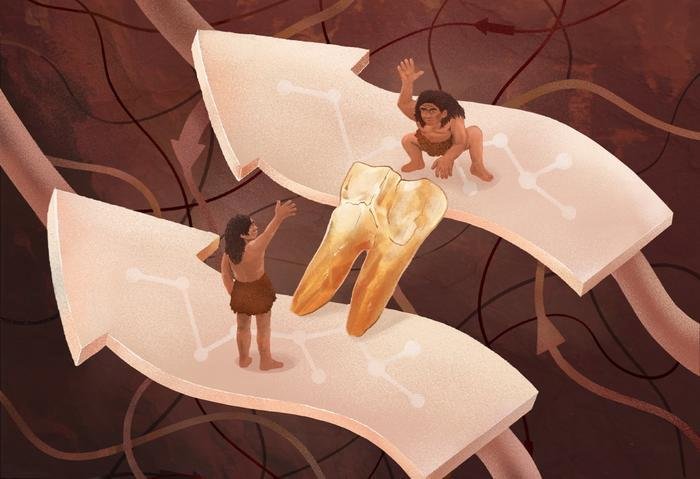
This marks the first molecular evidence linking Homo erectus from China to both Denisovans and living humans.
The study also highlights how much human evolution resembled a network rather than a straight line. During the Middle Pleistocene, between roughly 774,000 and 129,000 years ago, several human groups overlapped across Africa and Eurasia, including Homo erectus, Neanderthals, Denisovans, and early Homo sapiens. Scientists have often described this period as confusing because fossils from different groups frequently share similar physical traits.
Recent DNA research has already shown interbreeding between Neanderthals, Denisovans, and modern humans. The new enamel protein evidence pushes signs of mixing even deeper into the past, to a period where DNA evidence remains unavailable.
Researchers also introduced a new set of paleoproteomic methods designed to reduce damage to rare fossils. Instead of traditional destructive sampling, the team used a micro-destructive acid etching approach that preserved the teeth’s external shape. The study also developed new analytical tools, including a technique for determining biological sex using the male-specific enamel protein AMELY.
The work represents a major advance for paleoproteomics, a field that studies ancient proteins to reconstruct evolutionary history. No recoverable DNA has yet been found from Homo erectus, making protein analysis one of the few available paths for studying the species at the molecular level.
The findings also raise new questions. Some researchers argue the fossils traditionally labeled Homo erectus in China may represent several different populations or close relatives of Denisovans rather than a single species. As more molecular evidence emerges, scientists may need to rethink how ancient human species are defined.
For now, the enamel proteins from six fossil teeth have added a new piece to the story of human evolution, one that suggests ancient populations mixed with each other far more often than once believed.









Disclaimer: This website is a science-focused magazine that welcomes both academic and non-academic audiences. Comments are written by users and may include personal opinions or unverified claims. They do not necessarily reflect the views of our editorial team or rely on scientific evidence.
Comment Policy: We kindly ask all commenters to engage respectfully. Comments that contain offensive, insulting, degrading, discriminatory, or racist content will be automatically removed.