• About
  • Privacy Policy
  • Terms of Use
  • Donation
  • Contact
No Result
View All Result
Archaeology News
  • Home
  • News
    • Archaeology
    • Anthropology
    • Paleontology
  • Academic
    • Books
    • Conferences
    • Universities
  • Articles
  • VR Tours
  • Quiz & Game
  • Download
  • Encyclopedia
  • Forum
Archaeology News
No Result
View All Result
Home News Anthropology

Cut marks on 1.6-million-year-old bones reveal early humans moved and processed meat in Kenya

by Dario Radley
May 13, 2026

A new study from northern Kenya adds fresh detail to how early humans found, processed, and consumed meat about 1.6 million years ago. The findings suggest these hominins were not random scavengers picking over abandoned carcasses. Instead, they followed repeated food-gathering behaviors across different habitats, showing planning and flexibility in how they used animal resources.
Cut marks on 1.6-million-year-old bones reveal early humans moved and processed meat in Kenya
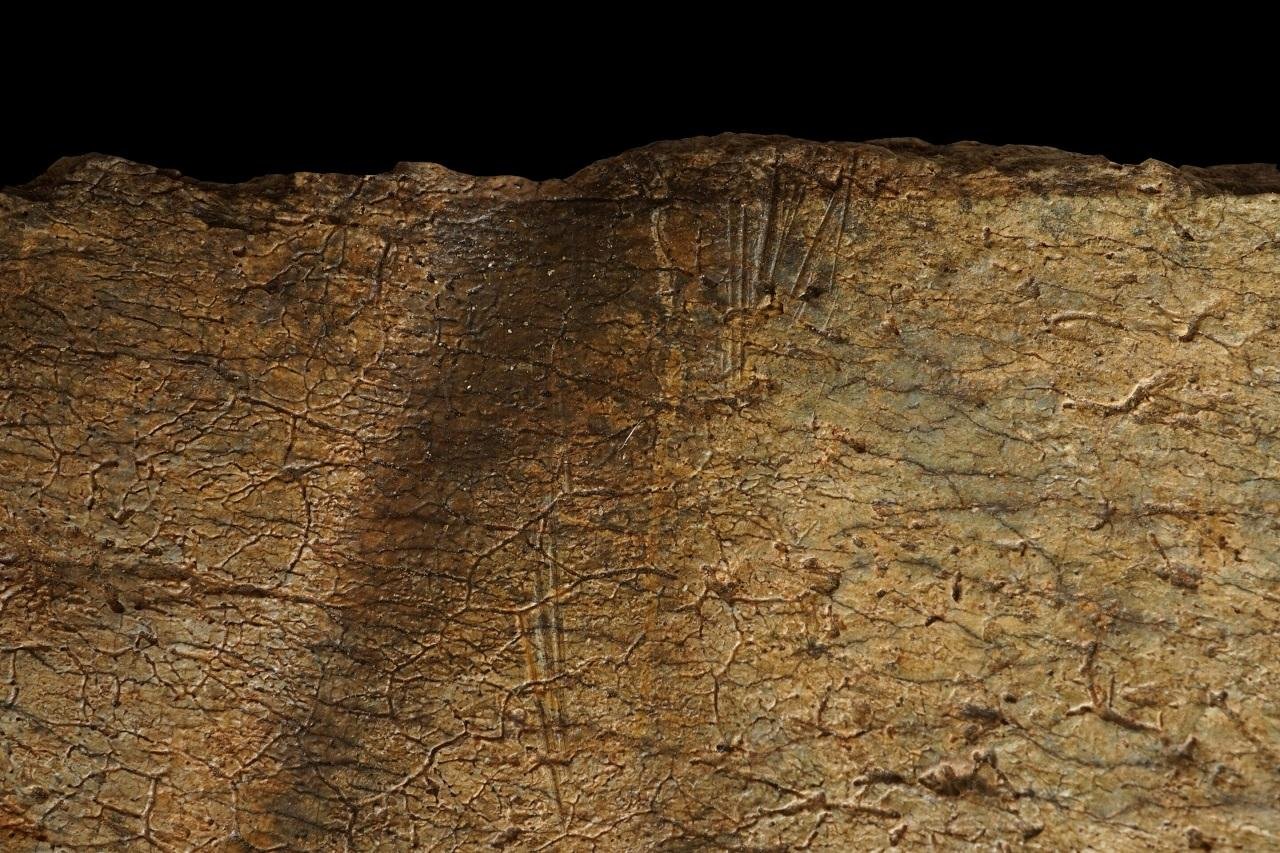
Close-up of cut marks on a fossil bone, made by stone tools during butchery. Credit: Sharon Kuo

The research, published in the journal Proceedings of the National Academy of Sciences, focused on animal fossils from FwJj 80, a site in the Koobi Fora Formation. This area is one of the most important regions for studying early human evolution because it preserves fossils of hominins, animals, and ancient environments from the Plio-Pleistocene.

Researchers analyzed more than 1,000 fossil bones, mostly from antelopes and other grazing animals. Using magnification, they studied tiny marks left on the bones. Cut marks made by stone tools and percussion marks from hammerstones showed clear signs of butchery. Tooth marks from carnivores appeared far less often, suggesting predators played only a limited role in modifying these remains.

Many of the clearest cut marks appeared on the shafts of leg bones, where large amounts of meat would have been attached. This pattern suggests early Homo reached carcasses before carnivores stripped them. The animals were not already reduced to scraps when humans arrived.
Cut marks on 1.6-million-year-old bones reveal early humans moved and processed meat in Kenya
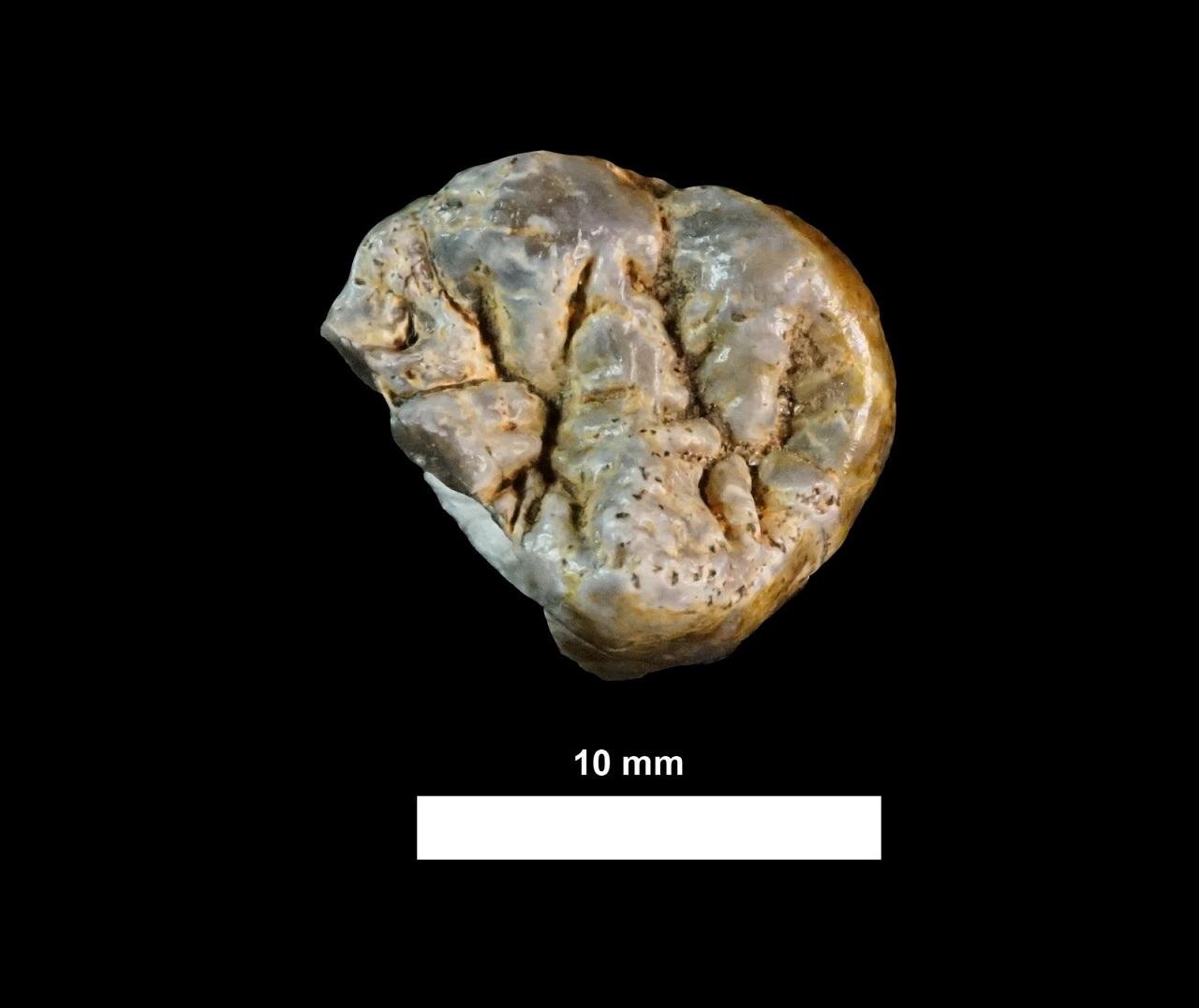
Upper molar tooth from a juvenile Homo, estimated to have been 6 to 7 years old, recovered from the site. Credit: Sharon Kuo

The team also found many broken long bones with impact marks linked to marrow extraction. Bone marrow offered a dense source of fat and calories, which would have been especially useful for hominins with growing energy demands. Access to meat and marrow has long been considered an important factor in the evolution of larger brains in the genus Homo.

RelatedStories

Neanderthals used rhinoceros teeth as tools for making stone implements, study finds

Neanderthals used rhinoceros teeth as tools for making stone implements, study finds

May 9, 2026
Ancient Maya traded live dogs across hundreds of miles, isotope study finds

Ancient Maya traded live dogs across hundreds of miles, isotope study finds

May 9, 2026

The composition of the fossil collection also tells an important story. Leg bones were much more common than skulls, ribs, and vertebrae. If animals had been butchered and eaten where they died, a more complete skeleton would be expected. Instead, the evidence suggests early humans selected nutrient-rich limbs and transported them elsewhere.

Researchers believe these hominins likely moved the best cuts of meat away from dangerous kill sites into safer places, possibly near rivers or sheltered vegetation. This behavior reduced the risk of conflict with large predators while allowing more careful processing of food.
Cut marks on 1.6-million-year-old bones reveal early humans moved and processed meat in Kenya
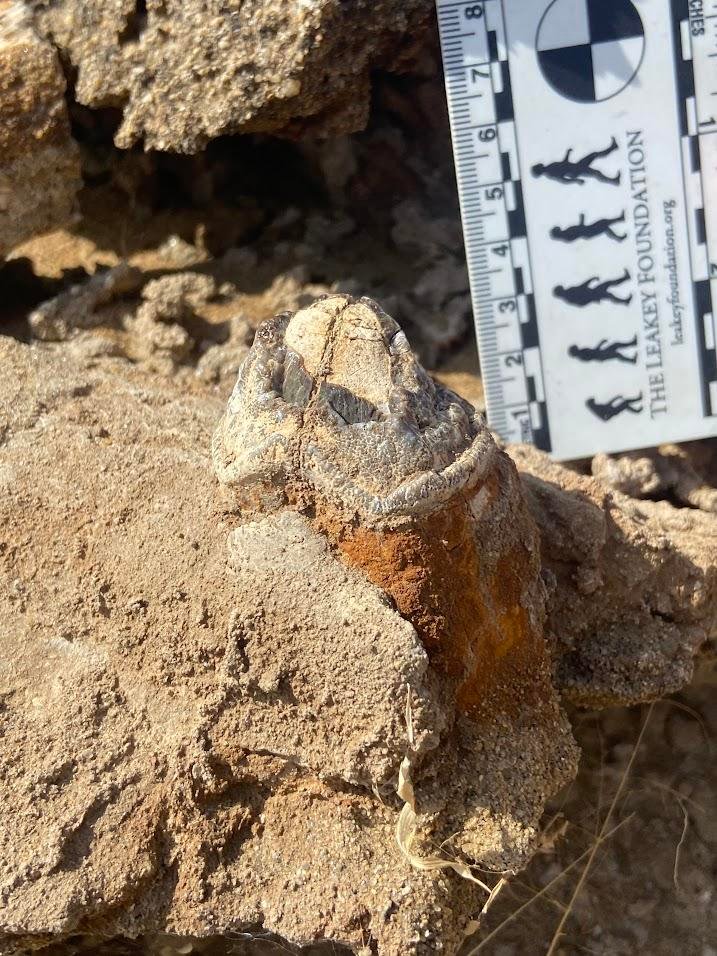
Fossil hippo tooth eroding out of sandstone at the site. Credit: Frances Forrest

FwJj 80 comes from the KBS Member of the Koobi Fora Formation, dated to about 1.87 to 1.56 million years ago. Although the region has yielded important hominin fossils, earlier layers from the KBS Member have produced fewer well-preserved animal assemblages for detailed study. This makes FwJj 80 especially important because researchers could examine butchery patterns, marrow extraction, and transport decisions in a way not previously possible for this time period.

The results closely match patterns already documented in younger deposits from Koobi Fora’s Okote Member, dated between about 1.56 and 1.38 million years ago. Similar evidence of early carcass access, limb transport, and marrow extraction appears in both layers, showing continuity in behavior over long stretches of time.
Cut marks on 1.6-million-year-old bones reveal early humans moved and processed meat in Kenya
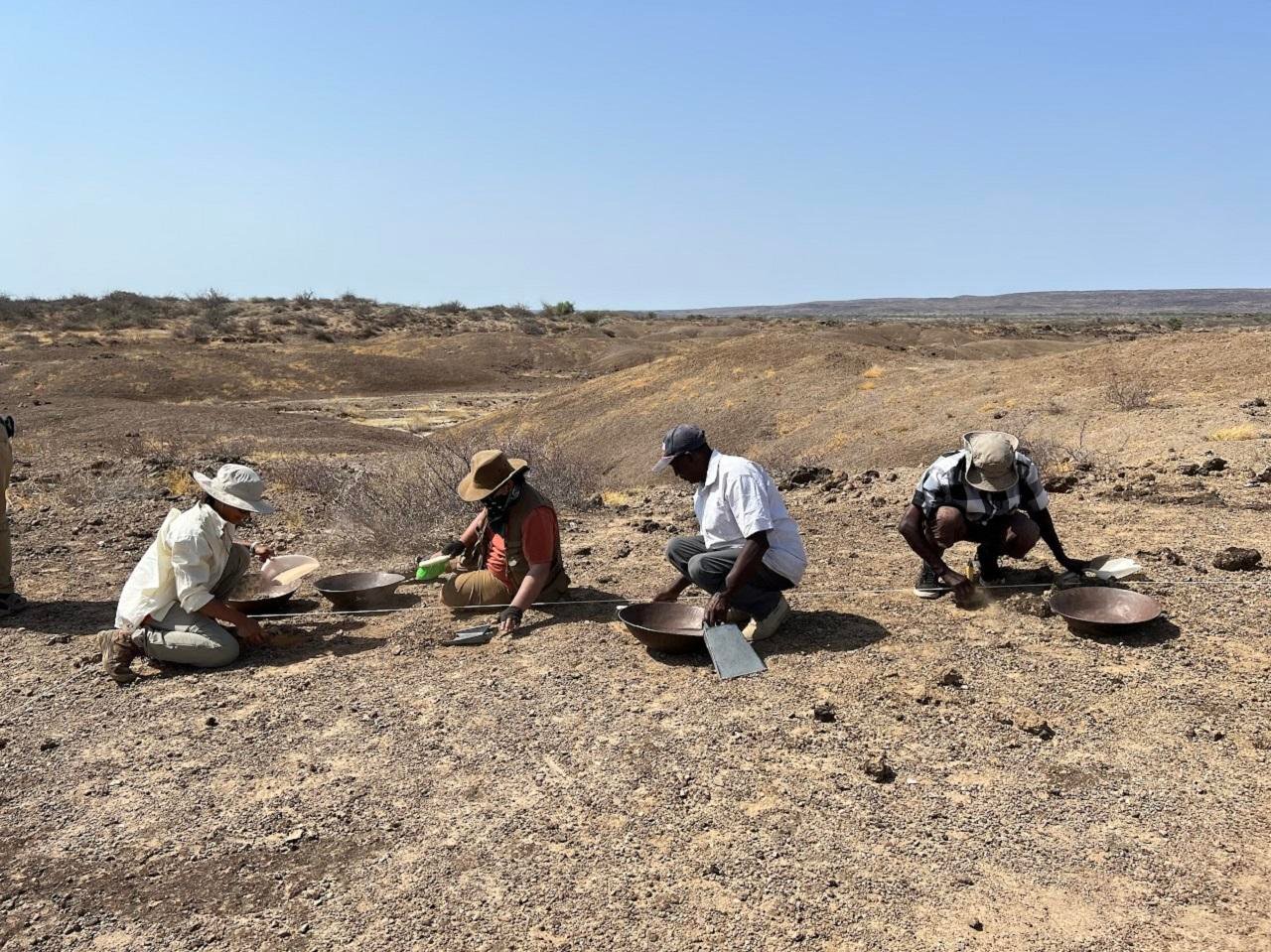
Researchers beginning a surface scrape to collect small fossils from the ground surface. Credit: Frances Forrest

The team also compared FwJj 80 with two older East African sites, FLK Zinj in Tanzania, dated to around 1.84 million years ago, and Kanjera South in Kenya, about 2 million years old. Across these sites, early humans repeatedly followed similar strategies despite environmental differences.

At the time, Koobi Fora included open grasslands as well as wetter floodplain areas with dense vegetation. The persistence of these food-related behaviors across shifting landscapes suggests early Homo maintained a stable but flexible foraging strategy.

This repeated access to high-quality animal foods likely supported major changes in human evolution. Reliable calories from meat and marrow would have helped meet the metabolic demands of larger brains. Food transport and shared processing areas may also have encouraged more organized group behavior, adding another piece to the story of how early humans adapted and expanded across ancient African landscapes.

More information: Forrest, F., Gonzalez-Alvarez, E., Rolier, D. P., Kuo, S., Skinner, M., Reeves, J., … Braun, D. R. (2026). Early evidence for a stable and flexible foraging niche in the evolution of Homo. Proceedings of the National Academy of Sciences of the United States of America, 123(20), e2537631123. doi:10.1073/pnas.2537631123
ShareTweetShareShareSend

You May Also Like...

280 ancient stone burial monuments found in Sudan reveal lost cattle-herding culture in the Sahara
Archaeology

280 ancient stone burial monuments found in Sudan reveal lost cattle-herding culture in the Sahara

May 13, 2026
Rare Bronze Age burial in Sweden reveals unusual pair of Wendel neck rings and complex ritual landscape near Norrköping
Archaeology

Rare Bronze Age burial in Sweden reveals unusual pair of Wendel neck rings and complex ritual landscape near Norrköping

May 12, 2026
Kasta Tomb in Amphipolis fully revealed as restoration uncovers largest burial mound in Macedonia
Archaeology

Kasta Tomb in Amphipolis fully revealed as restoration uncovers largest burial mound in Macedonia

May 12, 2026
Rare Roman villa threatened by farming damage reveals rare mosaic and bathhouse remains in Devon
Archaeology

Rare Roman villa threatened by farming damage reveals rare mosaic and bathhouse remains in Devon

May 12, 2026
Ancient burials, Roman well, and Anglo-Saxon house uncovered during A46 Newark bypass excavations
Anthropology

Ancient burials, Roman well, and Anglo-Saxon house uncovered during A46 Newark bypass excavations

May 12, 2026
8-year-old boy finds 1,700-year-old Roman statuette fragment in Ramon Crater
Archaeology

8-year-old boy finds 1,700-year-old Roman statuette fragment in Ramon Crater

May 11, 2026

Comments 0

  1. Editorial Team says:
    1 second ago

    Disclaimer: This website is a science-focused magazine that welcomes both academic and non-academic audiences. Comments are written by users and may include personal opinions or unverified claims. They do not necessarily reflect the views of our editorial team or rely on scientific evidence.

    Comment Policy: We kindly ask all commenters to engage respectfully. Comments that contain offensive, insulting, degrading, discriminatory, or racist content will be automatically removed.

    Reply

Leave a Reply Cancel reply

Your email address will not be published. Required fields are marked *

Follow us


Instagram
242K

Facebook
117K

Threads
46K

LinkedIn
14K

Twitter
6K

YouTube
1K
  • Trending
  • Comments
  • Latest
Shipwreck Salvage. Credit: rawpixel.com / Public Domain

2,000-year-old shipwreck discovered off Turkish coast with remarkably preserved stacked ceramics

July 2, 2025
A new study suggests the mysterious Voynich Manuscript may be a medieval cipher

A new study suggests the mysterious Voynich Manuscript may be a medieval cipher

January 3, 2026
Viking age DNA reveals 9,000-year-old HIV-resistant gene originating near the Black Sea

Viking age DNA reveals 9,000-year-old HIV-resistant gene originating near the Black Sea

May 18, 2025
3D analysis reveals Shroud of Turin image likely came from sculpture, not Jesus’ body

3D analysis reveals Shroud of Turin image likely came from sculpture, not Jesus’ body

August 3, 2025
Moses may be named in ancient Egyptian mine inscriptions, sparking debate over earliest biblical references

Moses may be named in ancient Egyptian mine inscriptions, sparking debate over earliest biblical references

July 31, 2025
3D analysis reveals Shroud of Turin image likely came from sculpture, not Jesus’ body

3D analysis reveals Shroud of Turin image likely came from sculpture, not Jesus’ body

Moses may be named in ancient Egyptian mine inscriptions, sparking debate over earliest biblical references

Moses may be named in ancient Egyptian mine inscriptions, sparking debate over earliest biblical references

$1 million prize offered to decipher 5,300-year-old Indus Valley script

$1 million prize offered to decipher 5,300-year-old Indus Valley script

Oldest ever genetic data from a human relative found in 2-million-year-old fossilized teeth

Oldest ever genetic data from a human relative found in 2-million-year-old fossilized teeth

Exceptionally large Roman shoes discovered at Magna fort near Hadrian’s Wall

Exceptionally large Roman shoes discovered at Magna fort near Hadrian’s Wall

Cut marks on 1.6-million-year-old bones reveal early humans moved and processed meat in Kenya

Cut marks on 1.6-million-year-old bones reveal early humans moved and processed meat in Kenya

May 13, 2026
280 ancient stone burial monuments found in Sudan reveal lost cattle-herding culture in the Sahara

280 ancient stone burial monuments found in Sudan reveal lost cattle-herding culture in the Sahara

May 13, 2026
Rare Bronze Age burial in Sweden reveals unusual pair of Wendel neck rings and complex ritual landscape near Norrköping

Rare Bronze Age burial in Sweden reveals unusual pair of Wendel neck rings and complex ritual landscape near Norrköping

May 12, 2026
Kasta Tomb in Amphipolis fully revealed as restoration uncovers largest burial mound in Macedonia

Kasta Tomb in Amphipolis fully revealed as restoration uncovers largest burial mound in Macedonia

May 12, 2026
Rare Roman villa threatened by farming damage reveals rare mosaic and bathhouse remains in Devon

Rare Roman villa threatened by farming damage reveals rare mosaic and bathhouse remains in Devon

May 12, 2026

Archaeology News online magazine

Archaeology News is an international online magazine that covers all aspects of archaeology.


Categories

  • Academics
    • Books
    • Conferences
    • Universities
  • Articles
  • Download
  • Game
  • News
    • Anthropology
    • Archaeology
    • Paleontology
  • Quiz
  • Tours

Subscribe to our newsletter

© 2024 - Archaeology News Online Magazine. All Rights Reserved.

  • About
  • Privacy Policy
  • Terms of Use
  • Donation
  • Contact

Manage Consent
To provide the best experiences, we use technologies like cookies to store and/or access device information. Consenting to these technologies will allow us to process data such as browsing behavior or unique IDs on this site. Not consenting or withdrawing consent, may adversely affect certain features and functions.
Functional Always active
The technical storage or access is strictly necessary for the legitimate purpose of enabling the use of a specific service explicitly requested by the subscriber or user, or for the sole purpose of carrying out the transmission of a communication over an electronic communications network.
Preferences
The technical storage or access is necessary for the legitimate purpose of storing preferences that are not requested by the subscriber or user.
Statistics
The technical storage or access that is used exclusively for statistical purposes. The technical storage or access that is used exclusively for anonymous statistical purposes. Without a subpoena, voluntary compliance on the part of your Internet Service Provider, or additional records from a third party, information stored or retrieved for this purpose alone cannot usually be used to identify you.
Marketing
The technical storage or access is required to create user profiles to send advertising, or to track the user on a website or across several websites for similar marketing purposes.
  • Manage options
  • Manage services
  • Manage {vendor_count} vendors
  • Read more about these purposes
View preferences
  • {title}
  • {title}
  • {title}
  • Home
  • News
    • Archaeology
    • Anthropology
    • Paleontology
  • Academic
    • Books
    • Conferences
    • Universities
  • Articles
  • VR Tours
  • Quiz & Game
  • Download
  • Encyclopedia
  • Forum

About  .  Contact  .  Donation

© 2024 - Archaeology News Online Magazine. All Rights Reserved