• About
  • Privacy Policy
  • Terms of Use
  • Donation
  • Contact
No Result
View All Result
Archaeology News
  • Home
  • News
    • Archaeology
    • Anthropology
    • Paleontology
  • Academic
    • Books
    • Conferences
    • Universities
  • Articles
  • VR Tours
  • Quiz & Game
  • Download
  • Encyclopedia
  • Forum
Archaeology News
No Result
View All Result
Home News Anthropology

Study suggests Neolithic women in Europe were tied up and buried alive in ritual sacrifices

by Dario Radley
April 11, 2024

A recent study has unveiled a disturbing trend of sacrificial murders spanning over 2,000 years. The research, published in Science Advances, delves into the horrible tradition of “incaprettamento” — a method of murder involving tying victims’ necks to their legs behind their backs, effectively causing them to strangle themselves.

Study Suggests Neolithic women in Europe were tied up and buried alive in ritual sacrifices
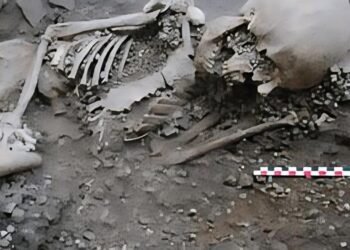
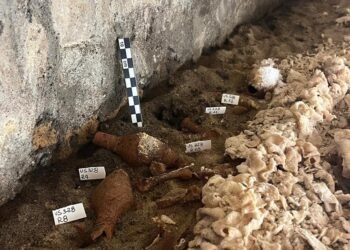
View taken from the upper part of the storage pit showing the three skeletons, with one individual in a central position (woman 1) and the other two placed under the overhang of the wall (woman 2 and woman 3). Credit: A. Beeching/Ludes et al., Science Advances 2024

The study, led by Eric Crubézy, a biological anthropologist at Paul Sabatier University in Toulouse, France, and forensic pathologist Bertrand Ludes of Paris Cité University, focuses on a tomb discovered over two decades ago near Avignon, in southern France.

This tomb, resembling a silo used for grain storage, contained the remains of three women buried around 5,500 years ago. Through a reevaluation of this tomb and an examination of similar cases across Europe, researchers identified a pattern of sacrificial killings.
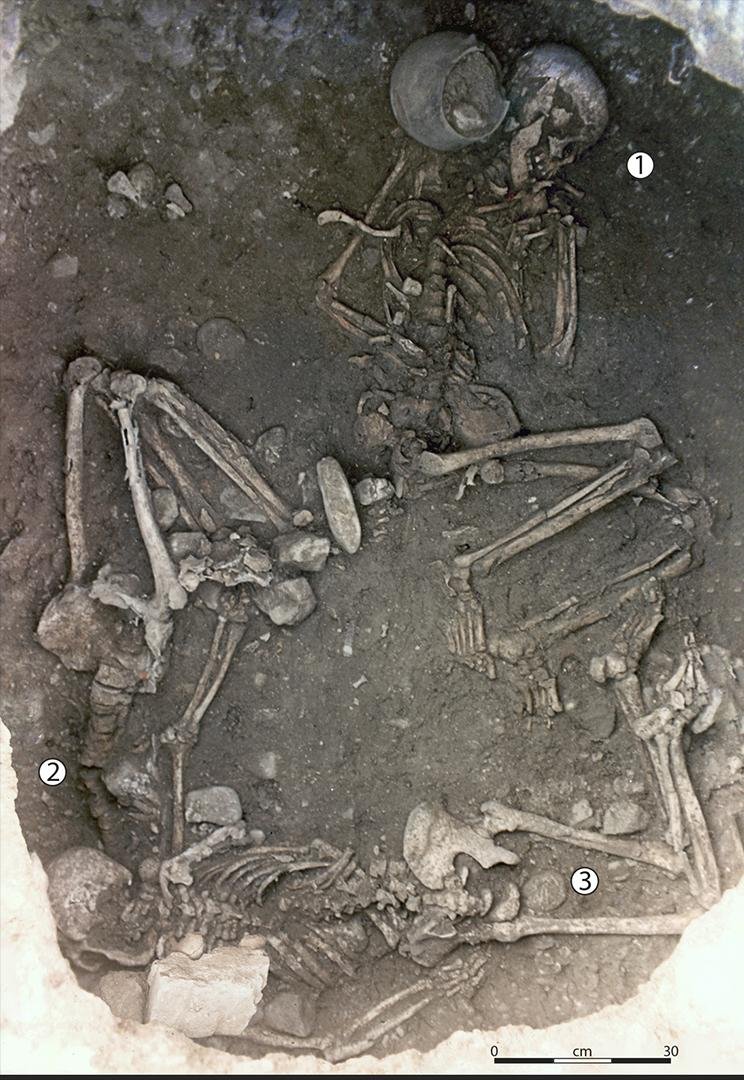
The victims, believed to have been deliberately killed, were bound in the incaprettamento manner before being buried, likely while still alive. The positioning of the victims, with two women buried in a prone position under the overhang of the tomb and a third centrally positioned, suggests a ritualized form of homicidal strangulation. Moreover, heavy grinding stones found at the site indicate that despite being bound, the victims were likely alive when buried.

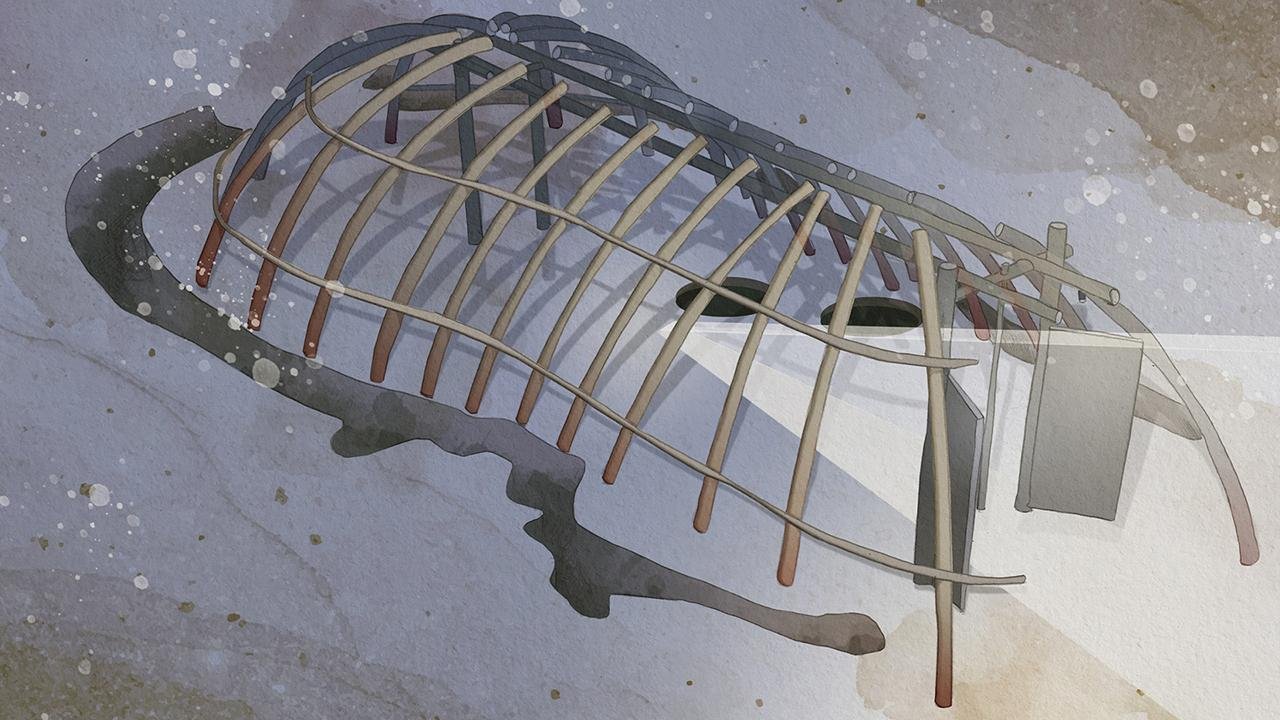
Study Suggests Neolithic women in Europe were tied up and buried alive in ritual sacrifices
Reconstruction of the area surrounding pits 69 and 70. The tomb containing the three skeletons was built in the style of a silo, or pit for storing grain, within a small wooden structure and surrounded by a trench. Credit: Ludes et al., Science Advances 2024

This gruesome practice of incaprettamento appears to have been widespread across Neolithic Europe, with evidence found at 14 sites spanning from the Czech Republic to Spain. The earliest known occurrence dates back to around 5400 BCE, while the latest discovery at Saint-Paul-Trois-Châteaux suggests that the practice persisted for over two millennia.

RelatedStories

Archaeologists reveal 7,000 years of continuous human activity at future airport site in Poland

Archaeologists reveal 7,000 years of continuous human activity at future airport site in Poland

December 4, 2025
6,000-year-old Neolithic shell trumpets uncovered in Catalonia reveal powerful long-distance sound technology

6,000-year-old Neolithic shell trumpets uncovered in Catalonia reveal powerful long-distance sound technology

December 3, 2025

The study also highlights the presence of agricultural symbolism surrounding the tomb, indicating a possible connection to farming practices during the Neolithic period. According to Crubézy, the ritual might have originated as a sacrificial custom before the advent of agriculture and later became associated with agricultural rituals.
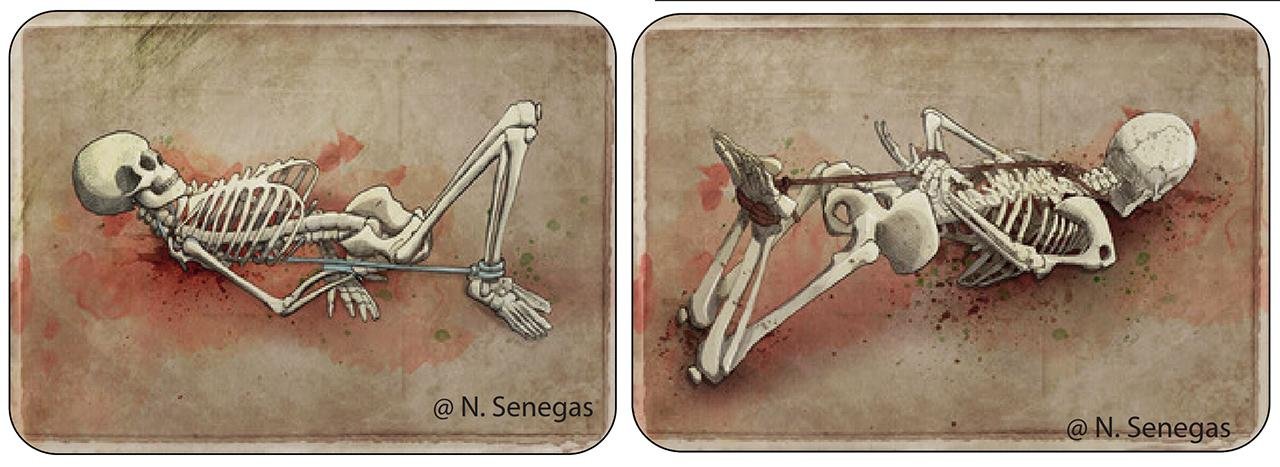
Study Suggests Neolithic women in Europe were tied up and buried alive in ritual sacrifices
The reconstructions correspond to the position of the skeleton before decomposition in two models of homicidal ligature strangulation based on recent forensic cases. Credit: Ludes et al., Science Advances 2024

While the motivations behind these sacrificial killings remain unclear, researchers speculate that the method of incaprettamento may have been used to create the illusion of self-inflicted strangulation.
Further research is needed to fully understand the significance of these sacrificial murders and their connection to the development of agriculture during the Neolithic period.
More information: Ludes, B., Alcouffe, A., Tupikova, I., Gérard, P., Tchérémissinoff, Y., Ribéron, A., … Crubézy, E. (2024). A ritual murder shaped the Early and Middle Neolithic across Central and Southern Europe. Science Advances, 10(15). doi:10.1126/sciadv.adl3374
Share4Tweet3Share1ShareSend

You May Also Like...

Ketton mosaic in Rutland reveals rare Aeschylean Trojan War scenes in late Roman Britain
Archaeology

Ketton mosaic in Rutland reveals rare Aeschylean Trojan War scenes in late Roman Britain

December 5, 2025
Denmark’s earliest iron weapons discovered: gold-plated lances unearthed at sacred Bronze Age site
Archaeology

Denmark’s earliest iron weapons discovered: gold-plated lances unearthed at sacred Bronze Age site

December 5, 2025
Oldest mule in western Europe found in an Iron Age Iberian burial site, revealing equid hybridization
Archaeology

Oldest mule in western Europe found in an Iron Age Iberian burial site, revealing equid hybridization

December 4, 2025
Archaeologists reveal 7,000 years of continuous human activity at future airport site in Poland
Archaeology

Archaeologists reveal 7,000 years of continuous human activity at future airport site in Poland

December 4, 2025
Early humans ate processed plant foods long before farming, new study shows
Archaeology

Early humans ate processed plant foods long before farming, new study shows

December 3, 2025
We built a database of 290,000 English medieval soldiers – here’s what it reveals
Archaeology

We built a database of 290,000 English medieval soldiers – here’s what it reveals

December 3, 2025

Follow us


Instagram
245K

Facebook
117K

Threads
45K

LinkedIn
14K

Twitter
6K

YouTube
1K
  • Trending
  • Comments
  • Latest
Shipwreck Salvage. Credit: rawpixel.com / Public Domain

2,000-year-old shipwreck discovered off Turkish coast with remarkably preserved stacked ceramics

July 2, 2025
Viking age DNA reveals 9,000-year-old HIV-resistant gene originating near the Black Sea

Viking age DNA reveals 9,000-year-old HIV-resistant gene originating near the Black Sea

May 18, 2025
Complete copy of the Canopus Decree unearthed in Egypt after 150 years

Complete copy of the Canopus Decree unearthed in Egypt after 150 years

September 13, 2025
Mystery of Armenia’s 6,000-year-old dragon stones solved

Mystery of Armenia’s 6,000-year-old dragon stones solved

September 23, 2025
Moses may be named in ancient Egyptian mine inscriptions, sparking debate over earliest biblical references

Moses may be named in ancient Egyptian mine inscriptions, sparking debate over earliest biblical references

July 31, 2025
3D analysis reveals Shroud of Turin image likely came from sculpture, not Jesus’ body

3D analysis reveals Shroud of Turin image likely came from sculpture, not Jesus’ body

Moses may be named in ancient Egyptian mine inscriptions, sparking debate over earliest biblical references

Moses may be named in ancient Egyptian mine inscriptions, sparking debate over earliest biblical references

$1 million prize offered to decipher 5,300-year-old Indus Valley script

$1 million prize offered to decipher 5,300-year-old Indus Valley script

Oldest ever genetic data from a human relative found in 2-million-year-old fossilized teeth

Oldest ever genetic data from a human relative found in 2-million-year-old fossilized teeth

Exceptionally large Roman shoes discovered at Magna fort near Hadrian’s Wall

Exceptionally large Roman shoes discovered at Magna fort near Hadrian’s Wall

Ketton mosaic in Rutland reveals rare Aeschylean Trojan War scenes in late Roman Britain

Ketton mosaic in Rutland reveals rare Aeschylean Trojan War scenes in late Roman Britain

December 5, 2025
Denmark’s earliest iron weapons discovered: gold-plated lances unearthed at sacred Bronze Age site

Denmark’s earliest iron weapons discovered: gold-plated lances unearthed at sacred Bronze Age site

December 5, 2025
Oldest mule in western Europe found in an Iron Age Iberian burial site, revealing equid hybridization

Oldest mule in western Europe found in an Iron Age Iberian burial site, revealing equid hybridization

December 4, 2025
Archaeologists reveal 7,000 years of continuous human activity at future airport site in Poland

Archaeologists reveal 7,000 years of continuous human activity at future airport site in Poland

December 4, 2025
Early humans ate processed plant foods long before farming, new study shows

Early humans ate processed plant foods long before farming, new study shows

December 3, 2025

Archaeology News online magazine

Archaeology News is an international online magazine that covers all aspects of archaeology.


Categories

  • Academics
    • Books
    • Conferences
    • Universities
  • Articles
  • Download
  • Game
  • News
    • Anthropology
    • Archaeology
    • Paleontology
  • Quiz
  • Tours

Subscribe to our newsletter

© 2024 - Archaeology News Online Magazine. All Rights Reserved.

  • About
  • Privacy Policy
  • Terms of Use
  • Donation
  • Contact

Welcome Back!

Login to your account below

Forgotten Password? Sign Up

Create New Account!

Fill the forms below to register

All fields are required. Log In

Retrieve your password

Please enter your username or email address to reset your password.

Log In

Add New Playlist

Manage Consent
To provide the best experiences, we use technologies like cookies to store and/or access device information. Consenting to these technologies will allow us to process data such as browsing behavior or unique IDs on this site. Not consenting or withdrawing consent, may adversely affect certain features and functions.
Functional Always active
The technical storage or access is strictly necessary for the legitimate purpose of enabling the use of a specific service explicitly requested by the subscriber or user, or for the sole purpose of carrying out the transmission of a communication over an electronic communications network.
Preferences
The technical storage or access is necessary for the legitimate purpose of storing preferences that are not requested by the subscriber or user.
Statistics
The technical storage or access that is used exclusively for statistical purposes. The technical storage or access that is used exclusively for anonymous statistical purposes. Without a subpoena, voluntary compliance on the part of your Internet Service Provider, or additional records from a third party, information stored or retrieved for this purpose alone cannot usually be used to identify you.
Marketing
The technical storage or access is required to create user profiles to send advertising, or to track the user on a website or across several websites for similar marketing purposes.
  • Manage options
  • Manage services
  • Manage {vendor_count} vendors
  • Read more about these purposes
View preferences
  • {title}
  • {title}
  • {title}
  • Home
  • News
    • Archaeology
    • Anthropology
    • Paleontology
  • Academic
    • Books
    • Conferences
    • Universities
  • Articles
  • VR Tours
  • Quiz & Game
  • Download
  • Encyclopedia
  • Forum

About  .  Contact  .  Donation

© 2024 - Archaeology News Online Magazine. All Rights Reserved