• About
  • Privacy Policy
  • Terms of Use
  • Donation
  • Contact
No Result
View All Result
Archaeology News
  • Home
  • News
    • Archaeology
    • Anthropology
    • Paleontology
  • Academic
    • Books
    • Conferences
    • Universities
  • Articles
  • VR Tours
  • Quiz & Game
  • Download
  • Encyclopedia
  • Forum
Archaeology News
No Result
View All Result
Home News Anthropology

6,800-year-old burial of Neolithic mayor uncovered in Germany

by Dario Radley
May 24, 2024

Archaeologists in Eichendorf, Germany, have unearthed a 6,800-year-old skeleton accompanied by an array of grave goods, suggesting that the individual was a prominent figure in their community.
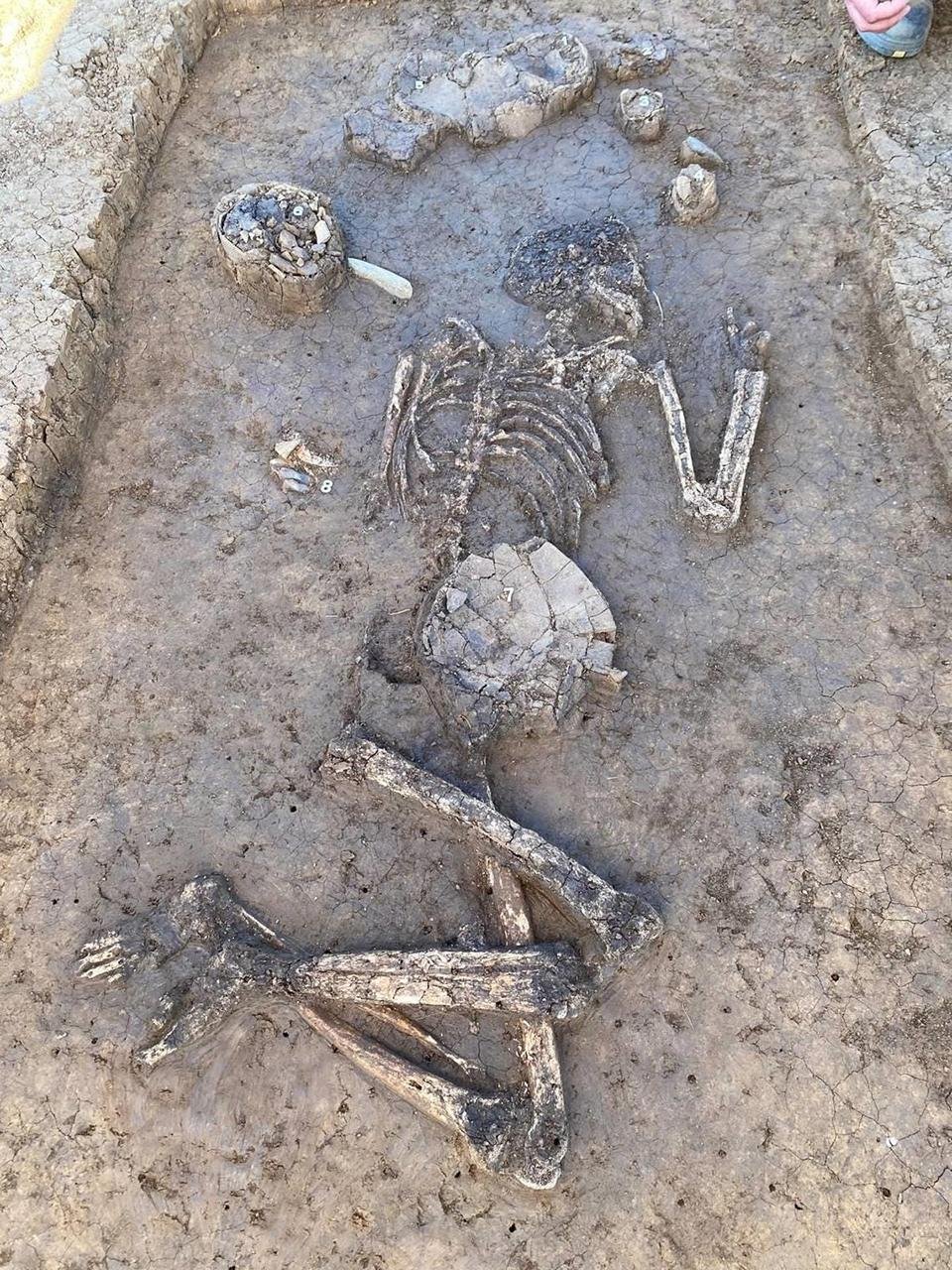
6,800-year-old burial of Neolithic mayor uncovered in Germany
A 6,800-year-old skeleton from the neolithic era was discovered in Germany. Credit: Dingolfing-Landau District

The skeleton, now referred to as the “Exinger,” was found in the district of Exing, a part of the town of Eichendorf, during routine archaeological checks prior to a construction project.

The finding was announced by district archaeologist Florian Eibl. The excavation, which began in mid-April 2024, revealed a grave filled with pottery, stone tools, and a distinctive boar’s tooth halved and used as decoration for a small bag. This bag likely contained flint and pyrite used for making fire, underscoring the individual’s high status and possibly his role as a village leader or a chieftain, a figure akin to a modern-day mayor.

The grave goods included a personal drinking vessel placed in front of the skeleton’s face, several stone blades positioned around the body, and a bowl of graphite, which was used as a dye during burial rites. The presence of these items suggests the deceased was a person of considerable importance and respect within the Neolithic society.
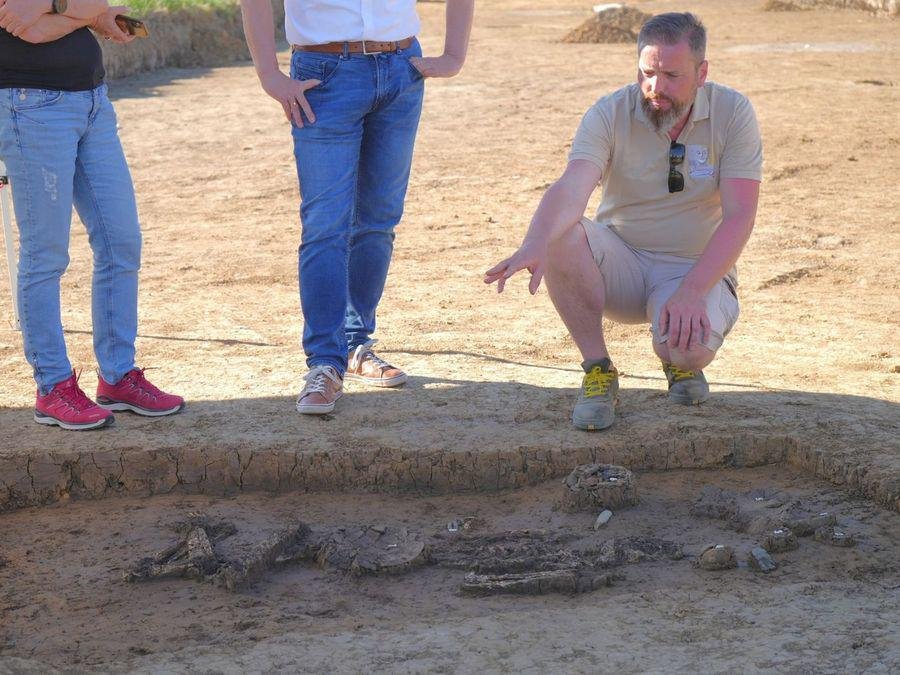
6,800-year-old burial of Neolithic mayor uncovered in Germany
Dingolfing-Landau district archaeologist Florian Eibl beside the skeleton. Credit: Dingolfing-Landau District

Eibl explained to German outlet Der Spiegel that the split boar’s tooth symbolized status due to the peril involved in hunting wild boars with rudimentary weapons of the time. The inclusion of these items, along with a large amount of pottery—about four times the usual quantity found in graves from this period—indicates that the individual had achieved their status through personal accomplishments rather than inheritance.

RelatedStories

Neolithic study finds gender roles in Europe were distinct yet remarkably flexible

Neolithic study finds gender roles in Europe were distinct yet remarkably flexible

February 17, 2026
DNA study reveals 3,000 years of genetic stability in Europe’s Low Countries before Bell Beaker expansion

DNA study reveals 3,000 years of genetic stability in Europe’s Low Countries before Bell Beaker expansion

February 16, 2026

Anthropologist Chiara Girotto, who examined the remains, estimated that the man was approximately 1.70 meters tall, an unusually tall stature for that era. Despite the good preservation of the skeleton, determining the exact age at death has been challenging due to its fragile condition. However, the grave goods imply that the man was middle-aged, as such status was typically earned through years of experience and leadership.

The body was buried in a crouching position, a form of burial that was uncommon for the period, making this discovery even more exceptional. The vessels placed around the head, though yet to be thoroughly analyzed, may still contain traces of their original contents.

6,800-year-old burial of Neolithic mayor uncovered in Germany
The site also yielded gold jewelry artifacts. Credit: Dingolfing-Landau District

The area around Eichendorf, particularly the village of Exing, has been a focal point for archaeological interest due to its rich history of human settlement. Florian Eibl noted that the region has been significant since the Neolithic period, with settlements active from around 10,000 years ago until 2,000 BCE. The discovery of the Exinger adds a valuable piece to the puzzle of understanding early European societies.
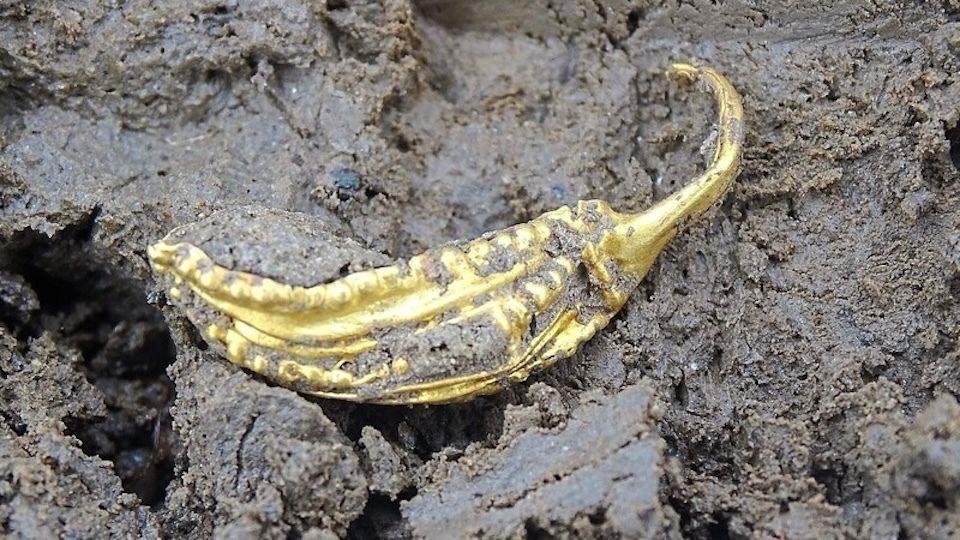
The rich archaeological findings in Exing, including gold jewelry from various periods, suggest that the area was an important cultural and economic center throughout the Neolithic, Copper, and Bronze Ages. Eibl emphasized that the Neolithic period was a time of significant societal development.

This grave is considered one of the best-preserved Neolithic sites in Lower Bavaria, with only ten other sets of remains discovered among 28 burial sites in the region. Further analysis of the skeleton and the grave goods will continue, with researchers employing photogrammetry to create a detailed 3D model of the burial site. This technique, which involves stitching together multiple digital images, will help archaeologists and historians better understand the burial practices and daily life of the Neolithic people in this region.

The Exinger’s grave, being approximately 1,500 years older than the famous Ötzi the Iceman, provides a new point of reference for studying early European human history.
Share2Tweet1ShareShareSend

You May Also Like...

New study reveals how Londoners used weekly death data to Survive the Great Plague of 1665
Archaeology

New study reveals how Londoners used weekly death data to survive the Great Plague of 1665

February 18, 2026
3D metrological analysis connects dispersed Egyptian artifacts and recovers their lost histories
Archaeology

3D metrological analysis connects dispersed Egyptian artifacts and recovers their lost histories

February 17, 2026
Neolithic study finds gender roles in Europe were distinct yet remarkably flexible
Anthropology

Neolithic study finds gender roles in Europe were distinct yet remarkably flexible

February 17, 2026
Chalcolithic cornets at Teleilat Ghassul reveal ritual lamp use in Jordan’s prehistoric communities
Archaeology

Chalcolithic cornets at Teleilat Ghassul reveal ritual lamp use in Jordan’s prehistoric communities

February 16, 2026
DNA study reveals 3,000 years of genetic stability in Europe’s Low Countries before Bell Beaker expansion
Anthropology

DNA study reveals 3,000 years of genetic stability in Europe’s Low Countries before Bell Beaker expansion

February 16, 2026
Second Temple period stone vessel workshop unearthed on Mount Scopus after antiquities theft arrests
Archaeology

Second Temple period stone vessel workshop unearthed on Mount Scopus after antiquities theft arrests

February 16, 2026

Follow us


Instagram
244K

Facebook
118K

Threads
45K

LinkedIn
14K

Twitter
6K

YouTube
1K
  • Trending
  • Comments
  • Latest
Shipwreck Salvage. Credit: rawpixel.com / Public Domain

2,000-year-old shipwreck discovered off Turkish coast with remarkably preserved stacked ceramics

July 2, 2025
Viking age DNA reveals 9,000-year-old HIV-resistant gene originating near the Black Sea

Viking age DNA reveals 9,000-year-old HIV-resistant gene originating near the Black Sea

May 18, 2025
A new study suggests the mysterious Voynich Manuscript may be a medieval cipher

A new study suggests the mysterious Voynich Manuscript may be a medieval cipher

January 3, 2026
Moses may be named in ancient Egyptian mine inscriptions, sparking debate over earliest biblical references

Moses may be named in ancient Egyptian mine inscriptions, sparking debate over earliest biblical references

July 31, 2025
Mystery of Armenia’s 6,000-year-old dragon stones solved

Mystery of Armenia’s 6,000-year-old dragon stones solved

September 23, 2025
3D analysis reveals Shroud of Turin image likely came from sculpture, not Jesus’ body

3D analysis reveals Shroud of Turin image likely came from sculpture, not Jesus’ body

Moses may be named in ancient Egyptian mine inscriptions, sparking debate over earliest biblical references

Moses may be named in ancient Egyptian mine inscriptions, sparking debate over earliest biblical references

$1 million prize offered to decipher 5,300-year-old Indus Valley script

$1 million prize offered to decipher 5,300-year-old Indus Valley script

Oldest ever genetic data from a human relative found in 2-million-year-old fossilized teeth

Oldest ever genetic data from a human relative found in 2-million-year-old fossilized teeth

Exceptionally large Roman shoes discovered at Magna fort near Hadrian’s Wall

Exceptionally large Roman shoes discovered at Magna fort near Hadrian’s Wall

New study reveals how Londoners used weekly death data to Survive the Great Plague of 1665

New study reveals how Londoners used weekly death data to survive the Great Plague of 1665

February 18, 2026
3D metrological analysis connects dispersed Egyptian artifacts and recovers their lost histories

3D metrological analysis connects dispersed Egyptian artifacts and recovers their lost histories

February 17, 2026
Neolithic study finds gender roles in Europe were distinct yet remarkably flexible

Neolithic study finds gender roles in Europe were distinct yet remarkably flexible

February 17, 2026
Chalcolithic cornets at Teleilat Ghassul reveal ritual lamp use in Jordan’s prehistoric communities

Chalcolithic cornets at Teleilat Ghassul reveal ritual lamp use in Jordan’s prehistoric communities

February 16, 2026
DNA study reveals 3,000 years of genetic stability in Europe’s Low Countries before Bell Beaker expansion

DNA study reveals 3,000 years of genetic stability in Europe’s Low Countries before Bell Beaker expansion

February 16, 2026

Archaeology News online magazine

Archaeology News is an international online magazine that covers all aspects of archaeology.


Categories

  • Academics
    • Books
    • Conferences
    • Universities
  • Articles
  • Download
  • Game
  • News
    • Anthropology
    • Archaeology
    • Paleontology
  • Quiz
  • Tours

Subscribe to our newsletter

© 2024 - Archaeology News Online Magazine. All Rights Reserved.

  • About
  • Privacy Policy
  • Terms of Use
  • Donation
  • Contact

Manage Consent
To provide the best experiences, we use technologies like cookies to store and/or access device information. Consenting to these technologies will allow us to process data such as browsing behavior or unique IDs on this site. Not consenting or withdrawing consent, may adversely affect certain features and functions.
Functional Always active
The technical storage or access is strictly necessary for the legitimate purpose of enabling the use of a specific service explicitly requested by the subscriber or user, or for the sole purpose of carrying out the transmission of a communication over an electronic communications network.
Preferences
The technical storage or access is necessary for the legitimate purpose of storing preferences that are not requested by the subscriber or user.
Statistics
The technical storage or access that is used exclusively for statistical purposes. The technical storage or access that is used exclusively for anonymous statistical purposes. Without a subpoena, voluntary compliance on the part of your Internet Service Provider, or additional records from a third party, information stored or retrieved for this purpose alone cannot usually be used to identify you.
Marketing
The technical storage or access is required to create user profiles to send advertising, or to track the user on a website or across several websites for similar marketing purposes.
  • Manage options
  • Manage services
  • Manage {vendor_count} vendors
  • Read more about these purposes
View preferences
  • {title}
  • {title}
  • {title}
  • Home
  • News
    • Archaeology
    • Anthropology
    • Paleontology
  • Academic
    • Books
    • Conferences
    • Universities
  • Articles
  • VR Tours
  • Quiz & Game
  • Download
  • Encyclopedia
  • Forum

About  .  Contact  .  Donation

© 2024 - Archaeology News Online Magazine. All Rights Reserved