• About
  • Privacy Policy
  • Terms of Use
  • Donation
  • Contact
No Result
View All Result
Archaeology News
  • Home
  • News
    • Archaeology
    • Anthropology
    • Paleontology
  • Academics
    • Books
    • Conferences
    • Universities
  • Articles
  • VR Tours
  • Quiz & Game
  • Download
  • Encyclopedia
  • Forum
Archaeology News
No Result
View All Result
Home News Archaeology

Ritual pit uncovered at Solnitsata, Bulgaria’s prehistoric salt production center

by Dario Radley
September 20, 2024

Archaeologists have uncovered a significant ritual pit filled with ceremonial objects during ongoing excavations at the prehistoric salt production center known as Solnitsata, near the town of Provadia in Bulgaria’s Varna region. This ancient settlement, believed to be the oldest town in Europe, dates back to around 5600 BCE and was a major center for salt production in the Balkans during the Chalcolithic (Copper Age) period.
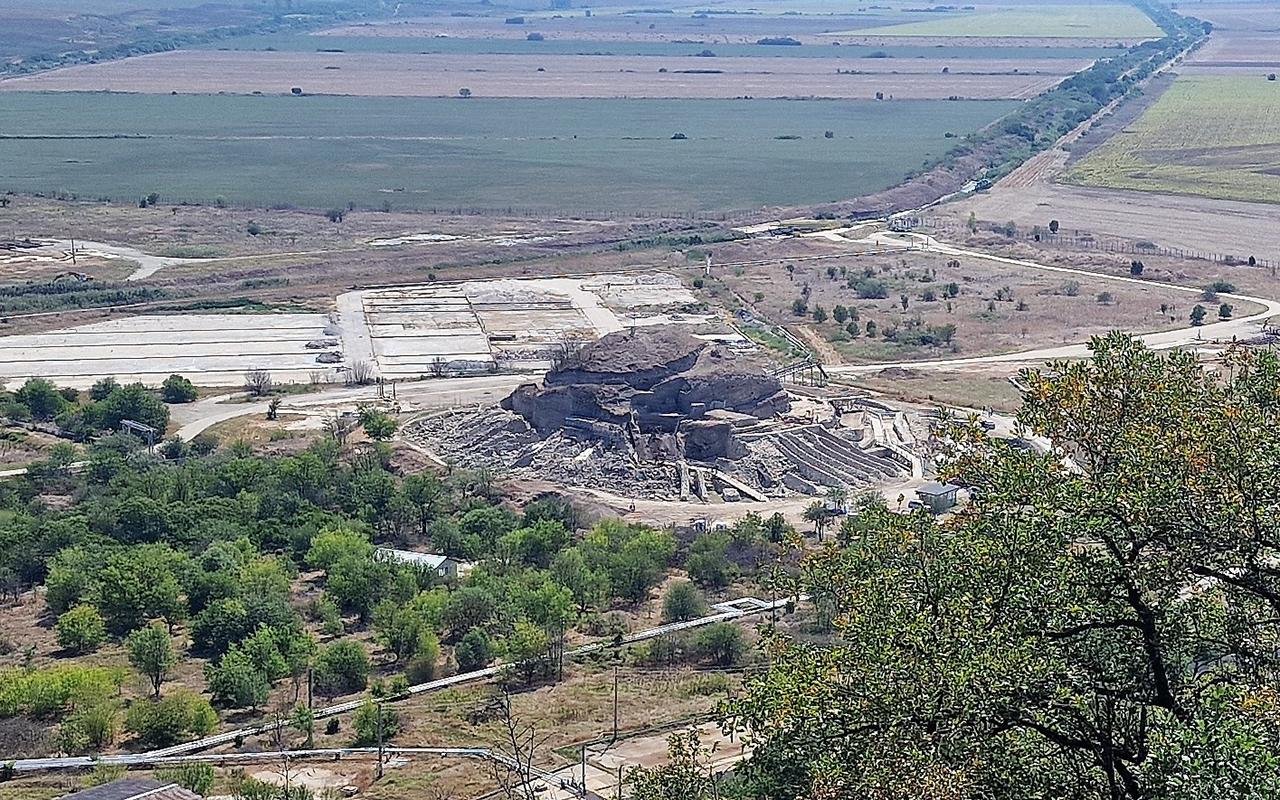
Ritual pit uncovered at Solnitsata, Bulgaria’s prehistoric salt production center
Site of Solnitsata. Credit: Pl71, CC BY-SA 4.0

Solnitsata, which means “The Saltworks,” derived its prosperity from its advanced salt production methods. Salt was an invaluable commodity at the time, and the settlement exported it across the region. The inhabitants collected brine from nearby salt springs, which was placed in ceramic jars. These jars were heated by fires, causing the brine to boil and leaving behind a semi-dry layer of salt. Over time, the process became more efficient, with dedicated furnaces enabling the production of up to 30 kilograms of salt from a single batch. This salt not only sustained the settlement’s economy but also made it a prominent trading hub.

The discovery of the ritual pit, which dates to the Late Chalcolithic period, was reported by the head of the excavation, Academician Vasil Nikolov. He noted that the pit, likely created around 4,350 BCE, contains significant ceremonial items, including a well-preserved zoomorphic ceramic vessel shaped like a bull. According to Nikolov, bulls symbolized male strength and fertility in European Neolithic and Chalcolithic cultures, and the vessel was probably used to hold liquid for ritual purposes. “Only a few such vessels have been found in the country, but this one has the finest craftsmanship I’ve ever seen,” Nikolov told reporters.

The pit also contained anthropomorphic figurines, geometric-patterned vessels, and various objects made from bone and ceramics. Nikolov highlighted that this is the first pit of its kind discovered at the site, and further investigations are ongoing to understand its full significance.

In addition to the ritual pit, archaeologists have been studying other parts of the settlement, uncovering evidence of its advanced infrastructure and wealth. This year’s research has revealed the remains of several multi-story houses, which were likely used both for living and storing salt. “It is still unclear how the ancients built two- and three-story houses, but no single-story house has been found at the site,” Nikolov said.

RelatedStories
Hellenistic-era Thracian warrior tomb unearthed in southern Bulgaria (The 2nd-century BCE burial of a Thracian warrior and his horse. Credit: Municipality of Topolovgrad)

Hellenistic-era Thracian warrior tomb unearthed in southern Bulgaria

August 7, 2025
Copper Age infant discovered in Italian well reveals rare genetic origins

Copper Age infant discovered in Italian well reveals rare genetic origins

July 6, 2025

The settlement, however, faced a decline after a series of devastating earthquakes, which damaged its fortifications and disrupted its salt production. Despite this, the site remained significant, with later occupations by Thracians and other cultures. Among the recent discoveries is a part of a Thracian ruler’s house, dating from centuries after Solnitsata’s peak, further showing the site’s long-term importance.

Nikolov emphasized the need for greater recognition of Solnitsata’s historical significance. “The prehistoric salt production center here is not only one of the oldest in Europe, but the stone walls of this settlement were built two millennia before the pyramids in Egypt,” he said, advocating for more state support to promote the site.

The site has been dubbed Europe’s first “mint,” as salt was the most valuable resource at the time, much like gold or currency in later eras.


Share1Tweet1ShareShareSend

You May Also Like...

Human hair khipus reveal Inca record-keeping was used by both elites and commoners
Archaeology

Human hair khipus reveal Inca record-keeping was used by both elites and commoners

August 19, 2025
Genetic mutation in key enzyme may explain why humans survived while Neanderthals went extinct
Anthropology

Genetic mutation in key enzyme may explain why humans survived while Neanderthals went extinct

August 19, 2025
Ancient human relatives transported stones 2.6 million years ago, rewriting human history
Anthropology

Ancient human relatives transported stones 2.6 million years ago, rewriting human history

August 17, 2025
3,000-year-old hymn reveals musical links across Bronze Age civilizations from India to the Mediterranean
Archaeology

3,000-year-old hymn reveals musical links across Bronze Age civilizations from India to the Mediterranean

August 16, 2025
First confirmed artifacts from Emperor Nintoku’s 5th-century tomb in Japan
Archaeology

First confirmed artifacts from Emperor Nintoku’s 5th-century tomb in Japan

August 16, 2025
40,000 Celtic artifacts and rare bronze warrior figurine unearthed at Manching in Bavaria
Archaeology

40,000 Celtic artifacts and rare bronze warrior figurine unearthed at Manching in Bavaria

August 16, 2025

Follow us


Instagram
246K

Facebook
113K

Threads
44K

LinkedIn
13K

Twitter
6K

YouTube
1K
  • Trending
  • Comments
  • Latest
Shipwreck Salvage. Credit: rawpixel.com / Public Domain

2,000-year-old shipwreck discovered off Turkish coast with remarkably preserved stacked ceramics

July 2, 2025
Viking age DNA reveals 9,000-year-old HIV-resistant gene originating near the Black Sea

Viking age DNA reveals 9,000-year-old HIV-resistant gene originating near the Black Sea

May 18, 2025
Mad emperor Caligula had surprising medical knowledge, new research reveals from ancient Roman texts

Mad emperor Caligula had surprising medical knowledge, new research reveals from ancient Roman texts

July 13, 2025
Moses may be named in ancient Egyptian mine inscriptions, sparking debate over earliest biblical references

Moses may be named in ancient Egyptian mine inscriptions, sparking debate over earliest biblical references

July 31, 2025
600-year-old amethyst jewel found in Polish castle moat reveals secrets of medieval nobility

600-year-old amethyst jewel found in Polish castle moat reveals secrets of medieval nobility

July 21, 2025
$1 million prize offered to decipher 5,300-year-old Indus Valley script

$1 million prize offered to decipher 5,300-year-old Indus Valley script

Moses may be named in ancient Egyptian mine inscriptions, sparking debate over earliest biblical references

Moses may be named in ancient Egyptian mine inscriptions, sparking debate over earliest biblical references

Oldest ever genetic data from a human relative found in 2-million-year-old fossilized teeth

Oldest ever genetic data from a human relative found in 2-million-year-old fossilized teeth

Exceptionally large Roman shoes discovered at Magna fort near Hadrian’s Wall

Exceptionally large Roman shoes discovered at Magna fort near Hadrian’s Wall

3D analysis reveals Shroud of Turin image likely came from sculpture, not Jesus’ body

3D analysis reveals Shroud of Turin image likely came from sculpture, not Jesus’ body

Human hair khipus reveal Inca record-keeping was used by both elites and commoners

Human hair khipus reveal Inca record-keeping was used by both elites and commoners

August 19, 2025
Genetic mutation in key enzyme may explain why humans survived while Neanderthals went extinct

Genetic mutation in key enzyme may explain why humans survived while Neanderthals went extinct

August 19, 2025
Ancient human relatives transported stones 2.6 million years ago, rewriting human history

Ancient human relatives transported stones 2.6 million years ago, rewriting human history

August 17, 2025
3,000-year-old hymn reveals musical links across Bronze Age civilizations from India to the Mediterranean

3,000-year-old hymn reveals musical links across Bronze Age civilizations from India to the Mediterranean

August 16, 2025
First confirmed artifacts from Emperor Nintoku’s 5th-century tomb in Japan

First confirmed artifacts from Emperor Nintoku’s 5th-century tomb in Japan

August 16, 2025

Archaeology News online magazine

Archaeology News is an international online magazine that covers all aspects of archaeology.


Categories

  • Academics
    • Books
    • Conferences
    • Universities
  • Articles
  • Download
  • Game
  • News
    • Anthropology
    • Archaeology
    • Paleontology
  • Quiz
  • Tours

Subscribe to our newsletter

© 2024 - Archaeology News Online Magazine. All Rights Reserved.

  • About
  • Privacy Policy
  • Terms of Use
  • Donation
  • Contact

Welcome Back!

Login to your account below

Forgotten Password? Sign Up

Create New Account!

Fill the forms below to register

All fields are required. Log In

Retrieve your password

Please enter your username or email address to reset your password.

Log In

Add New Playlist

Manage Consent
To provide the best experiences, we use technologies like cookies to store and/or access device information. Consenting to these technologies will allow us to process data such as browsing behavior or unique IDs on this site. Not consenting or withdrawing consent, may adversely affect certain features and functions.
Functional Always active
The technical storage or access is strictly necessary for the legitimate purpose of enabling the use of a specific service explicitly requested by the subscriber or user, or for the sole purpose of carrying out the transmission of a communication over an electronic communications network.
Preferences
The technical storage or access is necessary for the legitimate purpose of storing preferences that are not requested by the subscriber or user.
Statistics
The technical storage or access that is used exclusively for statistical purposes. The technical storage or access that is used exclusively for anonymous statistical purposes. Without a subpoena, voluntary compliance on the part of your Internet Service Provider, or additional records from a third party, information stored or retrieved for this purpose alone cannot usually be used to identify you.
Marketing
The technical storage or access is required to create user profiles to send advertising, or to track the user on a website or across several websites for similar marketing purposes.
Manage options Manage services Manage {vendor_count} vendors Read more about these purposes
View preferences
{title} {title} {title}
  • Home
  • News
    • Archaeology
    • Anthropology
    • Paleontology
  • Academics
    • Books
    • Conferences
    • Universities
  • Articles
  • VR Tours
  • Quiz & Game
  • Download
  • Encyclopedia
  • Forum

About  .  Contact  .  Donation

© 2024 - Archaeology News Online Magazine. All Rights Reserved