• About
  • Privacy Policy
  • Terms of Use
  • Donation
  • Contact
No Result
View All Result
Archaeology News
  • Home
  • News
    • Archaeology
    • Anthropology
    • Paleontology
  • Academic
    • Books
    • Conferences
    • Universities
  • Articles
  • VR Tours
  • Quiz & Game
  • Download
  • Encyclopedia
  • Forum
Archaeology News
No Result
View All Result
Home News Archaeology

‘House of life’ filled with educational artifacts discovered at the Ramesseum in Luxor

by Dario Radley
April 5, 2025

A joint Egyptian-French team has uncovered new archaeological finds at the Ramesseum—the imposing mortuary temple of Pharaoh Ramesses II—on the West Bank of Luxor in the Theban Necropolis. The team, composed of experts from Egypt’s Supreme Council of Antiquities and the National Center for Scientific Research of France, and Sorbonne University.

‘House of life’ filled with educational artifacts discovered at the Ramesseum in Luxor
Objects discovered in the Ramesseum. Credit: Courtesy of the Ministry of Tourism and Antiquities

Built during the reign of Ramesses II, also called “Ramesses the Great,” the Ramesseum was not only a monument to the legacy of the pharaoh but also a living center of religious, educational, administrative, and economic activity. This discovery has brought a change in scholars’ understanding of the way ancient Egyptians lived, worked, and organized their world, according to Mohamed Ismail Khaled, Secretary-General of the Supreme Council of Antiquities.

One of the most shocking revelations is the discovery of a House of Life—or Per Ankh—within the temple grounds. This institution was a temple-school or knowledge center that Egyptologists have long theorized about but never before physically confirmed at the Ramesseum. During excavation, students’ drawings, fragments of educational toys, and remnants of ancient learning tools were uncovered. The design of the House of Life was also revealed. According to the researchers, the find constitutes the first material evidence for an educational institution directly associated with the temple, also known as the “Temple of Millions of Years.”
‘House of life’ filled with educational artifacts discovered at the Ramesseum in Luxor
Objects discovered in the Ramesseum. Credit: Courtesy of the Ministry of Tourism and Antiquities

Beyond education, the mission also uncovered widespread evidence of the temple’s economic infrastructure. Subterranean storerooms and cellars on the north side were revealed as storage areas for olive oil, honey, fat, and wine. Widespread wine jar labels unearthed in the area confirm its role as an active wine cellar. Excavators also documented textile and stone workshops, kitchens, and bakeries—painting a rich picture of an independent complex that not only served the temple staff but the wider community as well.

‘House of life’ filled with educational artifacts discovered at the Ramesseum in Luxor
Objects discovered in the Ramesseum. Credit: Courtesy of the Ministry of Tourism and Antiquities

The Ramesseum’s eastern sector revealed another side of temple life: administrative offices. These structures suggest a complex hierarchy of civil servants who managed the production and redistribution of goods.

RelatedStories

Old Kingdom tombs with 160 pottery vessels discovered at Qubbet el Hawa, Egypt

Old Kingdom tombs with 160 pottery vessels discovered at Qubbet el Hawa, Egypt

February 24, 2026
3D metrological analysis connects dispersed Egyptian artifacts and recovers their lost histories

3D metrological analysis connects dispersed Egyptian artifacts and recovers their lost histories

February 17, 2026

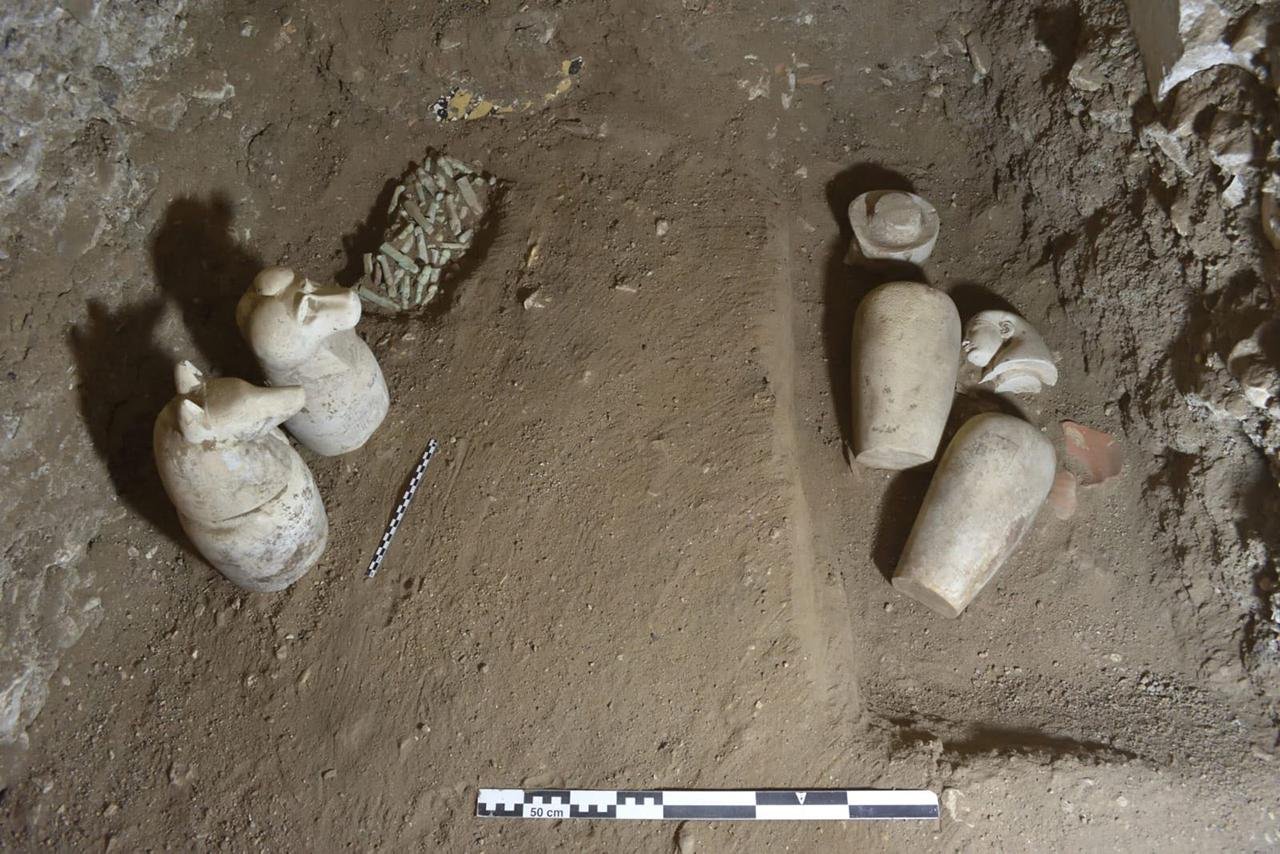
The northeast sector of the site produced a group of tombs dating to the Third Intermediate Period (1069–525 BCE). The tombs contain burial shafts, nested sarcophagi, canopic jars, funerary tools, and a total of 401 ceramic ushabti figurines. Human remains, scattered throughout the site, further confirm the temple’s function as a necropolis in later periods.

‘House of life’ filled with educational artifacts discovered at the Ramesseum in Luxor
Excavations also uncovered widespread evidence of the temple’s economic infrastructure. Credit: Courtesy of the Ministry of Tourism and Antiquities

Another major announcement was made by Egyptian archaeologist Hisham El-Leithy, who confirmed the re-excavation of the Middle Kingdom burial of Sehetep-ib-Re, originally found in 1896 by British archaeologist James Quibell. That burial contains well-preserved funerary art and adds yet another chronological layer to the use of the temple.

Restoration efforts also yielded results. In the temple’s southern sector, the team reconstructed the colossi of Ramesses II and his mother, Queen Tuya, and placed them in their original locations. The royal palace adjacent to the temple’s first courtyard has also been carefully restored, revealing its original throne room and reception hall, spaces likely used by the pharaoh when he visited on state visits.

The discoveries show the temple site was occupied even before Ramesses II’s reign and was reused by stonecutters during the Ptolemaic and Roman periods.

More information: Ministry of Tourism and Antiquities

Share8Tweet5Share1ShareSend

You May Also Like...

40,000-year-old European engravings reveal structured sign systems, study finds
Archaeology

40,000-year-old European engravings reveal structured sign systems, study finds

February 25, 2026
Iron Age mass killing in Serbia: 77 women and children found in 2,800-year-old grave at Gomolava
Anthropology

Iron Age mass killing in Serbia: 77 women and children found in 2,800-year-old grave at Gomolava

February 24, 2026
Old Kingdom tombs with 160 pottery vessels discovered at Qubbet el Hawa, Egypt
Archaeology

Old Kingdom tombs with 160 pottery vessels discovered at Qubbet el Hawa, Egypt

February 24, 2026
Genetic incompatibility between Homo sapiens and Neanderthals may have contributed to Neanderthal extinction
Anthropology

Did Preeclampsia contribute to Neanderthal extinction? new study explores a hidden reproductive risk

February 23, 2026
1,000-year-old elite tomb filled with gold uncovered at El Caño Archaeological Park in Panama
Anthropology

1,000-year-old elite tomb filled with gold uncovered at El Caño Archaeological Park in Panama

February 22, 2026
Ancient DNA reveals Golden Horde elites’ Mongolian roots and ties to Central Eurasian populations
Anthropology

Ancient DNA reveals Golden Horde elites’ Mongolian roots and ties to Central Eurasian populations

February 22, 2026

Follow us


Instagram
244K

Facebook
118K

Threads
45K

LinkedIn
14K

Twitter
6K

YouTube
1K
  • Trending
  • Comments
  • Latest
Shipwreck Salvage. Credit: rawpixel.com / Public Domain

2,000-year-old shipwreck discovered off Turkish coast with remarkably preserved stacked ceramics

July 2, 2025
Viking age DNA reveals 9,000-year-old HIV-resistant gene originating near the Black Sea

Viking age DNA reveals 9,000-year-old HIV-resistant gene originating near the Black Sea

May 18, 2025
A new study suggests the mysterious Voynich Manuscript may be a medieval cipher

A new study suggests the mysterious Voynich Manuscript may be a medieval cipher

January 3, 2026
Moses may be named in ancient Egyptian mine inscriptions, sparking debate over earliest biblical references

Moses may be named in ancient Egyptian mine inscriptions, sparking debate over earliest biblical references

July 31, 2025
Mystery of Armenia’s 6,000-year-old dragon stones solved

Mystery of Armenia’s 6,000-year-old dragon stones solved

September 23, 2025
3D analysis reveals Shroud of Turin image likely came from sculpture, not Jesus’ body

3D analysis reveals Shroud of Turin image likely came from sculpture, not Jesus’ body

Moses may be named in ancient Egyptian mine inscriptions, sparking debate over earliest biblical references

Moses may be named in ancient Egyptian mine inscriptions, sparking debate over earliest biblical references

$1 million prize offered to decipher 5,300-year-old Indus Valley script

$1 million prize offered to decipher 5,300-year-old Indus Valley script

Oldest ever genetic data from a human relative found in 2-million-year-old fossilized teeth

Oldest ever genetic data from a human relative found in 2-million-year-old fossilized teeth

Exceptionally large Roman shoes discovered at Magna fort near Hadrian’s Wall

Exceptionally large Roman shoes discovered at Magna fort near Hadrian’s Wall

40,000-year-old European engravings reveal structured sign systems, study finds

40,000-year-old European engravings reveal structured sign systems, study finds

February 25, 2026
Iron Age mass killing in Serbia: 77 women and children found in 2,800-year-old grave at Gomolava

Iron Age mass killing in Serbia: 77 women and children found in 2,800-year-old grave at Gomolava

February 24, 2026
Old Kingdom tombs with 160 pottery vessels discovered at Qubbet el Hawa, Egypt

Old Kingdom tombs with 160 pottery vessels discovered at Qubbet el Hawa, Egypt

February 24, 2026
Genetic incompatibility between Homo sapiens and Neanderthals may have contributed to Neanderthal extinction

Did Preeclampsia contribute to Neanderthal extinction? new study explores a hidden reproductive risk

February 23, 2026
1,000-year-old elite tomb filled with gold uncovered at El Caño Archaeological Park in Panama

1,000-year-old elite tomb filled with gold uncovered at El Caño Archaeological Park in Panama

February 22, 2026

Archaeology News online magazine

Archaeology News is an international online magazine that covers all aspects of archaeology.


Categories

  • Academics
    • Books
    • Conferences
    • Universities
  • Articles
  • Download
  • Game
  • News
    • Anthropology
    • Archaeology
    • Paleontology
  • Quiz
  • Tours

Subscribe to our newsletter

© 2024 - Archaeology News Online Magazine. All Rights Reserved.

  • About
  • Privacy Policy
  • Terms of Use
  • Donation
  • Contact

Manage Consent
To provide the best experiences, we use technologies like cookies to store and/or access device information. Consenting to these technologies will allow us to process data such as browsing behavior or unique IDs on this site. Not consenting or withdrawing consent, may adversely affect certain features and functions.
Functional Always active
The technical storage or access is strictly necessary for the legitimate purpose of enabling the use of a specific service explicitly requested by the subscriber or user, or for the sole purpose of carrying out the transmission of a communication over an electronic communications network.
Preferences
The technical storage or access is necessary for the legitimate purpose of storing preferences that are not requested by the subscriber or user.
Statistics
The technical storage or access that is used exclusively for statistical purposes. The technical storage or access that is used exclusively for anonymous statistical purposes. Without a subpoena, voluntary compliance on the part of your Internet Service Provider, or additional records from a third party, information stored or retrieved for this purpose alone cannot usually be used to identify you.
Marketing
The technical storage or access is required to create user profiles to send advertising, or to track the user on a website or across several websites for similar marketing purposes.
  • Manage options
  • Manage services
  • Manage {vendor_count} vendors
  • Read more about these purposes
View preferences
  • {title}
  • {title}
  • {title}
  • Home
  • News
    • Archaeology
    • Anthropology
    • Paleontology
  • Academic
    • Books
    • Conferences
    • Universities
  • Articles
  • VR Tours
  • Quiz & Game
  • Download
  • Encyclopedia
  • Forum

About  .  Contact  .  Donation

© 2024 - Archaeology News Online Magazine. All Rights Reserved