• About
  • Privacy Policy
  • Terms of Use
  • Donation
  • Contact
No Result
View All Result
Archaeology News
  • Home
  • News
    • Archaeology
    • Anthropology
    • Paleontology
  • Academic
    • Books
    • Conferences
    • Universities
  • Articles
  • VR Tours
  • Quiz & Game
  • Download
  • Encyclopedia
  • Forum
Archaeology News
No Result
View All Result
Home News Archaeology

Hidden fort, tree-lined road, and moat uncovered at ancient Egyptian fortress in the Sinai Desert

by Dario Radley
May 9, 2025

Archaeologists have uncovered breathtaking findings regarding an ancient Egyptian fort in the Sinai Desert north of Egypt, offering an unprecedented glimpse into the industrial and military activity that once thrived there over 2,000 years ago. Archaeological excavations at Tell Abu Saifi, Egypt’s long-time “Fortress of the East,” have revealed a sophisticated system of fortifications, a tree-lined limestone road, soldiers’ quarters, large lime kilns, and the possible remnants of a much older fort.

Hidden fort, tree-lined road, and moat uncovered at ancient Egyptian fortress in the Sinai Desert
This section reveals parts of the ancient fortress currently being excavated by archaeologists in Egypt’s Sinai Desert. Credit: Photo courtesy of the Egyptian Ministry of Tourism and Antiquities

The archaeological mission, conducted by Egypt’s Supreme Council of Antiquities, has focused on the site of two primary fortresses—one from the Ptolemaic period (circa 332–30 BCE) and the other from the Roman period (30 BCE–395 CE). Egypt’s Minister of Tourism and Antiquities, Sharif Fathi, said that the finds reveal the industrial and strategic importance of Tell Abu Saifi during various historical periods.

One of the most striking discoveries is a broad limestone-paved road, approximately 328 feet (100 meters) long and 36 feet (11 meters) wide, that led from the Roman fortress’s eastern gate deep into the heart of the site. According to archaeologists, this road was built atop an earlier Ptolemaic road and lined on both sides by over 500 planting circles. These circular structures likely held trees, so soldiers and commanders once passed along a shaded avenue as they approached the fortress—a rare architectural flourish in the Sinai Desert landscape.
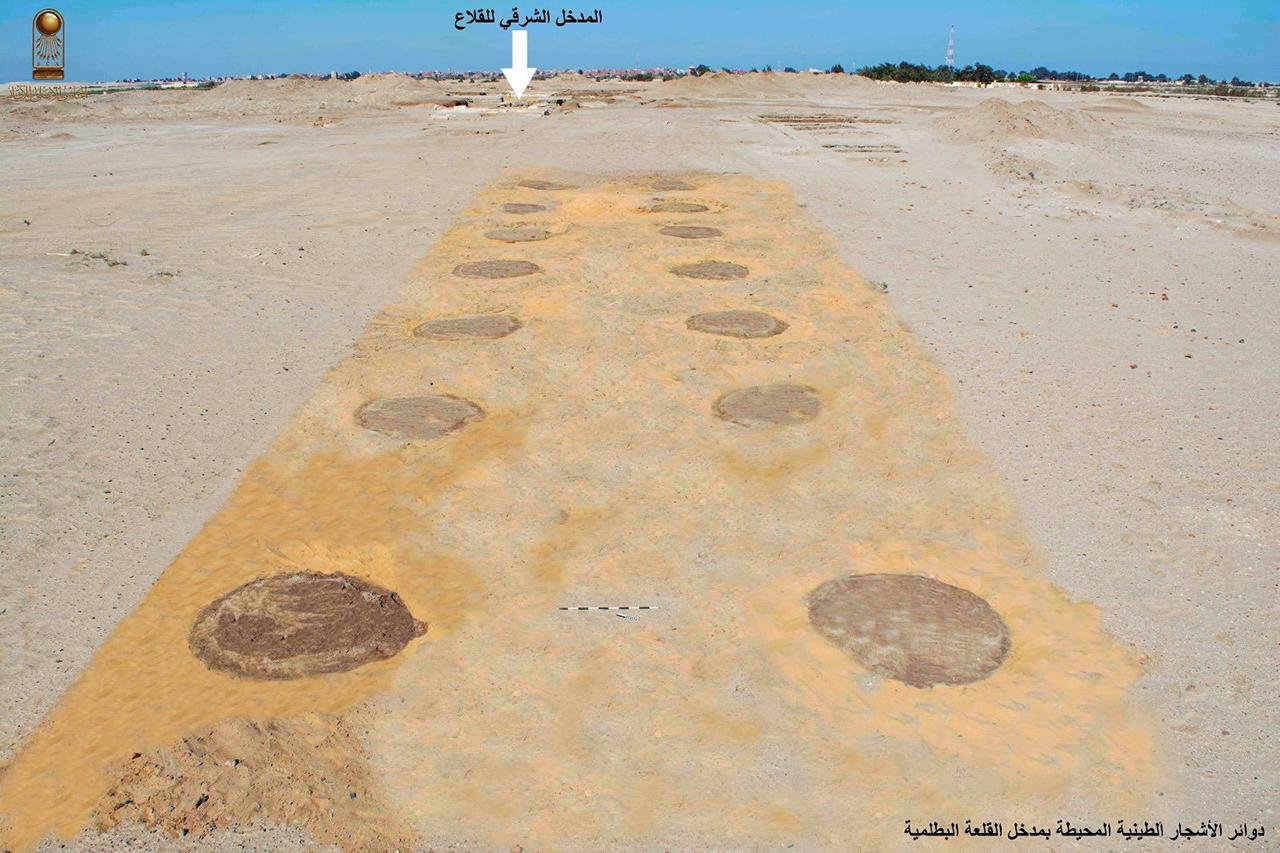
Hidden fort, tree-lined road, and moat uncovered at ancient Egyptian fortress in the Sinai Desert
According to archaeologists, planting circles surrounding the entrance road indicate that hundreds of trees had once been planted at the site. Credit: Photo courtesy of the Egyptian Ministry of Tourism and Antiquities

Defensive features of the fortress include a deep trench, or moat, more than 6.6 feet (2 meters) deep, aimed at deterring attackers. Dr. Mohamed Ismail Khaled, Secretary-General of the Supreme Council of Antiquities, noted that the trench could be temporarily disabled when required, suggesting an elaborate defensive strategy.

Accommodation for soldiers, and even for their families, was also discovered, giving a rare glimpse of everyday life in the fortress. These buildings, situated in layered patterns, seem to have been occupied over extended periods, especially during the reigns of Roman Emperors Diocletian and Maximian.


RelatedStories

3D metrological analysis connects dispersed Egyptian artifacts and recovers their lost histories

3D metrological analysis connects dispersed Egyptian artifacts and recovers their lost histories

February 17, 2026
10,000 years of rock art discovered at Umm Arak Plateau in Egypt’s southern Sinai

10,000 years of rock art discovered at Umm Arak Plateau in Egypt’s southern Sinai

February 15, 2026
Hidden fort, tree-lined road, and moat uncovered at ancient Egyptian fortress in the Sinai Desert
An overview of the sites at the “Fortress of the East” in the Sinai Desert. Credit: Photo courtesy of the Egyptian Ministry of Tourism and Antiquities

The site also bears evidence of large-scale industrial activity. Four large lime kilns, used to make quicklime, indicate the fortress’s transformation into an industrial center in the late Roman era. This industrialization probably resulted in the gradual destruction of some of the original stone structures, the excavation team believes.

Most intriguingly, perhaps, the archaeologists discovered four corners of a building thought to be older than both known fortresses. This has led researchers to hypothesize that there was a third, older fortress.

Hidden fort, tree-lined road, and moat uncovered at ancient Egyptian fortress in the Sinai Desert
Defensive features of the fortress include a deep trench, or moat, more than 6.6 feet (2 meters) deep. Credit: Photo courtesy of the Egyptian Ministry of Tourism and Antiquities

Greater strategic significance at Tell Abu Saifi may also be linked to shifting geography within Egypt. As the Nile River’s course shifted and the coastal site of Tell Hebua declined, Tell Abu Saifi became an increasingly significant site to defend Egypt’s eastern frontier.

The recent finds at Tell Abu Saifi not only validate the site’s historical military importance but also suggest a dynamic settlement that evolved to meet Egypt’s shifting political and environmental landscape.

Egyptian Ministry of Tourism and Antiquities

 

Share8Tweet5Share1ShareSend

You May Also Like...

2,000-year-old human and animal footprints discovered at Lunan Bay, Scotland
Archaeology

2,000-year-old human and animal footprints discovered at Lunan Bay, Scotland

February 20, 2026
The “Princess” of Bagicz re-dated: tree rings resolve the mystery of a rare Roman-era log coffin
Anthropology

The “Princess” of Bagicz re-dated: tree rings resolve the mystery of a rare Roman-era log coffin

February 20, 2026
1.77-million-year-old Homo erectus skulls in China show early humans reached Asia sooner than believed
Anthropology

1.77-million-year-old Homo erectus skulls in China show early humans reached Asia sooner than believed

February 19, 2026
Hidden 17th-century bastion fort discovered in Świerże, eastern Poland
Archaeology

Hidden 17th-century bastion fort discovered in Świerże, eastern Poland

February 19, 2026
Seabird guano fueled the rise of Peru’s Chincha Kingdom, isotope study finds
Archaeology

Seabird guano fueled the rise of Peru’s Chincha Kingdom, isotope study finds

February 19, 2026
Historic cannon unearthed during Hull’s Queen’s Gardens restoration in the UK
Archaeology

Historic cannon unearthed during Hull’s Queen’s Gardens restoration in England

February 18, 2026

Follow us


Instagram
244K

Facebook
118K

Threads
45K

LinkedIn
14K

Twitter
6K

YouTube
1K
  • Trending
  • Comments
  • Latest
Shipwreck Salvage. Credit: rawpixel.com / Public Domain

2,000-year-old shipwreck discovered off Turkish coast with remarkably preserved stacked ceramics

July 2, 2025
Viking age DNA reveals 9,000-year-old HIV-resistant gene originating near the Black Sea

Viking age DNA reveals 9,000-year-old HIV-resistant gene originating near the Black Sea

May 18, 2025
A new study suggests the mysterious Voynich Manuscript may be a medieval cipher

A new study suggests the mysterious Voynich Manuscript may be a medieval cipher

January 3, 2026
Moses may be named in ancient Egyptian mine inscriptions, sparking debate over earliest biblical references

Moses may be named in ancient Egyptian mine inscriptions, sparking debate over earliest biblical references

July 31, 2025
Mystery of Armenia’s 6,000-year-old dragon stones solved

Mystery of Armenia’s 6,000-year-old dragon stones solved

September 23, 2025
3D analysis reveals Shroud of Turin image likely came from sculpture, not Jesus’ body

3D analysis reveals Shroud of Turin image likely came from sculpture, not Jesus’ body

Moses may be named in ancient Egyptian mine inscriptions, sparking debate over earliest biblical references

Moses may be named in ancient Egyptian mine inscriptions, sparking debate over earliest biblical references

$1 million prize offered to decipher 5,300-year-old Indus Valley script

$1 million prize offered to decipher 5,300-year-old Indus Valley script

Oldest ever genetic data from a human relative found in 2-million-year-old fossilized teeth

Oldest ever genetic data from a human relative found in 2-million-year-old fossilized teeth

Exceptionally large Roman shoes discovered at Magna fort near Hadrian’s Wall

Exceptionally large Roman shoes discovered at Magna fort near Hadrian’s Wall

2,000-year-old human and animal footprints discovered at Lunan Bay, Scotland

2,000-year-old human and animal footprints discovered at Lunan Bay, Scotland

February 20, 2026
The “Princess” of Bagicz re-dated: tree rings resolve the mystery of a rare Roman-era log coffin

The “Princess” of Bagicz re-dated: tree rings resolve the mystery of a rare Roman-era log coffin

February 20, 2026
1.77-million-year-old Homo erectus skulls in China show early humans reached Asia sooner than believed

1.77-million-year-old Homo erectus skulls in China show early humans reached Asia sooner than believed

February 19, 2026
Hidden 17th-century bastion fort discovered in Świerże, eastern Poland

Hidden 17th-century bastion fort discovered in Świerże, eastern Poland

February 19, 2026
Seabird guano fueled the rise of Peru’s Chincha Kingdom, isotope study finds

Seabird guano fueled the rise of Peru’s Chincha Kingdom, isotope study finds

February 19, 2026

Archaeology News online magazine

Archaeology News is an international online magazine that covers all aspects of archaeology.


Categories

  • Academics
    • Books
    • Conferences
    • Universities
  • Articles
  • Download
  • Game
  • News
    • Anthropology
    • Archaeology
    • Paleontology
  • Quiz
  • Tours

Subscribe to our newsletter

© 2024 - Archaeology News Online Magazine. All Rights Reserved.

  • About
  • Privacy Policy
  • Terms of Use
  • Donation
  • Contact

Manage Consent
To provide the best experiences, we use technologies like cookies to store and/or access device information. Consenting to these technologies will allow us to process data such as browsing behavior or unique IDs on this site. Not consenting or withdrawing consent, may adversely affect certain features and functions.
Functional Always active
The technical storage or access is strictly necessary for the legitimate purpose of enabling the use of a specific service explicitly requested by the subscriber or user, or for the sole purpose of carrying out the transmission of a communication over an electronic communications network.
Preferences
The technical storage or access is necessary for the legitimate purpose of storing preferences that are not requested by the subscriber or user.
Statistics
The technical storage or access that is used exclusively for statistical purposes. The technical storage or access that is used exclusively for anonymous statistical purposes. Without a subpoena, voluntary compliance on the part of your Internet Service Provider, or additional records from a third party, information stored or retrieved for this purpose alone cannot usually be used to identify you.
Marketing
The technical storage or access is required to create user profiles to send advertising, or to track the user on a website or across several websites for similar marketing purposes.
  • Manage options
  • Manage services
  • Manage {vendor_count} vendors
  • Read more about these purposes
View preferences
  • {title}
  • {title}
  • {title}
  • Home
  • News
    • Archaeology
    • Anthropology
    • Paleontology
  • Academic
    • Books
    • Conferences
    • Universities
  • Articles
  • VR Tours
  • Quiz & Game
  • Download
  • Encyclopedia
  • Forum

About  .  Contact  .  Donation

© 2024 - Archaeology News Online Magazine. All Rights Reserved