• About
  • Privacy Policy
  • Terms of Use
  • Donation
  • Contact
No Result
View All Result
Archaeology News
  • Home
  • News
    • Archaeology
    • Anthropology
    • Paleontology
  • Academic
    • Books
    • Conferences
    • Universities
  • Articles
  • VR Tours
  • Quiz & Game
  • Download
  • Encyclopedia
  • Forum
Archaeology News
No Result
View All Result
Home News Anthropology

First infant burial found in Roman military camp in Iberia challenges old assumptions

by Dario Radley
August 27, 2025

Archaeologists have unearthed what may be the first known infant burial ever found in a Roman military camp in Iberia, which provides valuable insight into the blending of life, law, and ritual activity within the Roman military. The study, published in Childhood in the Past and led by Marta Fernández-Viejo of León University and Burgos University, centers on the castrum of Legio VI Victrix in León, Spain.

First infant burial found in Roman military camp in Iberia challenges old assumptions
Children playing ball games. Marble Roman relief, second quarter of the 2nd century CE, probably a fragment of a sarcophagus. Louvre Museum, Paris. Credit: Marie-Lan Nguyen / CC BY 3.0

It was discovered in 2006 during emergency excavations carried out at the sacristy of the convent of Siervas de Jesús and on Francisco Regueral Street. Legio VI Victrix, founded by Augustus in 41 BCE and stationed in Hispania Tarraconensis in 29 BCE, guarded key passes through the Asturian mountains near the confluence of the Bernesga and Torío rivers.

In Area 1 of the site, archaeologists found the remains of an infant buried in a tegula—a Roman roof tile—beneath the floor of a contubernium workshop. Roof-tile burials for infants were not unusual in Roman funerary practice but were typically confined to cemeteries or household spaces.

Infant graves in a military context are extremely rare, with confirmed cases at Hadrian’s Wall forts and in nearby settlements, but not within barracks. The León example is therefore unique, especially since it was placed near a doorway in a soldiers’ workspace.

First infant burial found in Roman military camp in Iberia challenges old assumptions
Roman roof tiles and box flue tiles on display at the Roman Museum, Butchery Lane, Canterbury, Kent. Infant burials in roof tiles were not uncommon in Roman funerary practice but were usually limited to cemeteries or domestic spaces. Credit: Linda Spashett / CC BY 3.0

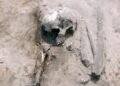
Skeletal analysis showed the infant was born to term, around 38–42 weeks, but some of the bones, including parts of the pelvis and skull, were not fully formed. This discrepancy, Fernández-Viejo states, is symptomatic of stress, illness, or poor nutrition during pregnancy. There were no external injuries visible, so infanticide can be excluded, but smothering or exposure deaths would not leave skeletal traces. Radiocarbon dating placed the burial between 47 BCE and 61 CE.
RelatedStories

1,900-year-old Roman unguentarium shows human feces used as medicine with thyme to mask smell

1,900-year-old Roman unguentarium shows human feces used as medicine with thyme to mask smell

January 29, 2026
Large Roman cemetery excavation at Brougham reveals diverse burial practices on Britain’s northern frontier

Large Roman cemetery excavation at Brougham reveals diverse burial practices on Britain’s northern frontier

January 24, 2026

This was the period when Augustus’s reforms banned soldiers from marrying while on service and, theoretically, excluded wives and children from military bases. But archaeological evidence in frontier provinces such as Britannia and Germania indicates that soldiers did circumvent these regulations most of the time. The presence of everyday items linked to family life—such as shoes and personal items—suggests that many garrisons contained women and children.

First infant burial found in Roman military camp in Iberia challenges old assumptions
Sarcophagus of a child decorated with sporting scenes, including the crowning of the winner. Roman artwork, ca. 175–225 CE, discovered at Vigna Carpi, Rome, Italy. Louvre Museum, Paris. Credit: Marie-Lan Nguyen / CC BY 4.0

The unconventional burial placement can be explained through Roman spiritual views. Infants who died at or shortly after birth were thought to have powerful souls that could affect the living. Burial of remains under a threshold was believed to prevent harm to the structure and the individuals who worked within it. Such “foundation burials,” usually animals but sometimes humans, were common in Roman construction rituals, marking the shift from a profane to a sacred space.

The León discovery challenges assumptions that life in the Roman army was rigidly separate from domestic and religious spheres. Instead, it suggests a more complex scenario—one in which soldiers, families, and spiritual practices intersected in the same spaces where the empire’s legions lived and worked.


More information: Marta, F.-V., Rebeca, G.-G., José Miguel, C., Emilio, C., & Laura, R. (2025). Uncovering childhood in the Roman army: A perinatal burial from the Roman castrum of the legio VI in León. Childhood in the Past, 1–17. doi:10.1080/17585716.2025.2538923
Share330Tweet207Share58ShareSend

You May Also Like...

Neanderthals in Spain deliberately deposited animal skulls in cave, revealing symbolic behavior
Anthropology

Neanderthals in Spain deliberately deposited animal skulls in cave, revealing symbolic behavior

January 31, 2026
Mysterious Medieval tunnel found inside 6,000 year old Neolithic ditch in Germany
Archaeology

Mysterious Medieval tunnel found inside 6,000 year old Neolithic ditch in Germany

January 31, 2026
Stone Age teen buried in Italy died after bear attack 28,000 years ago, new forensic study finds
Anthropology

Stone Age teen buried in Italy died after bear attack 28,000 years ago, new forensic study finds

January 30, 2026
5,000 year old rock art in Sinai shows early Egyptian conquest and control of copper mines
Archaeology

5,000 year old rock art in Sinai shows early Egyptian conquest and control of copper mines

January 30, 2026
DNA reveals rare dwarfism in teenager who lived in Italy 12,000 years ago
Anthropology

DNA reveals rare dwarfism in teenager who lived in Italy 12,000 years ago

January 29, 2026
1,900-year-old Roman unguentarium shows human feces used as medicine with thyme to mask smell
Archaeology

1,900-year-old Roman unguentarium shows human feces used as medicine with thyme to mask smell

January 29, 2026

Comments 2

  1. Editorial Team says:
    1 second ago

    Disclaimer: This website is a science-focused magazine that welcomes both academic and non-academic audiences. Comments are written by users and may include personal opinions or unverified claims. They do not necessarily reflect the views of our editorial team or rely on scientific evidence.

    Comment Policy: We kindly ask all commenters to engage respectfully. Comments that contain offensive, insulting, degrading, discriminatory, or racist content will be automatically removed.

    Reply
  2. Joe Barrera says:
    5 months ago

    Keep the archaeological news coming.

    Reply
  3. Raymond Harp says:
    5 months ago

    All the Roman movies that you see it’s always adults you never see children and to see the carving on the tablet of the kids playing ball it just makes perfectly good sense but I bet for a kid back in that day you stepped out of line you stepped in trouble sincerely Ray harp

    Reply

Leave a Reply Cancel reply

Your email address will not be published. Required fields are marked *

Follow us


Instagram
244K

Facebook
118K

Threads
45K

LinkedIn
14K

Twitter
6K

YouTube
1K
  • Trending
  • Comments
  • Latest
Shipwreck Salvage. Credit: rawpixel.com / Public Domain

2,000-year-old shipwreck discovered off Turkish coast with remarkably preserved stacked ceramics

July 2, 2025
Viking age DNA reveals 9,000-year-old HIV-resistant gene originating near the Black Sea

Viking age DNA reveals 9,000-year-old HIV-resistant gene originating near the Black Sea

May 18, 2025
A new study suggests the mysterious Voynich Manuscript may be a medieval cipher

A new study suggests the mysterious Voynich Manuscript may be a medieval cipher

January 3, 2026
Moses may be named in ancient Egyptian mine inscriptions, sparking debate over earliest biblical references

Moses may be named in ancient Egyptian mine inscriptions, sparking debate over earliest biblical references

July 31, 2025
Mystery of Armenia’s 6,000-year-old dragon stones solved

Mystery of Armenia’s 6,000-year-old dragon stones solved

September 23, 2025
3D analysis reveals Shroud of Turin image likely came from sculpture, not Jesus’ body

3D analysis reveals Shroud of Turin image likely came from sculpture, not Jesus’ body

Moses may be named in ancient Egyptian mine inscriptions, sparking debate over earliest biblical references

Moses may be named in ancient Egyptian mine inscriptions, sparking debate over earliest biblical references

$1 million prize offered to decipher 5,300-year-old Indus Valley script

$1 million prize offered to decipher 5,300-year-old Indus Valley script

Oldest ever genetic data from a human relative found in 2-million-year-old fossilized teeth

Oldest ever genetic data from a human relative found in 2-million-year-old fossilized teeth

Exceptionally large Roman shoes discovered at Magna fort near Hadrian’s Wall

Exceptionally large Roman shoes discovered at Magna fort near Hadrian’s Wall

Neanderthals in Spain deliberately deposited animal skulls in cave, revealing symbolic behavior

Neanderthals in Spain deliberately deposited animal skulls in cave, revealing symbolic behavior

January 31, 2026
Mysterious Medieval tunnel found inside 6,000 year old Neolithic ditch in Germany

Mysterious Medieval tunnel found inside 6,000 year old Neolithic ditch in Germany

January 31, 2026
Stone Age teen buried in Italy died after bear attack 28,000 years ago, new forensic study finds

Stone Age teen buried in Italy died after bear attack 28,000 years ago, new forensic study finds

January 30, 2026
5,000 year old rock art in Sinai shows early Egyptian conquest and control of copper mines

5,000 year old rock art in Sinai shows early Egyptian conquest and control of copper mines

January 30, 2026
DNA reveals rare dwarfism in teenager who lived in Italy 12,000 years ago

DNA reveals rare dwarfism in teenager who lived in Italy 12,000 years ago

January 29, 2026

Archaeology News online magazine

Archaeology News is an international online magazine that covers all aspects of archaeology.


Categories

  • Academics
    • Books
    • Conferences
    • Universities
  • Articles
  • Download
  • Game
  • News
    • Anthropology
    • Archaeology
    • Paleontology
  • Quiz
  • Tours

Subscribe to our newsletter

© 2024 - Archaeology News Online Magazine. All Rights Reserved.

  • About
  • Privacy Policy
  • Terms of Use
  • Donation
  • Contact

Welcome Back!

Login to your account below

Forgotten Password? Sign Up

Create New Account!

Fill the forms below to register

All fields are required. Log In

Retrieve your password

Please enter your username or email address to reset your password.

Log In

Add New Playlist

Manage Consent
To provide the best experiences, we use technologies like cookies to store and/or access device information. Consenting to these technologies will allow us to process data such as browsing behavior or unique IDs on this site. Not consenting or withdrawing consent, may adversely affect certain features and functions.
Functional Always active
The technical storage or access is strictly necessary for the legitimate purpose of enabling the use of a specific service explicitly requested by the subscriber or user, or for the sole purpose of carrying out the transmission of a communication over an electronic communications network.
Preferences
The technical storage or access is necessary for the legitimate purpose of storing preferences that are not requested by the subscriber or user.
Statistics
The technical storage or access that is used exclusively for statistical purposes. The technical storage or access that is used exclusively for anonymous statistical purposes. Without a subpoena, voluntary compliance on the part of your Internet Service Provider, or additional records from a third party, information stored or retrieved for this purpose alone cannot usually be used to identify you.
Marketing
The technical storage or access is required to create user profiles to send advertising, or to track the user on a website or across several websites for similar marketing purposes.
  • Manage options
  • Manage services
  • Manage {vendor_count} vendors
  • Read more about these purposes
View preferences
  • {title}
  • {title}
  • {title}
  • Home
  • News
    • Archaeology
    • Anthropology
    • Paleontology
  • Academic
    • Books
    • Conferences
    • Universities
  • Articles
  • VR Tours
  • Quiz & Game
  • Download
  • Encyclopedia
  • Forum

About  .  Contact  .  Donation

© 2024 - Archaeology News Online Magazine. All Rights Reserved