
Imagine strolling through a 2,500-year-old tomb chamber from the comfort of your own home. Thanks to a novel project by Swedish researchers, nearly 280 Etruscan chamber tombs in Italy have been documented digitally and reconstructed as an interactive online portal. The project opens up one of the ancient Mediterranean’s most fascinating cultures to researchers, students, and the public.

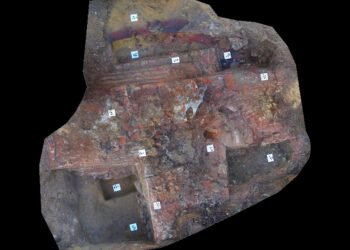
The project, developed at the University of Gothenburg in collaboration with the Swedish Institute in Rome, merges decades of archaeological research with innovative digital methods. Early studies of this type of tomb relied on sketches, measuring tapes, and field notes. Today, researchers employ advanced methods such as photogrammetry, laser scanning, and 3D modeling to obtain precise reconstructions. The result is a publicly accessible database where each tomb can be explored in detail, creating a virtual tour of what is normally hidden and difficult to reach.
The majority of the Etruscan tombs are located off the main roads, with collapsed passageways and heavy dust making them nearly inaccessible to visitors. In some cases, narrow openings require crawling through debris just to enter. Digital documentation not only preserves these fragile spaces but also allows people from all over the world to see them virtually—without the risks of field exploration.
The project has also produced a Virtual Reality app, providing a more immersive glimpse of what it is like to stand inside the chambers. Beyond the visual impact, the scans also open up new potential for research, enabling data to be gathered and analyzed that would be impossible without physical visits.

The Swedish Institute in Rome has long played a central role in Etruscan research. The institute has served as a focal point for Swedish archaeological work in Italy since its founding in 1925. In the 1950s, it took an active part in the large-scale excavations in southern Etruria, work that met with widespread attention in both Italy and Sweden. Much of that publicity was because King Gustav VI Adolf was very keen on archaeology and even took part himself in the excavations for many years, right up to the year before his death in 1973.
The institute continues its legacy today by supporting digital humanities projects like this. Its library remains one of the most important resources in the field of Etruscology, with scholars visiting from around the world. The new digital portal is expected to continue to expand, with more tombs being added to create a growing archive for international collaboration.

In the future, the project will also serve a significant educational function. As of 2026, students at the University of Gothenburg will use the portal as part of their studies, gaining practical experience in 3D scanning, digital documentation, and online publication. In coordination with the Swedish Institute in Rome, they will contribute directly to the growth and expansion of the database.
What once required the physical exploration of dusty, fragile tombs can now be explored by anyone with an internet connection, ensuring that the cultural heritage of the Etruscans is preserved, studied, and transmitted to future generations.






Disclaimer: This website is a science-focused magazine that welcomes both academic and non-academic audiences. Comments are written by users and may include personal opinions or unverified claims. They do not necessarily reflect the views of our editorial team or rely on scientific evidence.
Comment Policy: We kindly ask all commenters to engage respectfully. Comments that contain offensive, insulting, degrading, discriminatory, or racist content will be automatically removed.
Can we get this into all things archaeological and into schools so as to be current with what we actually know about, and not 40 year old pictures? This is a great example of growing with technology we need to teach this way of doing in all schools everywhere.
Thank you providing all of this information and knowledge, now everyone can digest it and maybe we can all grow knowledge and not, and/or do what has already been learned.
As an artist and craftsman I enjoy seeing all these structures built with heavy stones and decorated with design and such…. but then I wonder what labor was done by,,,,, slaves?
That is what the movies say,,,, but I wonder what the real truth is.
When Tutacomon came to the USA I was a budding silversmith and was stimulated by the beautiful Egyption works. I would have loved being a discover of those kinds of art.
Thanks for presenting these works and the digital platform you have created.