• About
  • Privacy Policy
  • Terms of Use
  • Donation
  • Contact
No Result
View All Result
Archaeology News
  • Home
  • News
    • Archaeology
    • Anthropology
    • Paleontology
  • Academic
    • Books
    • Conferences
    • Universities
  • Articles
  • VR Tours
  • Quiz & Game
  • Download
  • Encyclopedia
  • Forum
Archaeology News
No Result
View All Result
Home News Archaeology

Rare Roman-era circular stone monument unearthed near Nassenfels, Germany

by Dario Radley
October 18, 2025

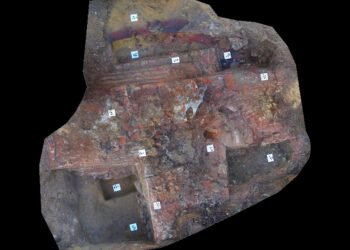
Archaeologists from the Bavarian State Office for Monument Preservation (BLfD) have uncovered the remains of a monumental circular stone structure close to the village of Wolkertshofen, near Nassenfels in Upper Bavaria. The discovery was made during construction work for a stormwater retention basin in autumn of 2024 and is believed to represent the foundation of a Roman burial mound, or tumulus, dating to the Imperial period.

Rare Roman-era circular stone monument unearthed near Nassenfels, Germany
Stone circle of Wolkertshofen, top view. Credit: Archäologiebüro Dr. Woidich GmbH

The carefully built stone circle is about twelve meters in diameter, with an attached square base on its southern side measuring two by two meters. Experts suggest that the annex likely supported a stele or statue, which formed the central point of the monument. Although no human remains or funerary goods were discovered, the structure is interpreted as a cenotaph—a symbolic grave for one buried elsewhere—by archaeologists.

“The discovery of a funerary monument of such scale here was unexpected,” said Prof. Mathias Pfeil, General Conservator at the BLfD. “Located along an important Roman road, it was a memorial and also a visible expression of social prestige.”

The tumulus stands along a Roman road that once led from Nassenfels into the valley of the Altmühl, one of the most important routes in the Raetian province, which covered parts of modern southern Germany, Switzerland, and Tyrol. Not far away is a villa rustica, a rural estate that likely belonged to a wealthy landowner. The proximity of these places suggests that the tumulus may have been raised to commemorate a member of the local elite.

Rare Roman-era circular stone monument unearthed near Nassenfels, Germany
Square annex measuring two by two meters. Credit: Archäologiebüro Dr. Woidich GmbH

Excavations also revealed evidence of prehistoric occupation in the area, including pottery fragments and remains of Neolithic, Bronze, and Iron Age settlements. This long history of occupation illustrates how the landscape continued to be used for ritual and domestic purposes over thousands of years.


RelatedStories

The “Princess” of Bagicz re-dated: tree rings resolve the mystery of a rare Roman-era log coffin

The “Princess” of Bagicz re-dated: tree rings resolve the mystery of a rare Roman-era log coffin

February 20, 2026
Drone surveys reveal Roman forum and previously unknown monumental theater at Fioccaglia

Drone surveys reveal Roman forum and previously unknown monumental theater at Fioccaglia

February 15, 2026

Burial mounds were an enduring Roman tradition, blending Mediterranean influences with older Central European customs. They appeared in the northwestern provinces from the first century CE. Some newly built tumuli coexisted with the reuse of prehistoric mounds, perhaps as a deliberate link to pre-Roman or Celtic traditions. Such stone tumuli of this size are extremely rare in Raetia, and the Wolkertshofen discovery is therefore particularly significant for understanding local funerary practices.

Rare Roman-era circular stone monument unearthed near Nassenfels, Germany
The stone circle was uncovered in the northeast of the village of Wolkertshofen. Credit: Archäologiebüro Dr. Woidich GmbH

The absence of bones and grave offerings indicates it is a symbolic tomb rather than a physical burial. Constructing such cenotaphs for those who died far from home allowed family members to perform commemorative rituals in their memory. The precise craftsmanship of the structure and its location along a Roman road both suggest technical skill as well as the social ambitions of the builders.

Archaeologists will now analyze soil samples and construction materials to determine the age of the monument and any possible phases of use. Despite its simplicity, the stone circle offers rare evidence of how Roman-age communities in Bavaria expressed identity, status, and memory through monumental construction.

More information: Bavarian State Office for Monument Preservation

Share42Tweet26Share7ShareSend

You May Also Like...

The “Princess” of Bagicz re-dated: tree rings resolve the mystery of a rare Roman-era log coffin
Anthropology

The “Princess” of Bagicz re-dated: tree rings resolve the mystery of a rare Roman-era log coffin

February 20, 2026
1.77-million-year-old Homo erectus skulls in China show early humans reached Asia sooner than believed
Anthropology

1.77-million-year-old Homo erectus skulls in China show early humans reached Asia sooner than believed

February 19, 2026
Hidden 17th-century bastion fort discovered in Świerże, eastern Poland
Archaeology

Hidden 17th-century bastion fort discovered in Świerże, eastern Poland

February 19, 2026
Seabird guano fueled the rise of Peru’s Chincha Kingdom, isotope study finds
Archaeology

Seabird guano fueled the rise of Peru’s Chincha Kingdom, isotope study finds

February 19, 2026
Historic cannon unearthed during Hull’s Queen’s Gardens restoration in the UK
Archaeology

Historic cannon unearthed during Hull’s Queen’s Gardens restoration in England

February 18, 2026
DNA reveals extended hunter-gatherer family ties in 5,500-year-old Stone Age graves on Gotland
Anthropology

DNA reveals extended hunter-gatherer family ties in 5,500-year-old Stone Age graves on Gotland

February 18, 2026

Comments 0

  1. Editorial Team says:
    1 second ago

    Disclaimer: This website is a science-focused magazine that welcomes both academic and non-academic audiences. Comments are written by users and may include personal opinions or unverified claims. They do not necessarily reflect the views of our editorial team or rely on scientific evidence.

    Comment Policy: We kindly ask all commenters to engage respectfully. Comments that contain offensive, insulting, degrading, discriminatory, or racist content will be automatically removed.

    Reply

Leave a Reply Cancel reply

Your email address will not be published. Required fields are marked *

Follow us


Instagram
244K

Facebook
118K

Threads
45K

LinkedIn
14K

Twitter
6K

YouTube
1K
  • Trending
  • Comments
  • Latest
Shipwreck Salvage. Credit: rawpixel.com / Public Domain

2,000-year-old shipwreck discovered off Turkish coast with remarkably preserved stacked ceramics

July 2, 2025
Viking age DNA reveals 9,000-year-old HIV-resistant gene originating near the Black Sea

Viking age DNA reveals 9,000-year-old HIV-resistant gene originating near the Black Sea

May 18, 2025
A new study suggests the mysterious Voynich Manuscript may be a medieval cipher

A new study suggests the mysterious Voynich Manuscript may be a medieval cipher

January 3, 2026
Moses may be named in ancient Egyptian mine inscriptions, sparking debate over earliest biblical references

Moses may be named in ancient Egyptian mine inscriptions, sparking debate over earliest biblical references

July 31, 2025
Mystery of Armenia’s 6,000-year-old dragon stones solved

Mystery of Armenia’s 6,000-year-old dragon stones solved

September 23, 2025
3D analysis reveals Shroud of Turin image likely came from sculpture, not Jesus’ body

3D analysis reveals Shroud of Turin image likely came from sculpture, not Jesus’ body

Moses may be named in ancient Egyptian mine inscriptions, sparking debate over earliest biblical references

Moses may be named in ancient Egyptian mine inscriptions, sparking debate over earliest biblical references

$1 million prize offered to decipher 5,300-year-old Indus Valley script

$1 million prize offered to decipher 5,300-year-old Indus Valley script

Oldest ever genetic data from a human relative found in 2-million-year-old fossilized teeth

Oldest ever genetic data from a human relative found in 2-million-year-old fossilized teeth

Exceptionally large Roman shoes discovered at Magna fort near Hadrian’s Wall

Exceptionally large Roman shoes discovered at Magna fort near Hadrian’s Wall

The “Princess” of Bagicz re-dated: tree rings resolve the mystery of a rare Roman-era log coffin

The “Princess” of Bagicz re-dated: tree rings resolve the mystery of a rare Roman-era log coffin

February 20, 2026
1.77-million-year-old Homo erectus skulls in China show early humans reached Asia sooner than believed

1.77-million-year-old Homo erectus skulls in China show early humans reached Asia sooner than believed

February 19, 2026
Hidden 17th-century bastion fort discovered in Świerże, eastern Poland

Hidden 17th-century bastion fort discovered in Świerże, eastern Poland

February 19, 2026
Seabird guano fueled the rise of Peru’s Chincha Kingdom, isotope study finds

Seabird guano fueled the rise of Peru’s Chincha Kingdom, isotope study finds

February 19, 2026
Historic cannon unearthed during Hull’s Queen’s Gardens restoration in the UK

Historic cannon unearthed during Hull’s Queen’s Gardens restoration in England

February 18, 2026

Archaeology News online magazine

Archaeology News is an international online magazine that covers all aspects of archaeology.


Categories

  • Academics
    • Books
    • Conferences
    • Universities
  • Articles
  • Download
  • Game
  • News
    • Anthropology
    • Archaeology
    • Paleontology
  • Quiz
  • Tours

Subscribe to our newsletter

© 2024 - Archaeology News Online Magazine. All Rights Reserved.

  • About
  • Privacy Policy
  • Terms of Use
  • Donation
  • Contact

Manage Consent
To provide the best experiences, we use technologies like cookies to store and/or access device information. Consenting to these technologies will allow us to process data such as browsing behavior or unique IDs on this site. Not consenting or withdrawing consent, may adversely affect certain features and functions.
Functional Always active
The technical storage or access is strictly necessary for the legitimate purpose of enabling the use of a specific service explicitly requested by the subscriber or user, or for the sole purpose of carrying out the transmission of a communication over an electronic communications network.
Preferences
The technical storage or access is necessary for the legitimate purpose of storing preferences that are not requested by the subscriber or user.
Statistics
The technical storage or access that is used exclusively for statistical purposes. The technical storage or access that is used exclusively for anonymous statistical purposes. Without a subpoena, voluntary compliance on the part of your Internet Service Provider, or additional records from a third party, information stored or retrieved for this purpose alone cannot usually be used to identify you.
Marketing
The technical storage or access is required to create user profiles to send advertising, or to track the user on a website or across several websites for similar marketing purposes.
  • Manage options
  • Manage services
  • Manage {vendor_count} vendors
  • Read more about these purposes
View preferences
  • {title}
  • {title}
  • {title}
  • Home
  • News
    • Archaeology
    • Anthropology
    • Paleontology
  • Academic
    • Books
    • Conferences
    • Universities
  • Articles
  • VR Tours
  • Quiz & Game
  • Download
  • Encyclopedia
  • Forum

About  .  Contact  .  Donation

© 2024 - Archaeology News Online Magazine. All Rights Reserved