
Underwater archaeologists in the waters of Lake Lednica in western Poland have found four exceptionally well-preserved medieval spears that add new depth to the story of Ostrów Lednicki, one of the most important strongholds of the early Piast state. This island, situated between Gniezno and Poznań, was an important political and religious center during the rule of Mieszko I and Bolesław I the Brave. Over many decades, the lake has yielded military objects from this formative era, but this year’s discoveries stand out for both their preservation and craftsmanship.
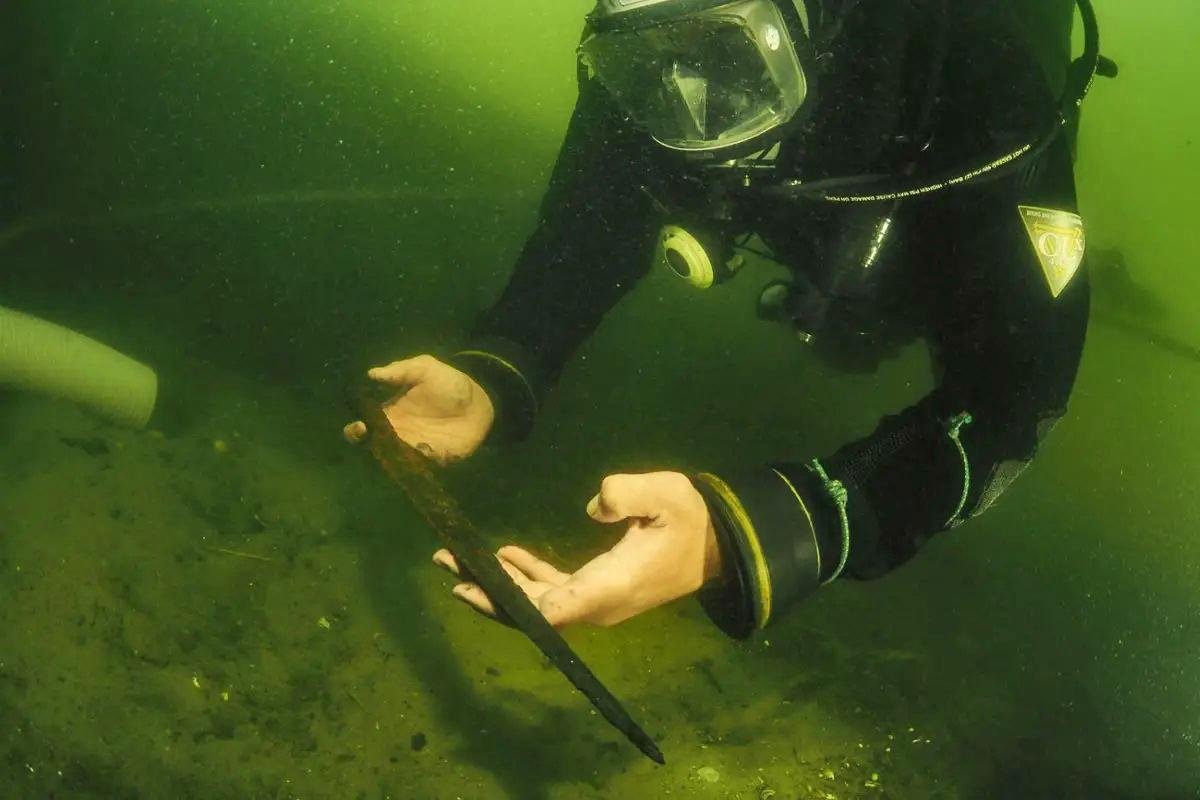
The spears, which date from the late 10th and early 11th centuries, were discovered during the 2025 research season by a team from Nicolaus Copernicus University’s Centre for Underwater Archaeology, working with the Museum of the First Piasts in Lednica. Small though they may be in number, the weapons reflect the diversity of military equipment used in the Piast realm during its height and offer rare insights into the skills of local metalworkers.
One of the spears has preserved a part of its original ash shaft, some 2.1 meters long, making it an exceptional find because only two other Lednica spears have retained similar wooden elements. It was finished with an antler ring and confirms that both long and shorter shafts were in circulation during the early Middle Ages. Another spearhead, in the form of a willow leaf, exemplifies a form widespread in Europe, and also points to a strong local tradition of craftsmanship, since similar pieces have been recovered from the region of Lednica.
The most technologically complex of the four spears is the longest, forged by pattern welding. This technique involves repeatedly joining soft and hard steels to produce blades with superior strength and was practiced by the most skilled smiths of the period. Its presence in the lake underscores the high level of expertise available to Piast warriors.

The most spectacular discovery, however, is a richly ornamented winged spear, which is often referred to as the “duke’s spear.” The socket was covered in spirals and triskelion motifs. Chemical analyses revealed traces of gold, silver, copper, tin, zinc, and lead in its decoration. X-ray macrofluorescence scanning showed traces of gilding and silver plating, suggesting that the weapon served not just in battle but also as a symbol of authority or ceremonial prestige. No comparably elaborate example has been found in this region, making it a unique object of elite identity.

Radiocarbon dating of the well-preserved wooden elements places the spears squarely in the early Piast period, most probably in the years 1016–1030 CE, during the rule of Bolesław I. Why so many weapons ended up in Lake Lednica is a matter of debate. One interpretation attributes them to the violent events of the 1030s, with political upheaval and foreign invasion striking the region. Another suggestion is that they were intentionally deposited as offerings, echoing long-standing ritual traditions that persisted even with the adoption of Christianity.
Further metallurgical and isotopic analyses are planned to determine the provenance of the decorated spear and to more precisely inform researchers about networks connecting Lednica with workshops across Europe. The spearheads will be exhibited at the Museum of the First Piasts in Lednica after conservation.
More information: Nicolaus Copernicus University
















Disclaimer: This website is a science-focused magazine that welcomes both academic and non-academic audiences. Comments are written by users and may include personal opinions or unverified claims. They do not necessarily reflect the views of our editorial team or rely on scientific evidence.
Comment Policy: We kindly ask all commenters to engage respectfully. Comments that contain offensive, insulting, degrading, discriminatory, or racist content will be automatically removed.