
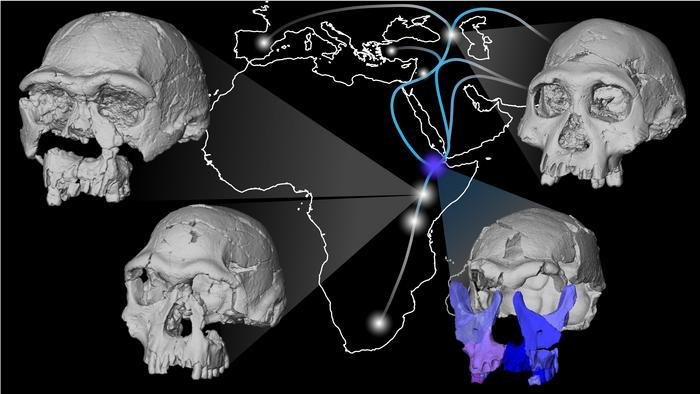
A recently reconstructed fossil face from northern Ethiopia is redefining how scientists understand the early evolution and spread of Homo erectus, the first human ancestor to have ventured out of Africa. The fossil, known as DAN5, dates back to approximately 1.6 to 1.5 million years ago and represents the most complete Early Pleistocene hominin cranium ever discovered from the Horn of Africa.

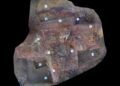
The fossils were found at the Gona site in the Afar region, which is well known for yielding some of the oldest hominin fossils and stone tools in the world. While parts of the skull were first described several years ago, new virtual reconstruction techniques have now allowed researchers to digitally reassemble fragmented facial bones and teeth and attach them to previously known parts. This produced a detailed face that offers rare insight into a critical moment in human evolution.
The skull has a mix of traits. Its braincase closely matches that of Homo erectus, a species associated with more modern body proportions, long-distance travel, and advanced methods of stone tool manufacture. Yet the face and teeth are unexpectedly primitive. The presence of large molars and a relatively flat, narrow nasal bridge is more typical of earlier Homo relatives, such as Homo habilis. The brain size is also smaller than what is usually seen in later African Homo erectus fossils of similar age.
This mosaic anatomy implies that early Homo erectus populations were much more diverse than previously believed. Comparable combinations of archaic and derived traits had been documented before in 1.8-million-year-old fossils from Dmanisi in Georgia, and some researchers proposed that Homo erectus may have evolved outside Africa. The Ethiopian fossil complicates that narrative. DAN5 indicates the existence of similar transitional forms in Africa, and these older features persisted there for hundreds of thousands of years after the first dispersals out of the continent.
The fossil is also significant from a behavioral perspective. At Gona, DAN5 is associated with both simple Oldowan stone tools and early Acheulian hand axes, giving the earliest direct evidence that a single species of hominins produced both tool technologies. This indicates that technological innovation did not follow a linear path, linked to a single anatomical form.


Researchers highlight that this discovery signifies a complex evolutionary transition rather than a sharp boundary between different species. The presence of small-brained, archaic-looking Homo alongside more derived populations provides strong evidence of overlapping lineages and possibly even interbreeding among early members of our genus. Future studies comparing this species with younger fossils from Europe, including specimens attributed to Homo erectus and Homo antecessor, would provide a better clue to understanding how facial diversity evolved as humans spread across the Old World.
The DAN5 reconstruction underscores how incomplete the fossil record remains and how much there is still to discover.














Disclaimer: This website is a science-focused magazine that welcomes both academic and non-academic audiences. Comments are written by users and may include personal opinions or unverified claims. They do not necessarily reflect the views of our editorial team or rely on scientific evidence.
Comment Policy: We kindly ask all commenters to engage respectfully. Comments that contain offensive, insulting, degrading, discriminatory, or racist content will be automatically removed.