
Archaeologists have taken a significant step toward understanding one of the most striking Roman mosaics ever unearthed in Britain. A new study from the University of Leicester has confirmed that the celebrated Ketton mosaic in Rutland does not follow the familiar storyline of Homer’s Iliad, as originally assumed. Instead, it draws from a different and largely lost retelling of the Trojan War — one attributed to the Greek tragedian Aeschylus — which circulated in antiquity but survives today only through indirect references.

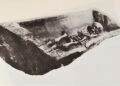
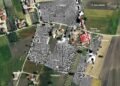
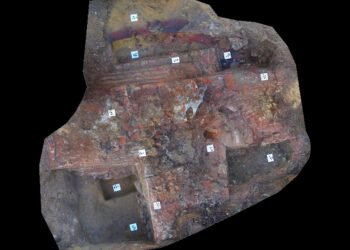
Found by the local resident Jim Irvine during lockdown in 2020, the mosaic instantly attracted national attention for its size, artistic quality, and remarkably well-preserved scenes. Large-scale excavations immediately took place by the University of Leicester Archaeological Services and Historic England; the villa complex was quickly granted Scheduled Monument status. The newly published research now reshapes how specialists interpret both the mosaic and the cultural world that produced it.
Set out in three dramatic panels, the artwork follows the clash between Achilles and Hector, the dragging of the Trojan prince’s body, and the final moment when King Priam seeks its return. It is the last scene that shows the strongest break from Homer. Rather than describing a negotiation over talents of gold, the mosaic depicts Priam placing heavy gold vessels onto a set of scales to match the weight of his son’s body, a detail which aligns with the now-lost tragedy Phrygians. This narrative choice suggests that the villa’s owner favored a more erudite and less widespread version of the myth, one that would have signaled learning and sophistication.
Researchers also found that the mosaic’s design was anything but a provincial improvisation: many of its elements can be traced to artistic patterns circulating in the Mediterranean for hundreds of years. The image of Hector standing in his chariot is very close to a second-century coin from Ilion; the image of Achilles dragging the body is very similar to an Attic vase from circa 490 BCE. The small touches, like the snake beneath the horses, are also Greek models. The central weighing scene has a close parallel in a silver jug from Roman Gaul. Taken together, these parallels confirm that the craftsmen working in Rutland were part of an extensive network, drawing on visual templates passed down by generations of artists across the empire.

This study shows how stories of the Trojan War moved not only through texts but through a shared repertoire of images created in pottery, silverware, coinage, and mosaics. The Ketton mosaic is evidence that people in late Roman Britain were not in a state of cultural isolation but drew upon the same artistic and intellectual currents that gave form to the wider classical world.
This new interpretation deepens our understanding of the site’s inhabitants and the choices behind the artwork’s creation. It suggests a household eager to present itself as connected, educated, and attuned to the prestige of classical myth.
More information: University of Leicester













Disclaimer: This website is a science-focused magazine that welcomes both academic and non-academic audiences. Comments are written by users and may include personal opinions or unverified claims. They do not necessarily reflect the views of our editorial team or rely on scientific evidence.
Comment Policy: We kindly ask all commenters to engage respectfully. Comments that contain offensive, insulting, degrading, discriminatory, or racist content will be automatically removed.
To answer the question “why” about the Ketton mosaic, maybe read the book “Where Troy once stood” (Iman Wilkens, 1990).
Are archaeology and a theory coming together?