
Researchers studying Neolithic Catalonia have provided new insight into how ancient people used large seashells as powerful sound-making devices, which likely carried messages over long distances and may also have served a musical purpose. The research focuses on Charonia lampas shells found at several sites dating to the late fifth and early fourth millennium BCE and now confirmed to be among the most acoustically potent instruments known from prehistory.

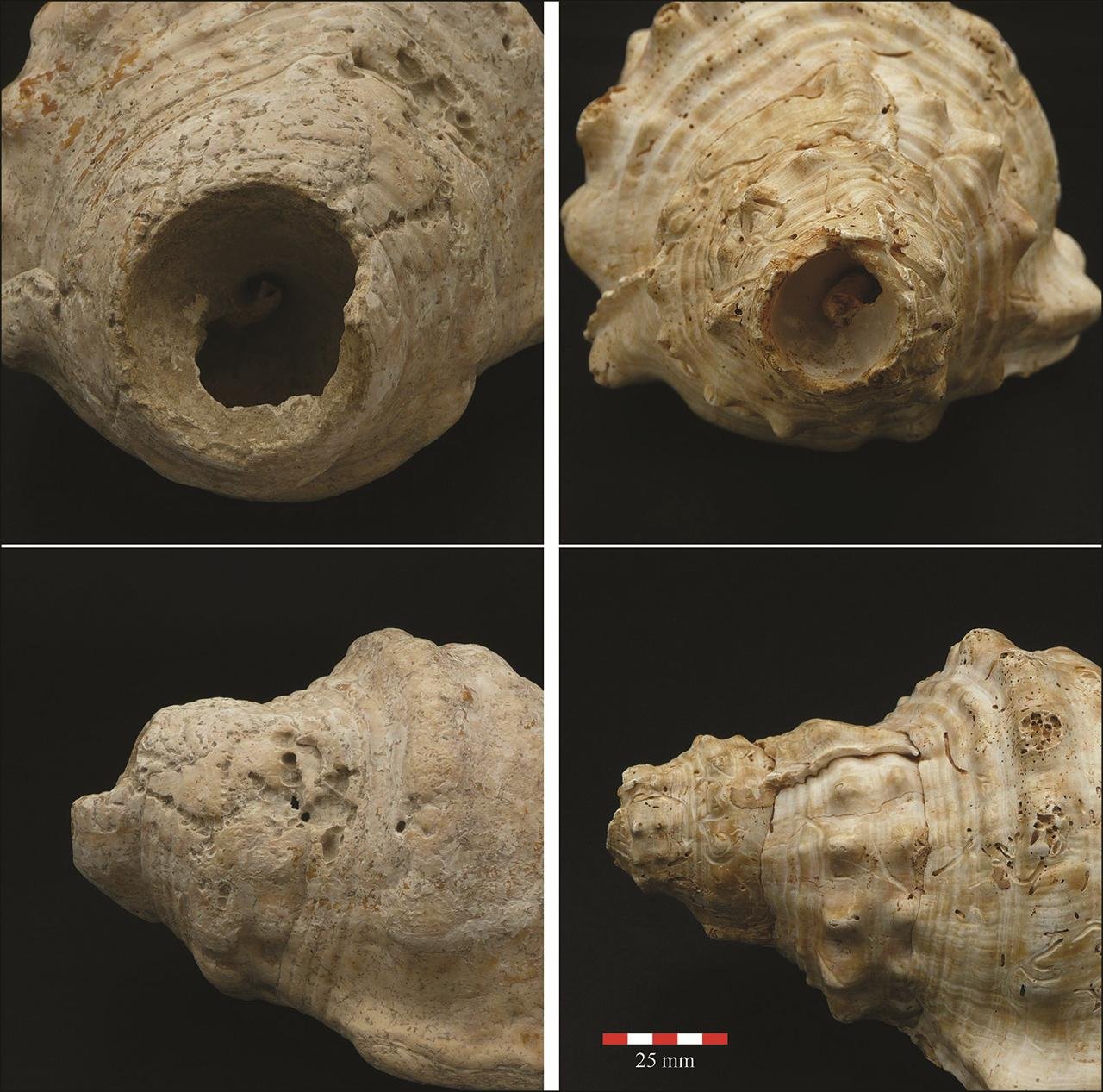
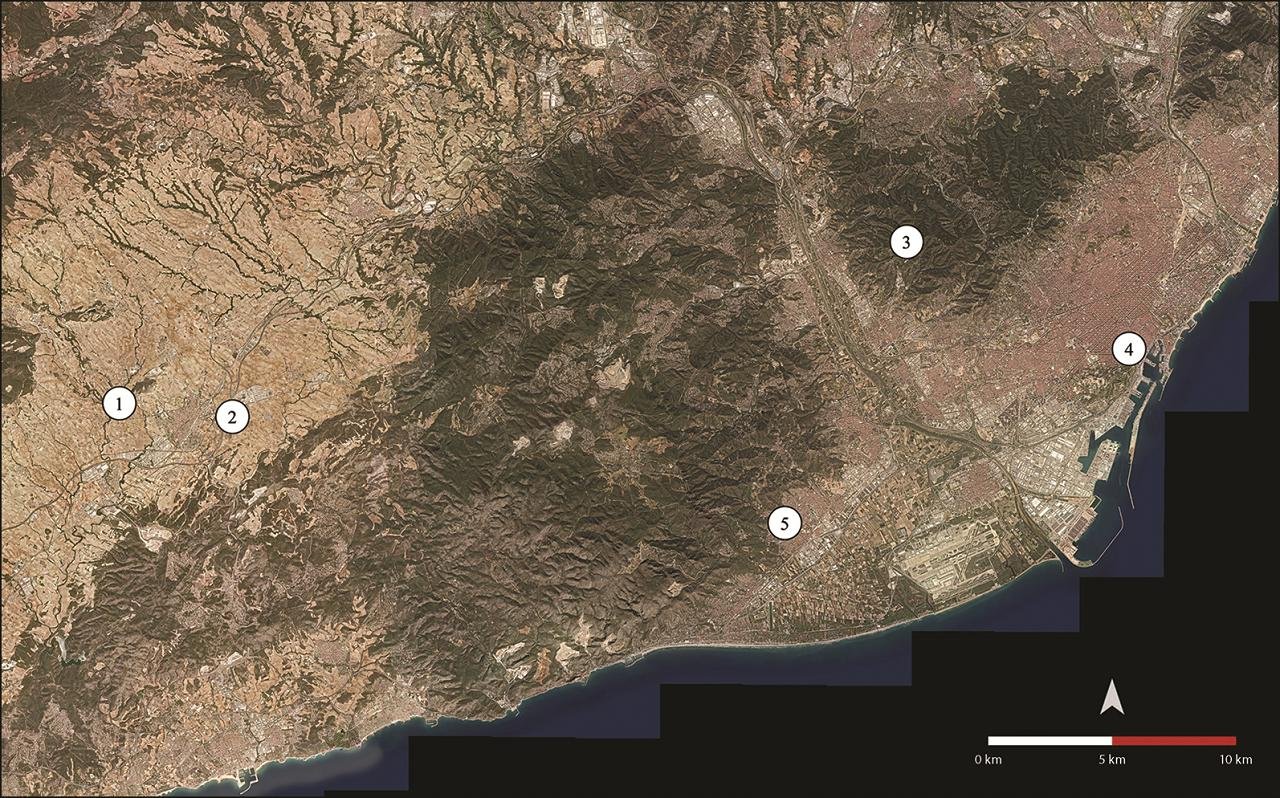
More than a dozen such shells have been found within the relatively small region stretching from the lower Llobregat River across to the Penedès depression and parts of the Barcelona plain. Their apexes have been carefully removed, suggesting intentional modification, and traces on the shells reveal that these were collected after the molluscs had died. This suggests that the shells were not collected for food but solely for their acoustic qualities.
A team from the University of Barcelona analyzed the best-preserved specimens and, for the first time, systematically played them to assess their sound. Eight shells were well enough preserved to be tested. When blown, they produced extremely loud tones, capable of carrying across distance and terrain. Their sound pressure levels, in acoustic terms, are higher than any other known device from the prehistoric era; thus, they served as effective signaling tools for communities across farmland, upland zones, and mining areas.
These findings help explain why the instruments appear concentrated in regions believed to have supported dense Neolithic populations. At sites like Mas d’en Boixos, Cal Pere Pastor, and the Gavà mines, where variscite was extracted for widely traded ornaments, shell trumpets may have coordinated activities among workers, farmers, and nearby settlements. In environments where visibility was limited, their penetrating sound could transmit information well beyond the reach of the human voice.
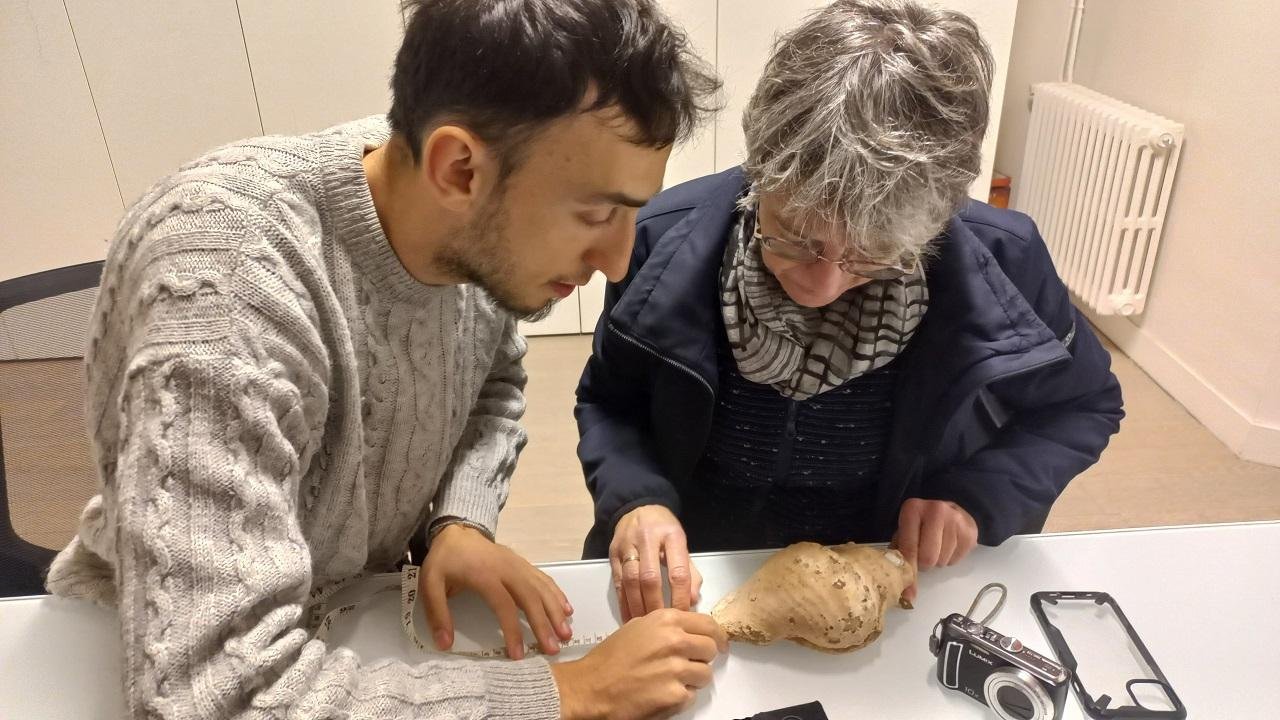
Miquel López-Garcia playing one of the shell trumpets. Credit: López-Garcia, M., & Díaz-Andreu, M., Antiquity Publications Ltd (2025)
Yet the study demonstrates that these shells were not purely functional. Several instruments are capable of producing as many as three reasonably stable notes, and skilled manipulation, through various techniques such as bending or hand-stopping, allows for subtle pitch changes along with melodic effects. Though such techniques decrease volume, they demonstrate the shells’ expressive potential. Some experiments even explored alternative methods, including relaxed lip vibrations that generate low, rough tones, or attempts to use the shells as voice modifiers, though those yielded limited results.
One question that remains open is whether the Neolithic people intentionally selected shells of a particular size to reach a preferred pitch. The fundamental frequency in shells depends on the length of the specimen, and the Catalonian specimens cluster between 400 and 470 Hz, which is higher than those found in many other regions. This suggests that shells of medium size might have been the most suitable, balancing power with portability and tonal clarity.
Taken together, these studies demonstrate that these instruments were far more than simple noisemakers. Their ability to carry sound across landscapes made them crucial tools for coordination and communication, while their musical qualities hint at richer forms of expression. By shaping how people interacted across space, the shell trumpets played an active role in the social and economic rhythms of Neolithic life.

















Disclaimer: This website is a science-focused magazine that welcomes both academic and non-academic audiences. Comments are written by users and may include personal opinions or unverified claims. They do not necessarily reflect the views of our editorial team or rely on scientific evidence.
Comment Policy: We kindly ask all commenters to engage respectfully. Comments that contain offensive, insulting, degrading, discriminatory, or racist content will be automatically removed.