
Archaeologists have identified an unknown area rich in Stone Age rock paintings near the municipality of Tingvoll in Møre og Romsdal, western Norway, opening up a new chapter in one of Northern Europe’s most important prehistoric art landscapes. Tingvoll is an area rich in rock art, with 25 documented panels spread across two main locations. The new discovery, however, represents a separate and distinct rock art area that had not been recognized before.
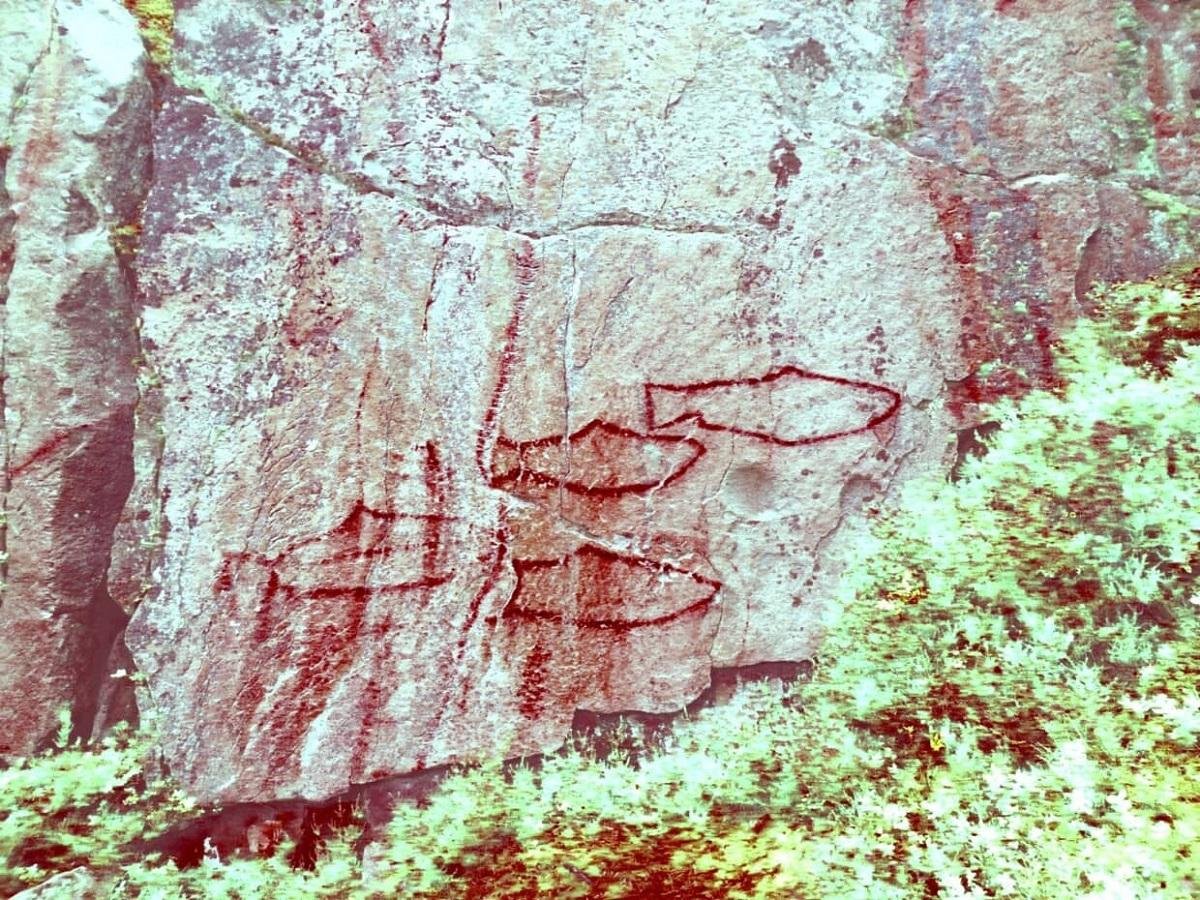
These paintings were observed during recent fieldwork by researchers from the Norwegian Institute for Cultural Heritage Research (NIKU) and the NTNU University Museum. While the initial goal of the team was to record and assess known sites at Hunnhammar, they were able to observe faint traces of pigment on a rock surface in difficult terrain, which were confirmed to be deliberate human paintings made thousands of years ago.
In contrast to petroglyphs, which are rock carvings, the Tingvoll images are rock paintings created by applying pigment, often red ochre, to the rock surface. While it is challenging to date rock paintings accurately, it is believed that paintings of this kind in Scandinavia are typically between 3,000 and 7,000 years old, dating to the Stone Age. The recently identified motifs include a fish figure, likely representing salmon or halibut, and geometric symbols believed to depict a boat. These images suggest that fishing and maritime activities had great significance in the lives and beliefs of the region’s prehistoric communities.
Digital documentation methods were crucial for confirming this discovery. Through the manipulation of color and the enhancement of contrast in high-resolution images, researchers were able to distinguish painted lines from natural cracks and mineral staining in the rock. Such processes are indicative of modern shifts that have occurred in the search for and identification of rock art. Instead of focusing only on large cliff faces, artworks are now known to also exist on smaller rock surfaces, often near ancient shorelines.

At the same time, the discovery also brings to the fore the alarming rate at which rock art is deteriorating. These paintings are found on exposed stone surfaces and are constantly affected by weathering, frost damage, and the biological growth of moss and lichens. It should be noted that temperature fluctuations around the freezing point could accelerate this degradation. Experts from the world-leading stone conservation community in Potsdam, Germany, have been brought in to assess the condition of the panels and help preserve and, where possible, conserve some of the rock art so that it does not disappear at its current rate.

At the moment, the locations of the newly discovered paintings are not being made public. It is hoped that, by doing so, the paintings will be protected from vandalism and unintentional harm, which have already caused the destruction of several known rock paintings in Tingvoll. Researchers believe that many more rock paintings are yet to be discovered in the area, some of which are not even noticeable to the naked eye.
More information: Norwegian Institute for Cultural Heritage Research











Disclaimer: This website is a science-focused magazine that welcomes both academic and non-academic audiences. Comments are written by users and may include personal opinions or unverified claims. They do not necessarily reflect the views of our editorial team or rely on scientific evidence.
Comment Policy: We kindly ask all commenters to engage respectfully. Comments that contain offensive, insulting, degrading, discriminatory, or racist content will be automatically removed.