• About
  • Privacy Policy
  • Terms of Use
  • Donation
  • Contact
No Result
View All Result
Archaeology News
  • Home
  • News
    • Archaeology
    • Anthropology
    • Paleontology
  • Academic
    • Books
    • Conferences
    • Universities
  • Articles
  • VR Tours
  • Quiz & Game
  • Download
  • Encyclopedia
  • Forum
Archaeology News
No Result
View All Result
Home News Anthropology

Casablanca fossils dated 773,000 years back reveal African origin of last common ancestor of humans and Neanderthals

by Dario Radley
January 10, 2026

A set of ancient human bones from Casablanca reshapes how we think about early human history. New research places a key ancestral population of modern humans and Neanderthals in northwest Africa around 773,000 years ago. The study draws on fossils, stone tools, and precise geological dating from a cave known as the Grotte à Hominidés at Thomas Quarry I in Morocco.
Casablanca fossils dated 773,000 years back reveal African origin of last common ancestor of humans and Neanderthals
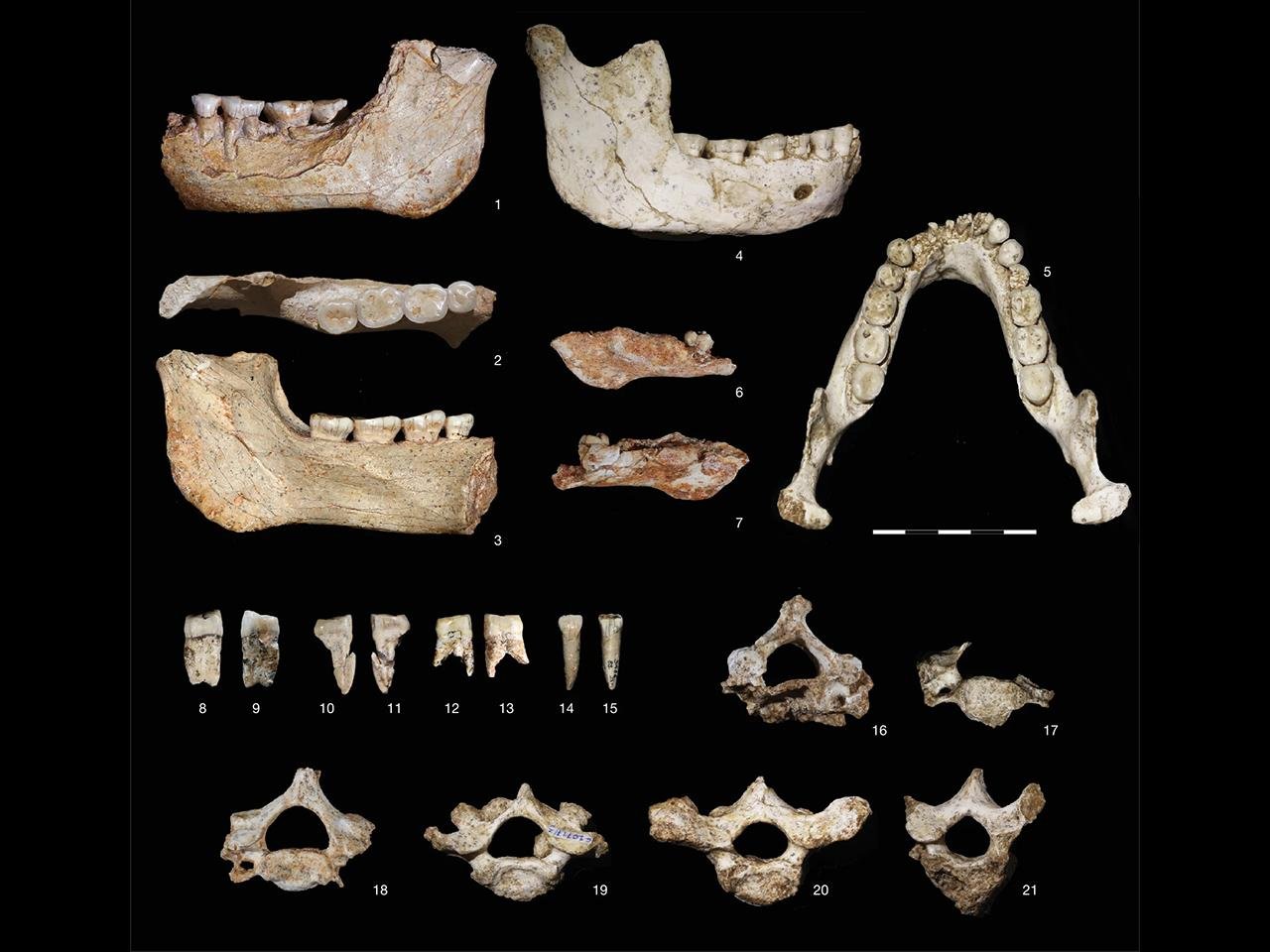
Hominin specimens from the Grotte à Hominidés at Thomas Quarry I in Morocco. Credit: J.P. Raynal, Programme Préhistoire de Casablanca

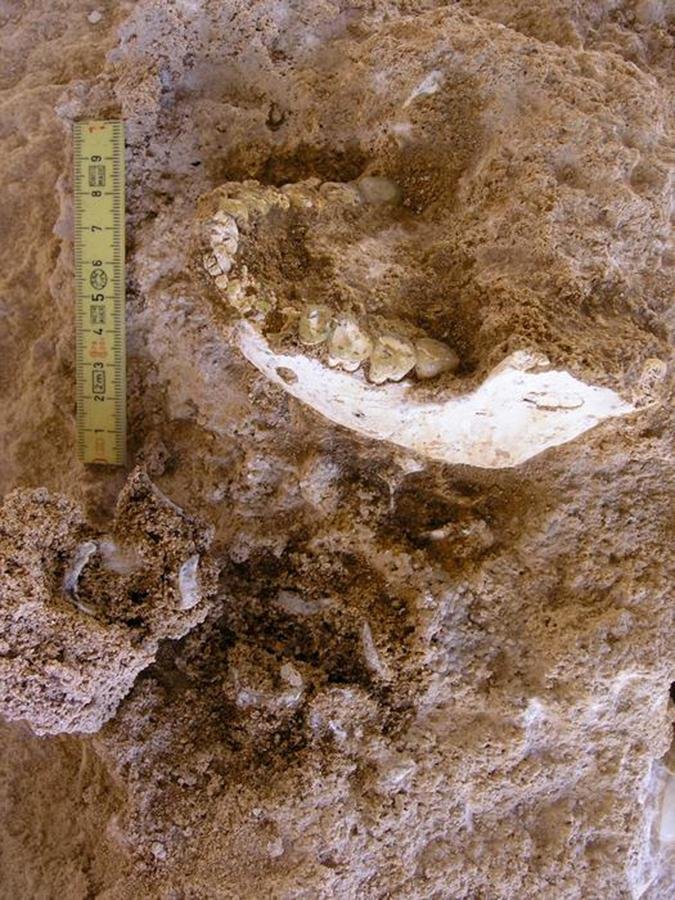
The research team analyzed partial lower jaws from two adults and one child, several vertebrae, and many teeth. Tooth structure and jaw shape show a mix of older features seen in Homo erectus and newer traits linked to later humans. This pattern points to a population close to the shared origin of Homo sapiens, Neanderthals, and Denisovans. You see neither a clear match with Homo erectus nor with Homo antecessor from Spain, even though all groups lived around the same period.

Dating plays a central role in this work. The team tested 180 sediment samples from the cave and tracked a global reversal in Earth’s magnetic field known as the Matuyama–Brunhes transition. This event occurred about 773,000 years ago and provides one of the most reliable time markers available. Sediments holding the fossils formed during this reversal, giving you a rare level of chronological precision for African human remains from this era.

The cave served as a carnivore den during the Early Pleistocene. Bite marks on a leg bone suggest hyenas fed on human bodies. Stone tools found nearby link these people to early Acheulean technology, which spread across Africa more than one million years ago. Together, bones, tools, and sediments form a tight package of evidence tied to a specific moment in deep time.
Casablanca fossils dated 773,000 years back reveal African origin of last common ancestor of humans and Neanderthals
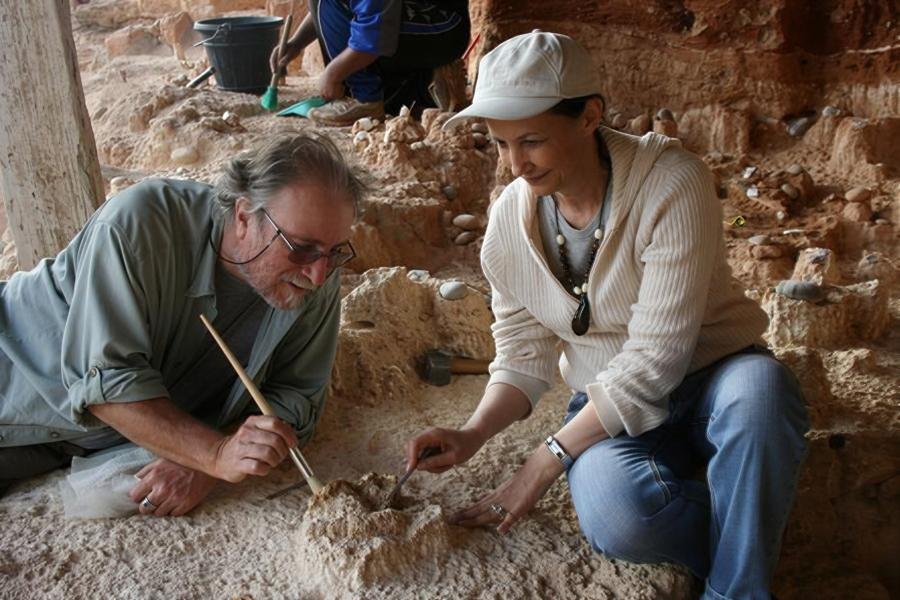
Jean-Paul Raynal and Fatima Zohra Sihi-Alaoui, co-directors of the program “Préhistoire de Casablanca” throughout the excavation that led to the discovery of the mandible ThI-GH-10717, in May 2008. Credit: R. Gallotti, Programme Préhistoire de Casablanca

For decades, fossil gaps between one million and 600,000 years ago limited efforts to trace human origins. Genetic studies placed the shared ancestor of modern humans and Neanderthals within this window, yet physical remains stayed scarce. The Moroccan fossils narrow this gap and shift attention toward northwest Africa. You no longer need to look only to eastern or southern Africa for crucial stages of human evolution.


RelatedStories

Oldest known rock art dated to 67,800 years discovered in Sulawesi cave

Oldest known rock art dated to 67,800 years discovered in Sulawesi cave

January 20, 2026
60,000-year-old poison arrows from South Africa reveal the world’s earliest poisoned weapons and advanced hunting techniques

60,000-year-old poison arrows from South Africa reveal the world’s earliest poisoned weapons and advanced hunting techniques

January 8, 2026

Comparisons with European fossils add another layer. Homo antecessor from Atapuerca in Spain shows early signs of Neanderthal traits. The Moroccan remains share some broad similarities in age and anatomy, yet detailed scans of tooth structure reveal clear differences. Internal tooth features, studied with micro-CT imaging, separate the Casablanca group from both Homo erectus and Homo antecessor. This result supports the idea of early population diversity across Africa and southern Europe rather than a single ancestral form.
Casablanca fossils dated 773,000 years back reveal African origin of last common ancestor of humans and Neanderthals
Thomas Quarry I, Grotte à Hominidés: Mandible ThI-GH-10717 during the excavation. Credit: J.P. Raynal, Programme Préhistoire de Casablanca

The wider setting strengthens the case. The Atlantic coast near Casablanca preserves raised shorelines, dunes, and caves formed by changing sea levels. Rapid burial of sediments helped protect fossils and tools. Long-term fieldwork in this region has already documented early human occupations and environmental shifts. The new finds build on decades of careful excavation and stratigraphic study.

You gain a clearer picture of where the roots of modern humanity lie. The earliest confirmed Homo sapiens fossils date to about 300,000 years ago at Jebel Irhoud, also in Morocco. The Thomas Quarry hominins lived roughly half a million years earlier and show traits leading toward later humans. Genetic estimates place the split between modern humans and Neanderthals between about 765,000 and 550,000 years ago. The Moroccan fossils align with the older end of this range.

This evidence points to Africa as the deep source of our lineage, with northwest Africa playing a central role. Population movements across the Sahara during wetter phases likely linked regions rather than isolating them. For you as a reader, the message stays direct. Human evolution involved multiple African populations, long before the appearance of our own species, and northwest Africa now stands at the center of this story.
More information: Hublin, JJ., Lefèvre, D., Perini, S. et al. (2026). Early hominins from Morocco basal to the Homo sapiens lineage. Nature. doi:10.1038/s41586-025-09914-y
ShareTweetShareShareSend

You May Also Like...

Oldest known rock art dated to 67,800 years discovered in Sulawesi cave
Archaeology

Oldest known rock art dated to 67,800 years discovered in Sulawesi cave

January 20, 2026
Roman marching camps discovered in Saxony-Anhalt reveal early military advances deep into Germania
Archaeology

Roman marching camps discovered in Saxony-Anhalt reveal early military advances deep into Germania

January 15, 2026
60,000-year-old poison arrows from South Africa reveal the world’s earliest poisoned weapons and advanced hunting techniques
Archaeology

60,000-year-old poison arrows from South Africa reveal the world’s earliest poisoned weapons and advanced hunting techniques

January 8, 2026
Inscribed clay cylinders reveal Nebuchadnezzar II’s restoration of the Kish Ziggurat
Archaeology

Inscribed clay cylinders reveal Nebuchadnezzar II’s restoration of the Kish Ziggurat

January 7, 2026
Rare Late Roman mosaic with Solomon’s Knot discovered beneath modern İzmir
Archaeology

Rare Late Roman mosaic with Solomon’s Knot discovered beneath modern İzmir

January 7, 2026
1130 depiction of Saxons, Jutes, and Angles crossing the sea to Britain. Credit: Wikimedia / CC BY-SA 4.0. Roots of medieval migration into England uncovered by large-scale bioarchaeological study
Anthropology

Roots of medieval migration into England uncovered by large-scale bioarchaeological study

January 6, 2026

Comments 0

  1. Editorial Team says:
    1 second ago

    Disclaimer: This website is a science-focused magazine that welcomes both academic and non-academic audiences. Comments are written by users and may include personal opinions or unverified claims. They do not necessarily reflect the views of our editorial team or rely on scientific evidence.

    Comment Policy: We kindly ask all commenters to engage respectfully. Comments that contain offensive, insulting, degrading, discriminatory, or racist content will be automatically removed.

    Reply

Leave a Reply Cancel reply

Your email address will not be published. Required fields are marked *

Follow us


Instagram
244K

Facebook
118K

Threads
45K

LinkedIn
14K

Twitter
6K

YouTube
1K
  • Trending
  • Comments
  • Latest
Shipwreck Salvage. Credit: rawpixel.com / Public Domain

2,000-year-old shipwreck discovered off Turkish coast with remarkably preserved stacked ceramics

July 2, 2025
Viking age DNA reveals 9,000-year-old HIV-resistant gene originating near the Black Sea

Viking age DNA reveals 9,000-year-old HIV-resistant gene originating near the Black Sea

May 18, 2025
A new study suggests the mysterious Voynich Manuscript may be a medieval cipher

A new study suggests the mysterious Voynich Manuscript may be a medieval cipher

January 3, 2026
Moses may be named in ancient Egyptian mine inscriptions, sparking debate over earliest biblical references

Moses may be named in ancient Egyptian mine inscriptions, sparking debate over earliest biblical references

July 31, 2025
Mystery of Armenia’s 6,000-year-old dragon stones solved

Mystery of Armenia’s 6,000-year-old dragon stones solved

September 23, 2025
3D analysis reveals Shroud of Turin image likely came from sculpture, not Jesus’ body

3D analysis reveals Shroud of Turin image likely came from sculpture, not Jesus’ body

Moses may be named in ancient Egyptian mine inscriptions, sparking debate over earliest biblical references

Moses may be named in ancient Egyptian mine inscriptions, sparking debate over earliest biblical references

$1 million prize offered to decipher 5,300-year-old Indus Valley script

$1 million prize offered to decipher 5,300-year-old Indus Valley script

Oldest ever genetic data from a human relative found in 2-million-year-old fossilized teeth

Oldest ever genetic data from a human relative found in 2-million-year-old fossilized teeth

Exceptionally large Roman shoes discovered at Magna fort near Hadrian’s Wall

Exceptionally large Roman shoes discovered at Magna fort near Hadrian’s Wall

Oldest known rock art dated to 67,800 years discovered in Sulawesi cave

Oldest known rock art dated to 67,800 years discovered in Sulawesi cave

January 20, 2026
Roman marching camps discovered in Saxony-Anhalt reveal early military advances deep into Germania

Roman marching camps discovered in Saxony-Anhalt reveal early military advances deep into Germania

January 15, 2026
Casablanca fossils dated 773,000 years back reveal African origin of last common ancestor of humans and Neanderthals

Casablanca fossils dated 773,000 years back reveal African origin of last common ancestor of humans and Neanderthals

January 10, 2026
60,000-year-old poison arrows from South Africa reveal the world’s earliest poisoned weapons and advanced hunting techniques

60,000-year-old poison arrows from South Africa reveal the world’s earliest poisoned weapons and advanced hunting techniques

January 8, 2026
Inscribed clay cylinders reveal Nebuchadnezzar II’s restoration of the Kish Ziggurat

Inscribed clay cylinders reveal Nebuchadnezzar II’s restoration of the Kish Ziggurat

January 7, 2026

Archaeology News online magazine

Archaeology News is an international online magazine that covers all aspects of archaeology.


Categories

  • Academics
    • Books
    • Conferences
    • Universities
  • Articles
  • Download
  • Game
  • News
    • Anthropology
    • Archaeology
    • Paleontology
  • Quiz
  • Tours

Subscribe to our newsletter

© 2024 - Archaeology News Online Magazine. All Rights Reserved.

  • About
  • Privacy Policy
  • Terms of Use
  • Donation
  • Contact

Welcome Back!

Login to your account below

Forgotten Password? Sign Up

Create New Account!

Fill the forms below to register

All fields are required. Log In

Retrieve your password

Please enter your username or email address to reset your password.

Log In

Add New Playlist

Manage Consent
To provide the best experiences, we use technologies like cookies to store and/or access device information. Consenting to these technologies will allow us to process data such as browsing behavior or unique IDs on this site. Not consenting or withdrawing consent, may adversely affect certain features and functions.
Functional Always active
The technical storage or access is strictly necessary for the legitimate purpose of enabling the use of a specific service explicitly requested by the subscriber or user, or for the sole purpose of carrying out the transmission of a communication over an electronic communications network.
Preferences
The technical storage or access is necessary for the legitimate purpose of storing preferences that are not requested by the subscriber or user.
Statistics
The technical storage or access that is used exclusively for statistical purposes. The technical storage or access that is used exclusively for anonymous statistical purposes. Without a subpoena, voluntary compliance on the part of your Internet Service Provider, or additional records from a third party, information stored or retrieved for this purpose alone cannot usually be used to identify you.
Marketing
The technical storage or access is required to create user profiles to send advertising, or to track the user on a website or across several websites for similar marketing purposes.
  • Manage options
  • Manage services
  • Manage {vendor_count} vendors
  • Read more about these purposes
View preferences
  • {title}
  • {title}
  • {title}
  • Home
  • News
    • Archaeology
    • Anthropology
    • Paleontology
  • Academic
    • Books
    • Conferences
    • Universities
  • Articles
  • VR Tours
  • Quiz & Game
  • Download
  • Encyclopedia
  • Forum

About  .  Contact  .  Donation

© 2024 - Archaeology News Online Magazine. All Rights Reserved