• About
  • Privacy Policy
  • Terms of Use
  • Donation
  • Contact
No Result
View All Result
Archaeology News
  • Home
  • News
    • Archaeology
    • Anthropology
    • Paleontology
  • Academic
    • Books
    • Conferences
    • Universities
  • Articles
  • VR Tours
  • Quiz & Game
  • Download
  • Encyclopedia
  • Forum
Archaeology News
No Result
View All Result
Home News Archaeology

Republican-era tombs and a Hercules shrine unearthed in eastern Rome reveal centuries of suburban life

by Dario Radley
January 23, 2026

Archaeological excavations at Parco delle Acacie in the Pietralata district of eastern Rome have revealed a long and complex history of settlement outside the ancient city walls. Work led by the Special Superintendency of Rome documents activity from the fifth or fourth century BCE through the first century CE, with weaker traces during the second and third centuries CE. The results challenge older views of Rome’s eastern outskirts as marginal zones with limited historical depth.
Republican-era tombs and a Hercules shrine unearthed in eastern Rome reveal centuries of suburban life
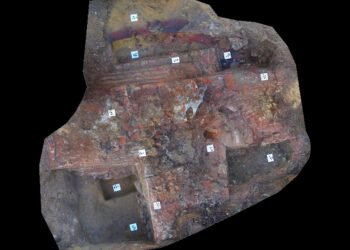
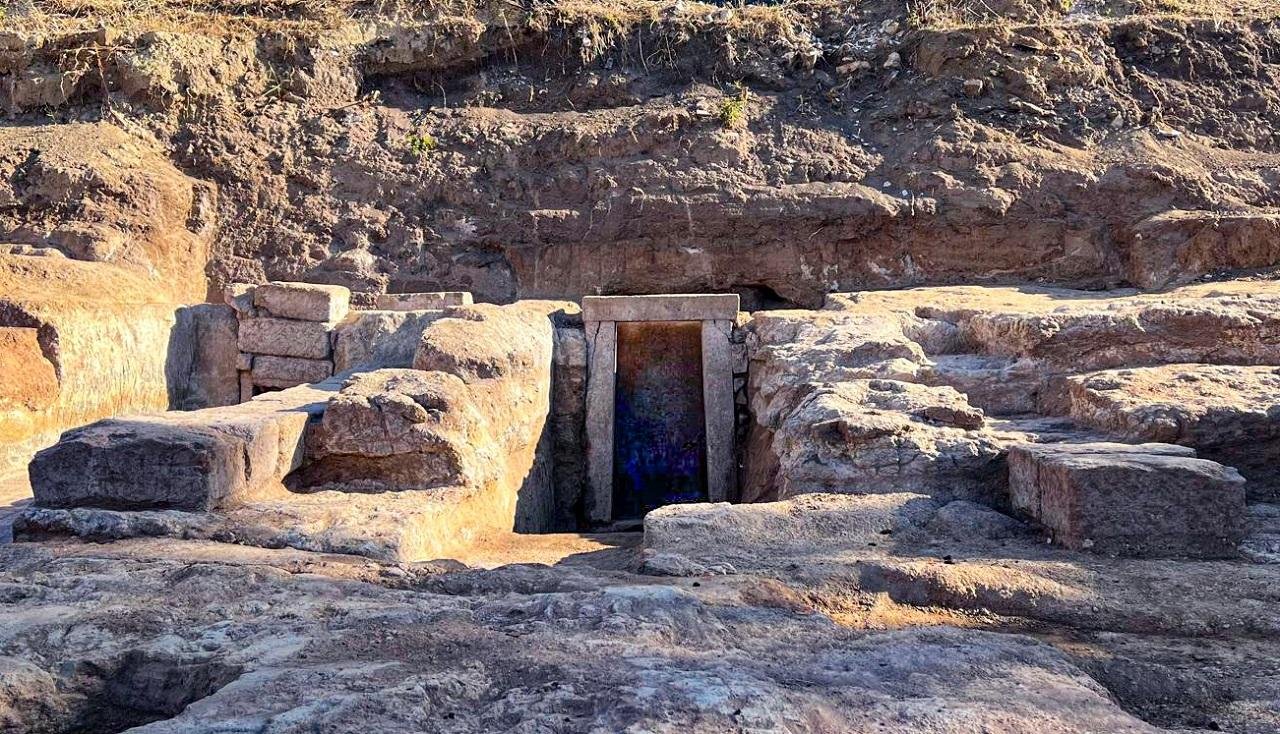
Archaeologists uncovered two tombs dating to the Roman Republic near Via Pietralata in northeastern Rome. Credit: Italian Ministry of Culture

The investigation began during the summer of 2022 as part of preventive archaeology connected to an urban development program. Excavations across roughly four hectares exposed an area of concentrated remains covering about one hectare. At the center of this context lies an ancient road aligned northwest to southeast, laid across terrain shaped by a watercourse flowing toward the Aniene River. One stretch of the route near Via di Pietralata consisted of compacted earth, while another section closer to Via Feronia was cut directly into tuff bedrock. Cart ruts preserved in the rock surface point to sustained traffic during the Republican period. Formal construction along this axis started during the third century BCE with a large retaining wall built of tuff blocks, replaced a century later by masonry in opus incertum. During the first century CE, new paving and flanking walls in opus reticulatum kept the route in use until gradual abandonment, marked by modest pit graves dating to the second and third centuries CE.

Along this road stood a small quadrangular sacellum measuring about 4.5 by 5.5 meters. The building featured walls in tuff opus incertum with traces of interior plaster. A square plastered base aligned with the entrance served as an altar, while a rear projection likely supported a cult statue. Excavation beneath the structure exposed a disused votive deposit with terracotta heads, feet, female figurines, and two bovine figures. Combined with the site’s position near the Via Tiburtina, these finds link the shrine to the cult of Hercules, a protective deity widely honored in Republican Rome. Bronze coins date construction of the sacellum to the late third or second century BCE.

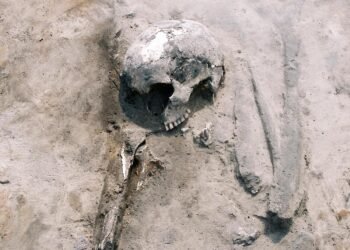
Nearby, a single funerary complex contained two elite chamber tombs accessed through parallel corridors. Tomb A, dated to the fourth or early third century BCE, held a peperino sarcophagus and three cremation urns, accompanied by fine ceramic vessels, black glazed cups, and a bronze mirror. Tomb B, probably slightly later, contained benches for inhumation and the remains of an adult male skull bearing evidence of surgical trepanation. The scale and architecture of both tombs point to ownership by a wealthy Roman gens controlling this territory during the Republican era.
Republican-era tombs and a Hercules shrine unearthed in eastern Rome reveal centuries of suburban life
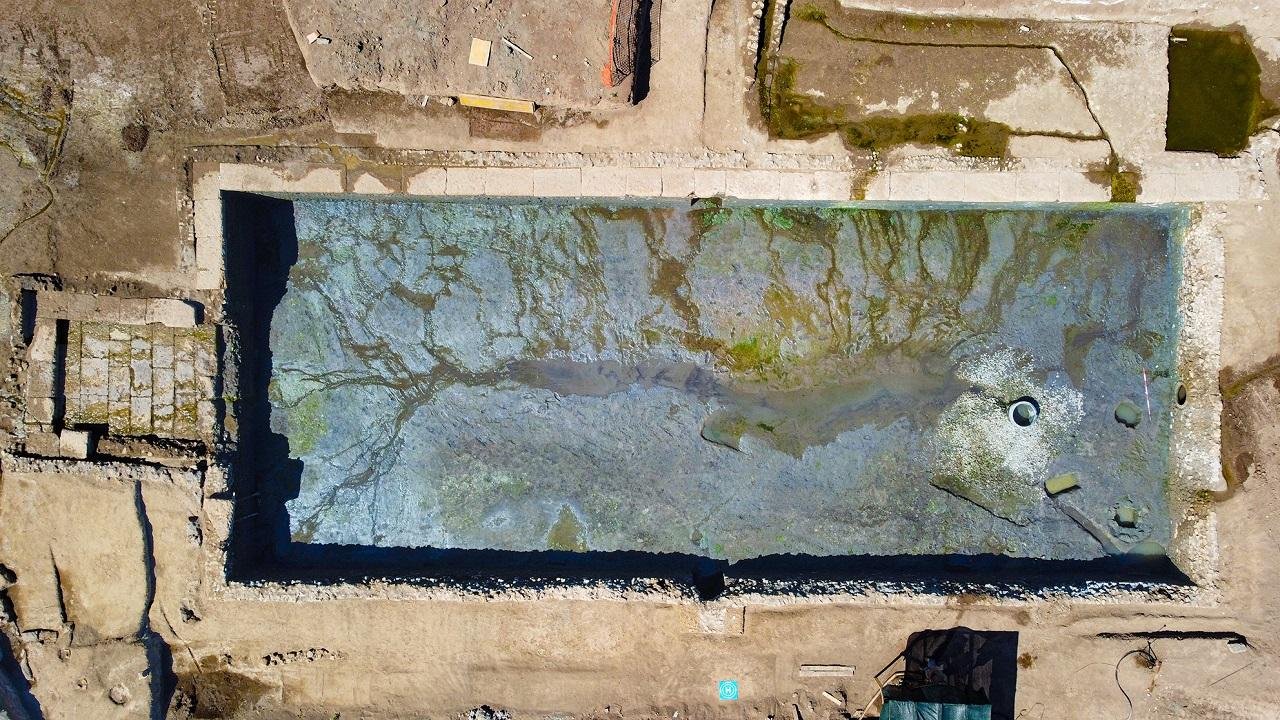
One of two large water tanks uncovered during the excavations. Credit: Italian Ministry of Culture

The most imposing features at the site are two monumental basins. The eastern basin measured about 28 by 10 meters and reached a depth of just over two meters. Built during the second century BCE in opus incertum, the structure included vaulted niches, a dolium set into concrete, and a ramp descending partway into the interior. Channels supplied water from the nearby stream and hillside. Architectural terracottas and inscribed ceramic fragments recovered from the fill suggest ritual activity, although productive functions also receive consideration. Decline began during the first century CE, with final closure by the end of the second century.


RelatedStories

Roman marching camps discovered in Saxony-Anhalt reveal early military advances deep into Germania

Roman marching camps discovered in Saxony-Anhalt reveal early military advances deep into Germania

January 15, 2026
Rare Late Roman mosaic with Solomon’s Knot discovered beneath modern İzmir

Rare Late Roman mosaic with Solomon’s Knot discovered beneath modern İzmir

January 7, 2026

A second basin to the south was cut directly into tuff bedrock and reached a depth of about four meters. Walls of squared blocks lined the exterior, with later additions in opus reticulatum and opus quadratum. Access involved two descending ramps paved with large stone blocks and concrete slabs. No clear inlet or outlet channels have appeared, leaving function unresolved. Similarities with a third century BCE basin excavated at Gabii, interpreted as sacred, support a ritual explanation. Ceramic material within the fill places abandonment during the second century CE.

Together, the road, shrine, tombs, and basins portray Pietralata as an active zone shaped by ritual, burial, movement, and water management across several centuries. Continued study aims to integrate these findings into a broader understanding of Rome as a dispersed city whose growth relied on peripheral areas as much as on monumental centers.

More information: Italian Ministry of Culture

ShareTweetShareShareSend

You May Also Like...

5,500-year-old human skeleton in Colombia reveals earliest evidence of syphilis in the Americas
Anthropology

5,500-year-old human skeleton in Colombia reveals earliest evidence of syphilis in the Americas

January 23, 2026
Oldest known rock art dated to 67,800 years discovered in Sulawesi cave
Archaeology

Oldest known rock art dated to 67,800 years discovered in Sulawesi cave

January 20, 2026
Roman marching camps discovered in Saxony-Anhalt reveal early military advances deep into Germania
Archaeology

Roman marching camps discovered in Saxony-Anhalt reveal early military advances deep into Germania

January 15, 2026
Casablanca fossils dated 773,000 years back reveal African origin of last common ancestor of humans and Neanderthals
Anthropology

Casablanca fossils dated 773,000 years back reveal African origin of last common ancestor of humans and Neanderthals

January 10, 2026
60,000-year-old poison arrows from South Africa reveal the world’s earliest poisoned weapons and advanced hunting techniques
Archaeology

60,000-year-old poison arrows from South Africa reveal the world’s earliest poisoned weapons and advanced hunting techniques

January 8, 2026
Inscribed clay cylinders reveal Nebuchadnezzar II’s restoration of the Kish Ziggurat
Archaeology

Inscribed clay cylinders reveal Nebuchadnezzar II’s restoration of the Kish Ziggurat

January 7, 2026

Comments 0

  1. Editorial Team says:
    1 second ago

    Disclaimer: This website is a science-focused magazine that welcomes both academic and non-academic audiences. Comments are written by users and may include personal opinions or unverified claims. They do not necessarily reflect the views of our editorial team or rely on scientific evidence.

    Comment Policy: We kindly ask all commenters to engage respectfully. Comments that contain offensive, insulting, degrading, discriminatory, or racist content will be automatically removed.

    Reply

Leave a Reply Cancel reply

Your email address will not be published. Required fields are marked *

Follow us


Instagram
244K

Facebook
118K

Threads
45K

LinkedIn
14K

Twitter
6K

YouTube
1K
  • Trending
  • Comments
  • Latest
Shipwreck Salvage. Credit: rawpixel.com / Public Domain

2,000-year-old shipwreck discovered off Turkish coast with remarkably preserved stacked ceramics

July 2, 2025
Viking age DNA reveals 9,000-year-old HIV-resistant gene originating near the Black Sea

Viking age DNA reveals 9,000-year-old HIV-resistant gene originating near the Black Sea

May 18, 2025
A new study suggests the mysterious Voynich Manuscript may be a medieval cipher

A new study suggests the mysterious Voynich Manuscript may be a medieval cipher

January 3, 2026
Moses may be named in ancient Egyptian mine inscriptions, sparking debate over earliest biblical references

Moses may be named in ancient Egyptian mine inscriptions, sparking debate over earliest biblical references

July 31, 2025
Mystery of Armenia’s 6,000-year-old dragon stones solved

Mystery of Armenia’s 6,000-year-old dragon stones solved

September 23, 2025
3D analysis reveals Shroud of Turin image likely came from sculpture, not Jesus’ body

3D analysis reveals Shroud of Turin image likely came from sculpture, not Jesus’ body

Moses may be named in ancient Egyptian mine inscriptions, sparking debate over earliest biblical references

Moses may be named in ancient Egyptian mine inscriptions, sparking debate over earliest biblical references

$1 million prize offered to decipher 5,300-year-old Indus Valley script

$1 million prize offered to decipher 5,300-year-old Indus Valley script

Oldest ever genetic data from a human relative found in 2-million-year-old fossilized teeth

Oldest ever genetic data from a human relative found in 2-million-year-old fossilized teeth

Exceptionally large Roman shoes discovered at Magna fort near Hadrian’s Wall

Exceptionally large Roman shoes discovered at Magna fort near Hadrian’s Wall

5,500-year-old human skeleton in Colombia reveals earliest evidence of syphilis in the Americas

5,500-year-old human skeleton in Colombia reveals earliest evidence of syphilis in the Americas

January 23, 2026
Republican-era tombs and a Hercules shrine unearthed in eastern Rome reveal centuries of suburban life

Republican-era tombs and a Hercules shrine unearthed in eastern Rome reveal centuries of suburban life

January 23, 2026
Oldest known rock art dated to 67,800 years discovered in Sulawesi cave

Oldest known rock art dated to 67,800 years discovered in Sulawesi cave

January 20, 2026
Roman marching camps discovered in Saxony-Anhalt reveal early military advances deep into Germania

Roman marching camps discovered in Saxony-Anhalt reveal early military advances deep into Germania

January 15, 2026
Casablanca fossils dated 773,000 years back reveal African origin of last common ancestor of humans and Neanderthals

Casablanca fossils dated 773,000 years back reveal African origin of last common ancestor of humans and Neanderthals

January 10, 2026

Archaeology News online magazine

Archaeology News is an international online magazine that covers all aspects of archaeology.


Categories

  • Academics
    • Books
    • Conferences
    • Universities
  • Articles
  • Download
  • Game
  • News
    • Anthropology
    • Archaeology
    • Paleontology
  • Quiz
  • Tours

Subscribe to our newsletter

© 2024 - Archaeology News Online Magazine. All Rights Reserved.

  • About
  • Privacy Policy
  • Terms of Use
  • Donation
  • Contact

Welcome Back!

Login to your account below

Forgotten Password? Sign Up

Create New Account!

Fill the forms below to register

All fields are required. Log In

Retrieve your password

Please enter your username or email address to reset your password.

Log In

Add New Playlist

Manage Consent
To provide the best experiences, we use technologies like cookies to store and/or access device information. Consenting to these technologies will allow us to process data such as browsing behavior or unique IDs on this site. Not consenting or withdrawing consent, may adversely affect certain features and functions.
Functional Always active
The technical storage or access is strictly necessary for the legitimate purpose of enabling the use of a specific service explicitly requested by the subscriber or user, or for the sole purpose of carrying out the transmission of a communication over an electronic communications network.
Preferences
The technical storage or access is necessary for the legitimate purpose of storing preferences that are not requested by the subscriber or user.
Statistics
The technical storage or access that is used exclusively for statistical purposes. The technical storage or access that is used exclusively for anonymous statistical purposes. Without a subpoena, voluntary compliance on the part of your Internet Service Provider, or additional records from a third party, information stored or retrieved for this purpose alone cannot usually be used to identify you.
Marketing
The technical storage or access is required to create user profiles to send advertising, or to track the user on a website or across several websites for similar marketing purposes.
  • Manage options
  • Manage services
  • Manage {vendor_count} vendors
  • Read more about these purposes
View preferences
  • {title}
  • {title}
  • {title}
  • Home
  • News
    • Archaeology
    • Anthropology
    • Paleontology
  • Academic
    • Books
    • Conferences
    • Universities
  • Articles
  • VR Tours
  • Quiz & Game
  • Download
  • Encyclopedia
  • Forum

About  .  Contact  .  Donation

© 2024 - Archaeology News Online Magazine. All Rights Reserved