• About
  • Privacy Policy
  • Terms of Use
  • Donation
  • Contact
No Result
View All Result
Archaeology News
  • Home
  • News
    • Archaeology
    • Anthropology
    • Paleontology
  • Academic
    • Books
    • Conferences
    • Universities
  • Articles
  • VR Tours
  • Quiz & Game
  • Download
  • Encyclopedia
  • Forum
Archaeology News
No Result
View All Result
Home News Archaeology

LiDAR mapping reveals over 630,000 historic charcoal kiln sites across Poland’s forests

by Dario Radley
February 5, 2026

Researchers from the Polish Academy of Sciences mapped more than 630,000 former charcoal kiln sites across Poland. The results show the size of an industry that supported metalworking, glass production, and other trades for centuries. The team combined airborne laser scanning with historical records, place names, and environmental data. These sources helped reconstruct patterns of forest use that written documents barely recorded.
LiDAR mapping reveals over 630,000 historic charcoal kiln sites across Poland’s forests
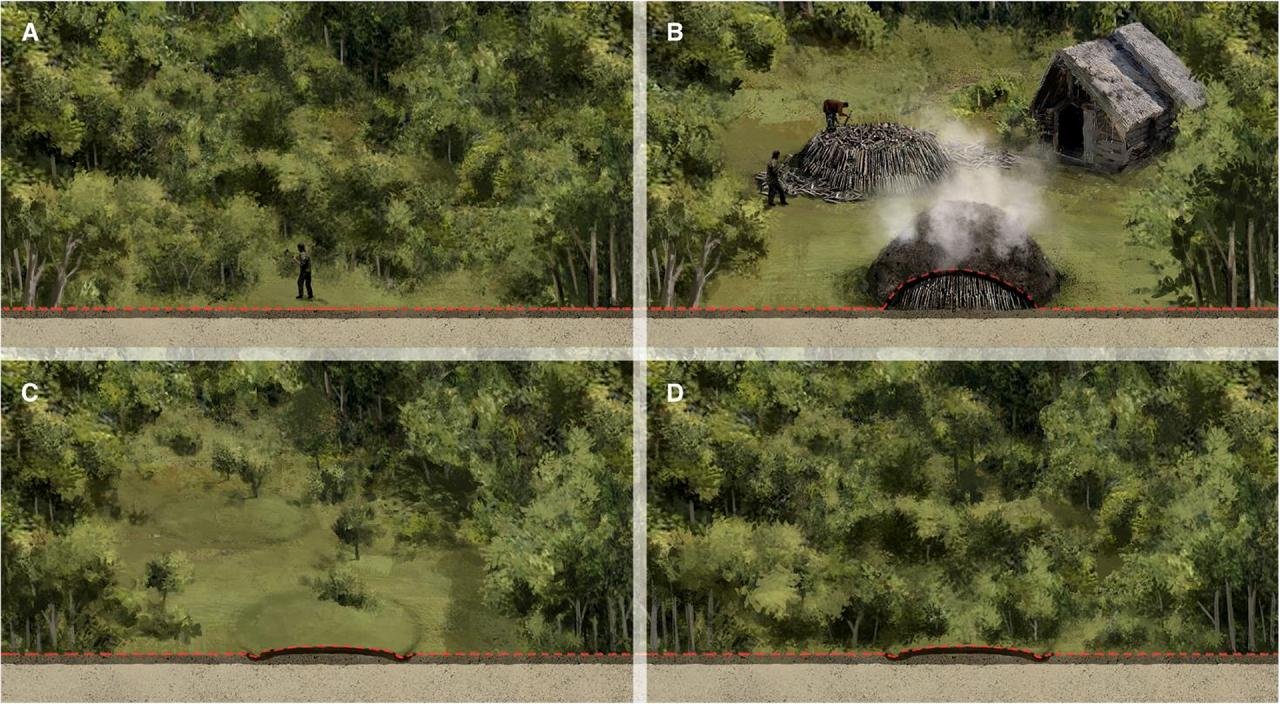
Progression of stages and environmental consequences of establishing and operating charcoal hearths. (A) Locating charcoal hearths site and forest logging. (B) Developing and operating of charcoal hearths. (C) Site abandoning after charcoal production. (D) Spontaneous regeneration and introduction of pioneer vegetation. Credit: Illustrations of the 3 phases were drawn by Tomasz Ryger / M. Słowiński et al., Elementa (Washington, D.C.) (2024); CC-BY 4.0

Charcoal served as a primary fuel for high-temperature work before coal became common. Iron smelting, tool forging, nail production, and glassmaking required steady heat between about 500 and 800 degrees Celsius. Charcoal provided this range more effectively than raw wood. Resin-rich timber processed through carbonization also produced tar and pitch for sealing boats and treating leather. Ash from the process yielded potash, which people used in gunpowder production. Daily economic activity in medieval and early modern Poland relied on these materials.

Workers followed a consistent production method. They stacked logs in a circular pile, often close to 10 meters wide. They covered the mound with turf and sand to restrict oxygen. Fire smoldered inside for 10 to 20 days at temperatures near 300 degrees Celsius. One burn consumed 200 to 250 cubic meters of wood, equal to timber from about half a hectare of forest. After each cycle, workers moved to a new location with fresh wood supplies. This mobile system left few permanent structures, which explains why earlier historians missed much of this work.

Forests rarely vanished from maps because cutters removed trees in shifting patches instead of clearing large areas for farming. Pollen records from lake sediments show repeated phases of forest thinning and regrowth in the same areas over long periods. Mapmakers marked the outer forest borders, while interior zones went through cycles of cutting and recovery. Later regrowth covered most surface traces of kiln activity.
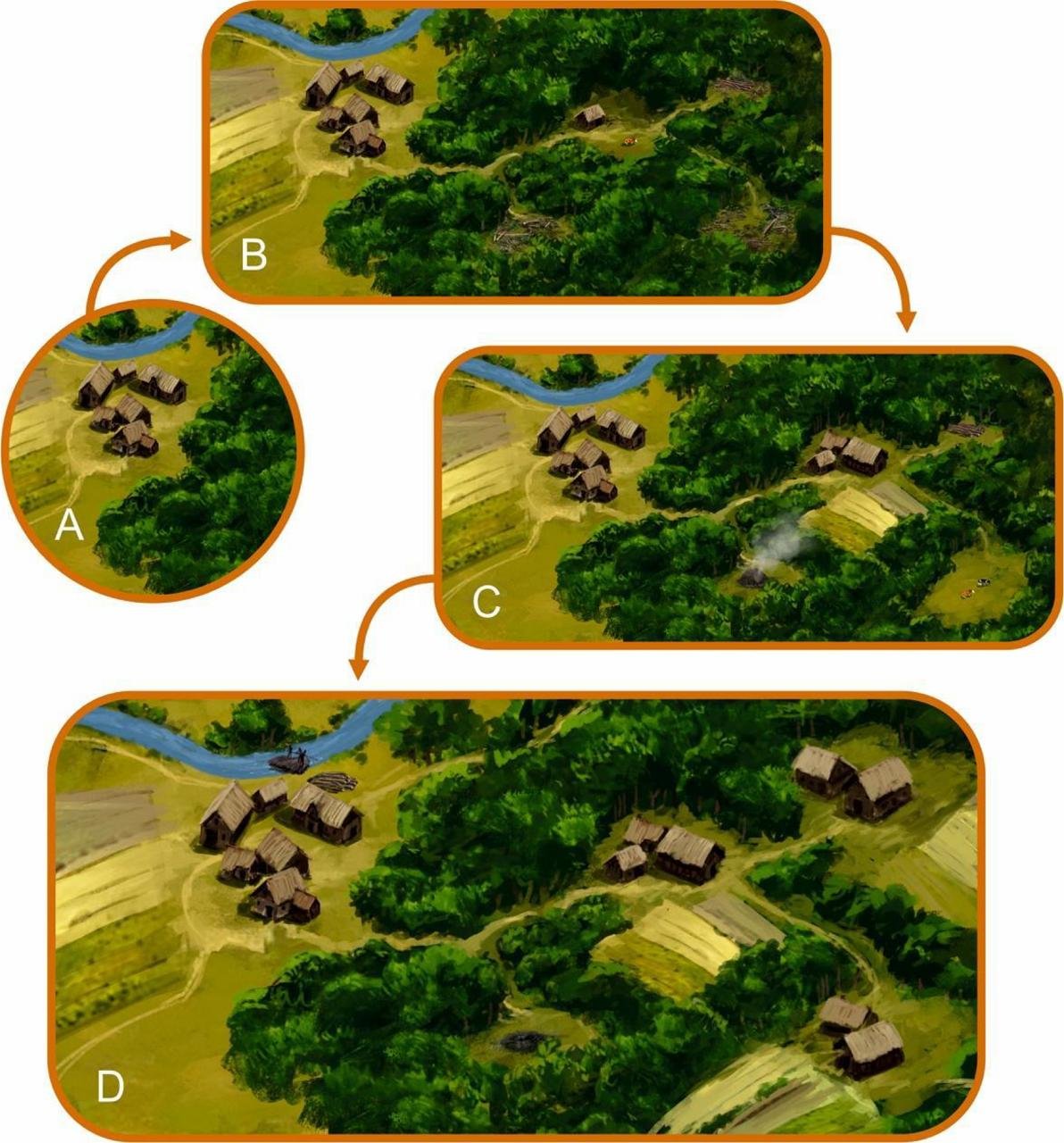
LiDAR mapping reveals over 630,000 historic charcoal kiln sites across Poland’s forests
Gradual encroachment of settlements into the forest. (A) Establishment of a settlement at the forest wall. (B) Beginning of people’s migration into the forest. Establishment of seasonal huts. (C) Transformation of temporary settlements into more permanent units. (D) Stabilization of forest settlements resulting in intense human impact. Credit: Illustrations by Tomasz Ryger / M. Słowiński et al., Elementa (Washington, D.C.) (2024); CC-BY 4.0

Airborne LiDAR scanning enabled national-scale mapping. Former kiln sites appear as shallow circular depressions beneath tree cover. A graduate researcher spent two years reviewing datasets and marked more than 630,000 features, most in present day forests. Many other sites likely disappeared under plowed fields or urban development. Soil studies at selected locations show long-term chemical change. High heat sterilized soil layers and altered acidity. Even after a century, former kiln soils contain fewer microbes and higher concentrations of some heavy metals, including cadmium.


RelatedStories

Scientists uncover Ireland’s largest prehistoric hillfort settlement, reshaping views of Bronze Age society

Scientists uncover Ireland’s largest prehistoric hillfort settlement, reshaping views of Bronze Age society

January 1, 2026
Inscription on important Roman sitella found in Cartagena reveals unknown governor and casting-lot use

Inscription on Roman sitella in Cartagena reveals unknown governor and casting-lot use

December 21, 2025

Language also preserved evidence of this work. Many settlement names recorded before the seventeenth century refer to charcoal burning, tar production, or related trades. Archival maps, written records, and onomastic research match the spatial patterns identified through laser scanning.

The research team included geographers, paleoecologists, historians, linguists, soil scientists, foresters, and GIS specialists. Their combined effort produced a national database scheduled for public release. Heritage specialists treat these kiln remains as part of industrial archaeology. The sites record long-term interaction between communities and forest environments.


More information: Słowiński, M., Związek, T., Swoboda, P., Niedzielski, M. A., Słowińska, S., Konopski, M., … Brykała, D. (2024). Human impacts on environment in the preindustrial forest landscapes in Poland—An overview. Elementa (Washington, D.C.), 12(1). doi:10.1525/elementa.2023.00065
ShareTweetShareShareSend

You May Also Like...

CT scans of ancient Egyptian mummies reveal lifespans, health, and daily life of priests
Anthropology

CT scans of ancient Egyptian mummies reveal lifespans, health, and daily life of priests

February 4, 2026
14,000-year-old Alaska campsite helps trace how the first people arrived in North America
Archaeology

14,000-year-old Alaska campsite helps trace how the first people arrived in North America

February 4, 2026
Study identifies first deliberate mummification in Inca capacocha child sacrifice
Anthropology

Study identifies first deliberate mummification in Inca capacocha child sacrifice

February 3, 2026
Archaeologists identify forgotten city of Alexandria on the Tigris in southern Iraq
Archaeology

Archaeologists identify forgotten city of Alexandria on the Tigris in southern Iraq

February 3, 2026
Unexpected discovery: sand layer beneath Ishtar Temple in Assur reveals city’s founding and ancient ritual practices
Archaeology

Unexpected discovery: sand layer beneath Ishtar Temple in Assur reveals city’s founding and ancient ritual practices

February 2, 2026
Isotope analysis of sacrificial horses uncovers long-distance animal networks in Iron Age Spain
Archaeology

Analysis of sacrificial horses at Casas del Turuñuelo uncovers long-distance animal networks in Iron Age Spain

February 2, 2026

Comments 0

  1. Editorial Team says:
    1 second ago

    Disclaimer: This website is a science-focused magazine that welcomes both academic and non-academic audiences. Comments are written by users and may include personal opinions or unverified claims. They do not necessarily reflect the views of our editorial team or rely on scientific evidence.

    Comment Policy: We kindly ask all commenters to engage respectfully. Comments that contain offensive, insulting, degrading, discriminatory, or racist content will be automatically removed.

    Reply

Leave a Reply Cancel reply

Your email address will not be published. Required fields are marked *

Follow us


Instagram
244K

Facebook
118K

Threads
45K

LinkedIn
14K

Twitter
6K

YouTube
1K
  • Trending
  • Comments
  • Latest
Shipwreck Salvage. Credit: rawpixel.com / Public Domain

2,000-year-old shipwreck discovered off Turkish coast with remarkably preserved stacked ceramics

July 2, 2025
Viking age DNA reveals 9,000-year-old HIV-resistant gene originating near the Black Sea

Viking age DNA reveals 9,000-year-old HIV-resistant gene originating near the Black Sea

May 18, 2025
A new study suggests the mysterious Voynich Manuscript may be a medieval cipher

A new study suggests the mysterious Voynich Manuscript may be a medieval cipher

January 3, 2026
Moses may be named in ancient Egyptian mine inscriptions, sparking debate over earliest biblical references

Moses may be named in ancient Egyptian mine inscriptions, sparking debate over earliest biblical references

July 31, 2025
Mystery of Armenia’s 6,000-year-old dragon stones solved

Mystery of Armenia’s 6,000-year-old dragon stones solved

September 23, 2025
3D analysis reveals Shroud of Turin image likely came from sculpture, not Jesus’ body

3D analysis reveals Shroud of Turin image likely came from sculpture, not Jesus’ body

Moses may be named in ancient Egyptian mine inscriptions, sparking debate over earliest biblical references

Moses may be named in ancient Egyptian mine inscriptions, sparking debate over earliest biblical references

$1 million prize offered to decipher 5,300-year-old Indus Valley script

$1 million prize offered to decipher 5,300-year-old Indus Valley script

Oldest ever genetic data from a human relative found in 2-million-year-old fossilized teeth

Oldest ever genetic data from a human relative found in 2-million-year-old fossilized teeth

Exceptionally large Roman shoes discovered at Magna fort near Hadrian’s Wall

Exceptionally large Roman shoes discovered at Magna fort near Hadrian’s Wall

LiDAR mapping reveals over 630,000 historic charcoal kiln sites across Poland’s forests

LiDAR mapping reveals over 630,000 historic charcoal kiln sites across Poland’s forests

February 5, 2026
CT scans of ancient Egyptian mummies reveal lifespans, health, and daily life of priests

CT scans of ancient Egyptian mummies reveal lifespans, health, and daily life of priests

February 4, 2026
14,000-year-old Alaska campsite helps trace how the first people arrived in North America

14,000-year-old Alaska campsite helps trace how the first people arrived in North America

February 4, 2026
Study identifies first deliberate mummification in Inca capacocha child sacrifice

Study identifies first deliberate mummification in Inca capacocha child sacrifice

February 3, 2026
Archaeologists identify forgotten city of Alexandria on the Tigris in southern Iraq

Archaeologists identify forgotten city of Alexandria on the Tigris in southern Iraq

February 3, 2026

Archaeology News online magazine

Archaeology News is an international online magazine that covers all aspects of archaeology.


Categories

  • Academics
    • Books
    • Conferences
    • Universities
  • Articles
  • Download
  • Game
  • News
    • Anthropology
    • Archaeology
    • Paleontology
  • Quiz
  • Tours

Subscribe to our newsletter

© 2024 - Archaeology News Online Magazine. All Rights Reserved.

  • About
  • Privacy Policy
  • Terms of Use
  • Donation
  • Contact

Welcome Back!

Login to your account below

Forgotten Password? Sign Up

Create New Account!

Fill the forms below to register

All fields are required. Log In

Retrieve your password

Please enter your username or email address to reset your password.

Log In

Add New Playlist

Manage Consent
To provide the best experiences, we use technologies like cookies to store and/or access device information. Consenting to these technologies will allow us to process data such as browsing behavior or unique IDs on this site. Not consenting or withdrawing consent, may adversely affect certain features and functions.
Functional Always active
The technical storage or access is strictly necessary for the legitimate purpose of enabling the use of a specific service explicitly requested by the subscriber or user, or for the sole purpose of carrying out the transmission of a communication over an electronic communications network.
Preferences
The technical storage or access is necessary for the legitimate purpose of storing preferences that are not requested by the subscriber or user.
Statistics
The technical storage or access that is used exclusively for statistical purposes. The technical storage or access that is used exclusively for anonymous statistical purposes. Without a subpoena, voluntary compliance on the part of your Internet Service Provider, or additional records from a third party, information stored or retrieved for this purpose alone cannot usually be used to identify you.
Marketing
The technical storage or access is required to create user profiles to send advertising, or to track the user on a website or across several websites for similar marketing purposes.
  • Manage options
  • Manage services
  • Manage {vendor_count} vendors
  • Read more about these purposes
View preferences
  • {title}
  • {title}
  • {title}
  • Home
  • News
    • Archaeology
    • Anthropology
    • Paleontology
  • Academic
    • Books
    • Conferences
    • Universities
  • Articles
  • VR Tours
  • Quiz & Game
  • Download
  • Encyclopedia
  • Forum

About  .  Contact  .  Donation

© 2024 - Archaeology News Online Magazine. All Rights Reserved