
Archaeologists have been working for months in the historic center of Borken, where a new health center and Caritas building are planned in the Brinkerhof quarter. Before construction begins, teams from the Landschaftsverband Westfalen-Lippe and a private excavation firm examined the ground. What they found shows how densely this part of town was built and rebuilt over hundreds of years.
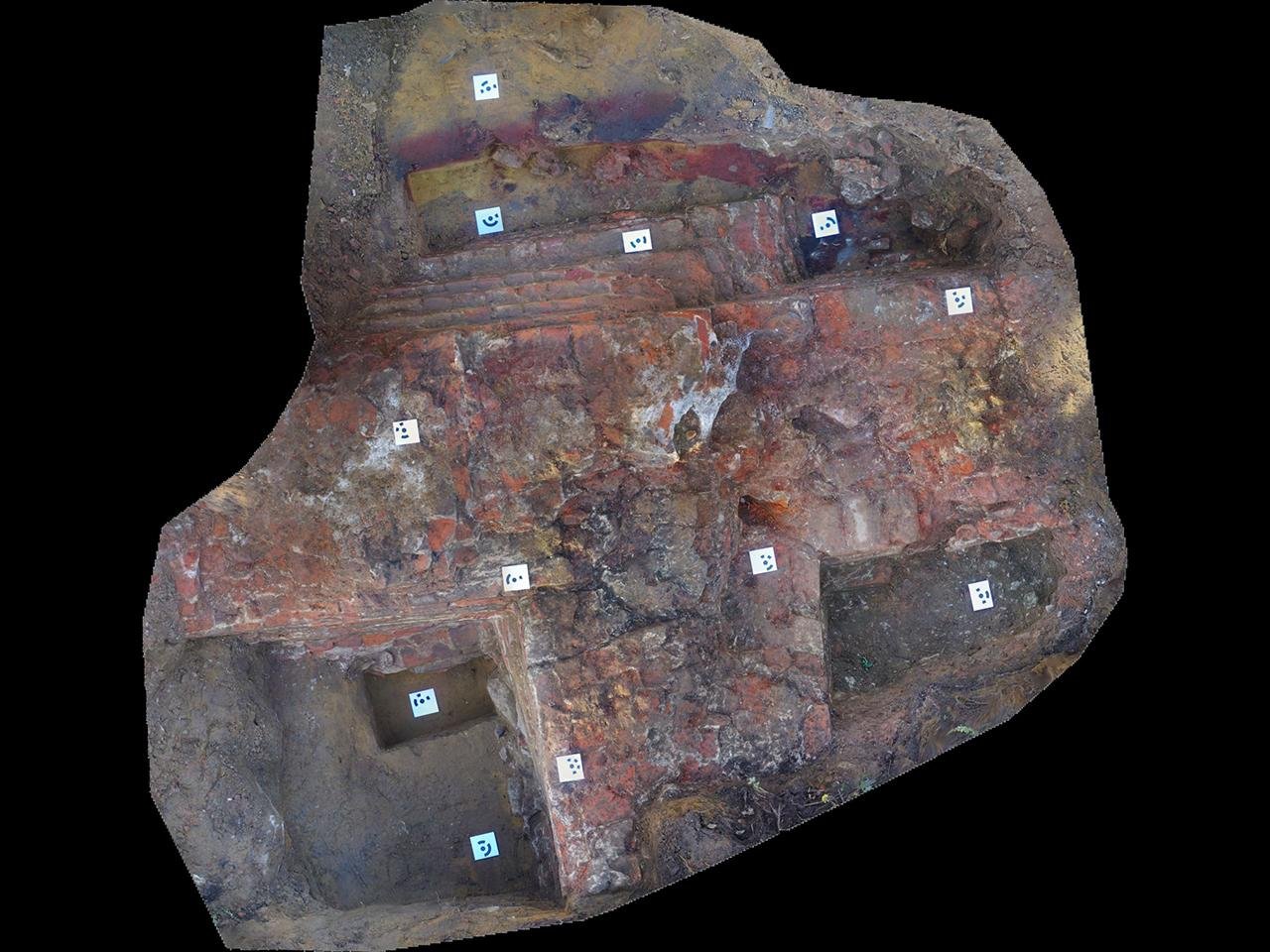
Initial test trenches and geophysical surveys started in 2024 south of the current Caritas buildings. During this phase, archaeologists encountered the first clear remains of the former Marienbrink Monastery church. The church dates back to the 15th century. Sections of the western and southern walls came to light and were carefully recorded.
Further excavation in late 2025 exposed more of the structure. Parts of the foundation survive in solid condition. One outer wall measures up to 1.25 meters wide, and the preserved foundation rises about 1.60 meters high. Builders constructed the church with red brick set in lime mortar. Thick rubble layers covered sections of the masonry, which helped protect the lower courses.
The site also holds traces from the 20th century. In 2024, the team identified a World War II air raid bunker southwest of the church remains. Early assessments show the bunker extends across a large portion of the planned development area. War damage shaped this district in other ways as well. Many buildings in Borken’s center were destroyed during the war, and postwar reconstruction altered street lines and property boundaries.
Additional trenches were opened between October and November 2025 in garden areas where an entrance to an underground parking garage is planned. Archaeologists documented filled cellars from earlier houses, an animal carcass pit, and several pits and postholes from the Early Modern period. Ceramic fragments recovered from these layers date from the late High Middle Ages through modern times. The finds point to continuous occupation and repeated rebuilding over centuries.

The project area lies near St. Remigius Church. The church traces its origins to around the year 800, when a royal missionary post or episcopal estate stood in the area. Because of this long history, archaeologists expect deep and layered deposits beneath the present streets.
The former Marienbrink Monastery adds another chapter to the story. After the monastery was dissolved in the early 19th century, the church was torn down. In 1818, a synagogue with an adjoining school and a mikveh was established on the grounds, reusing parts of the older complex. During the November pogroms of 1938, the synagogue suffered heavy damage and was demolished the following year.
So far, excavations have not produced structural remains clearly linked to the synagogue or ritual bath. Work continues as planning moves forward. Each layer in the soil reflects a different period in Borken’s past, from medieval brick walls to wartime concrete.
More information: Landschaftsverband Westfalen-Lippe (LWL)








Disclaimer: This website is a science-focused magazine that welcomes both academic and non-academic audiences. Comments are written by users and may include personal opinions or unverified claims. They do not necessarily reflect the views of our editorial team or rely on scientific evidence.
Comment Policy: We kindly ask all commenters to engage respectfully. Comments that contain offensive, insulting, degrading, discriminatory, or racist content will be automatically removed.