• About
  • Privacy Policy
  • Terms of Use
  • Donation
  • Contact
No Result
View All Result
Archaeology News
  • Home
  • News
    • Archaeology
    • Anthropology
    • Paleontology
  • Academic
    • Books
    • Conferences
    • Universities
  • Articles
  • VR Tours
  • Quiz & Game
  • Download
  • Encyclopedia
  • Forum
Archaeology News
No Result
View All Result
Home News Anthropology

Pre-historic Wallacea – a melting pot of human genetic ancestries

by Archaeology News
June 9, 2022

The Wallacean islands, situated amidst the deep sea waters separating Asia and Oceania, have long been isolated from the surrounding regions. However, these tropical islands played a crucial role as a migration route for ancient peoples moving into the Pleistocene Australia-New Guinea landmass (known as Sahul), and they have been inhabited by modern human populations for over 47,000 years.
Pre-historic Wallacea - a melting pot of human genetic ancestries
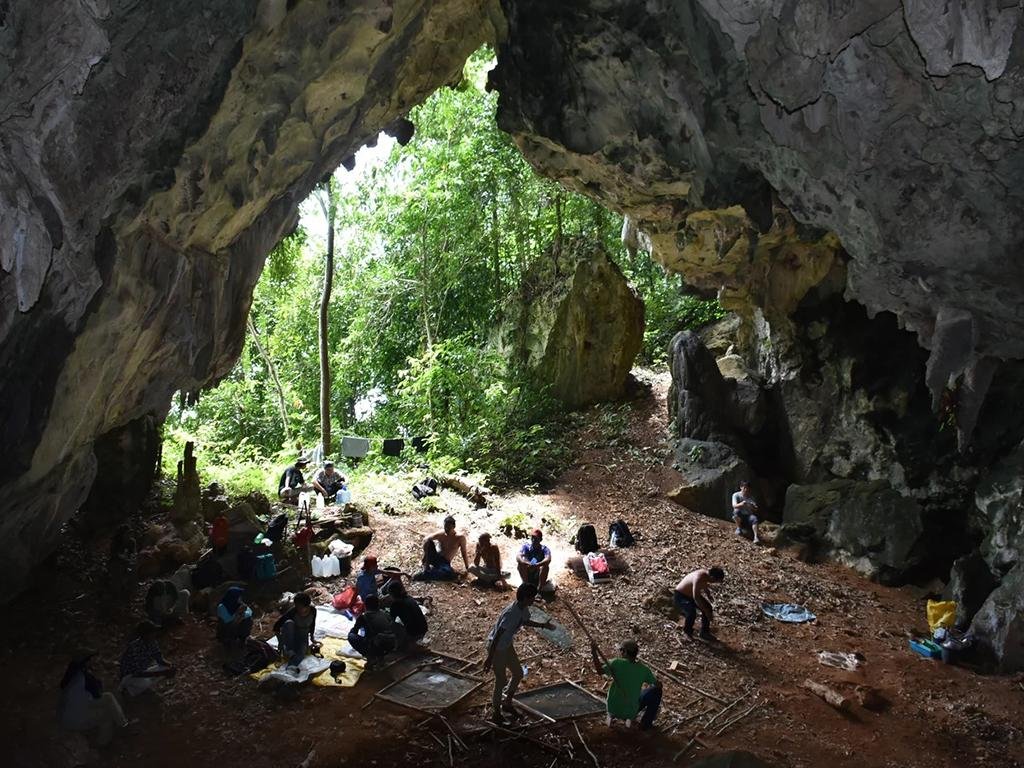
Cave entrance of the Topogaro 2 site, one of the cave sites of the Topogaro complex located in Central Sulawesi. Credit: Rintaro Ono

Recent archaeological findings reveal a significant cultural transformation across Wallacea around 3,500 years ago. This transformation is associated with the expansion of Austronesian-speaking farmers who intermingled with local hunter-gatherer populations. Genetic studies of modern-day populations have previously provided varying dates for this intermixing, ranging from 1,100 to nearly 5,000 years ago.

To gain deeper insights into this expansion and the resulting human interactions, an international research team conducted DNA analysis on 16 ancient individuals from different islands in Wallacea. This extensive genomic data from the region sheds new light on these historical developments.

“We found striking differences between regions in Wallacea and surprisingly, the ancestry of ancient individuals from the southern islands cannot be simply explained by admixture between Austronesian- and Papuan-related groups,” says Sandra Oliveira, one of the lead authors of the study.

The research team identified an additional ancestry contribution from Mainland Southeast Asia, with the closest resemblance to present-day Austroasiatic speakers. They propose that admixture initially occurred between Mainland Southeast Asian and Papuan-related ancestry groups, and gene flow from Austronesian-related groups followed at a later stage.

RelatedStories
6,000 years of human occupation found in highest prehistoric cave in Spain’s Pyrenees

6,000 years of human occupation found in highest prehistoric cave in Spain’s Pyrenees

May 5, 2026
7,000-year-old beaver bone pit discovered in Germany reveals Neolithic fur hunting practices

7,000-year-old beaver bone pit discovered in Germany reveals Neolithic fur hunting practices

May 1, 2026

Peter Bellwood, an author of the study with extensive archaeological experience in Island Southeast Asia, remarks on the mystery surrounding the Mainland Southeast Asian component. He speculates that it may represent small groups, potentially early farmers, who traveled extensively and left minimal archaeological or linguistic traces along their path but grew in population size after arrival.

While the identity of the people responsible for spreading this ancestry remains unclear, the discovery of Mainland Southeast Asian ancestry in the southern Wallacean islands carries significant implications for understanding the Neolithic dispersals into Island Southeast Asia.

Toetik Koesbardiati, an anthropologist at the Universitas Airlangga in Indonesia and a co-author of the study, emphasizes the importance of this finding for archaeologists in the region. She suggests that further research will intensify efforts to study this migration using additional lines of evidence.

The study also reveals a closer genetic relationship between Austronesian-related ancestry in ancient individuals from northern Wallacea and the Pacific, compared to their counterparts in southern Wallacea. This pattern aligns with linguistic evidence. Moreover, it provides insights into the timing of genetic admixture between Asian and Papuan populations.

Mark Stoneking, a senior author of the study, notes that previous research based on present-day populations yielded diverse estimates regarding the timing of the Austronesian expansion. The ancient genomes now available show that admixture occurred in multiple phases or continuously for at least 3,000 years throughout Wallacea, a pattern that can be extended with the study of older genomes in the future.

Additionally, the research team investigated genetic similarities between the ancient Wallaceans and a previously studied pre-Neolithic individual from Sulawesi, another island in Wallacea. Their findings indicate that all individuals from Wallacea in this study are genetically more similar to present-day New Guinean groups than to the earlier local population. This suggests a stronger ancient connection between these regions than previously understood and confirms significant genetic replacement among Wallacean hunter-gatherer populations. — Max Planck Society

More information: Sandra Oliveira, (2022). Ancient genomes from the last three millennia support multiple human dispersals into Wallacea, Nature Ecology & Evolution. DOI: 10.1038/s41559-022-01775-2.
ShareTweetShareShareSend

You May Also Like...

World War II mass grave in Poland reveals remains of German officer killed during Battle of Lauban
Anthropology

World War II mass grave in Poland reveals remains of German officer killed during Battle of Lauban

May 19, 2026
massive jar in Laos contained remains of 37 people, revealing ancient burial rituals and Asian trade links
Anthropology

Massive jar in Laos contained remains of 37 people, revealing ancient burial rituals and Asian trade links

May 19, 2026
6,000-year-old necropolis in Spain rewrites origins of Europe’s first megalithic tombs
Archaeology

6,000-year-old necropolis in Spain rewrites origins of Europe’s first megalithic tombs

May 18, 2026
Ancient settlement with weaving workshop and longhouses uncovered in Germany gravel pit
Archaeology

Ancient settlement with weaving workshop and longhouses uncovered in Germany gravel pit

May 17, 2026
Pompeii victim identified as Roman physician killed while fleeing Vesuvius eruption
Anthropology

Pompeii victim identified as Roman physician killed while fleeing Vesuvius eruption

May 17, 2026
Archaeologists uncover hidden whisky smuggler bothy in Scottish Highlands with rare copper still piece
Archaeology

Archaeologists uncover hidden whisky smuggler bothy in Scottish Highlands with rare copper still piece

May 16, 2026

Follow us


Instagram
242K

Facebook
117K

Threads
46K

LinkedIn
14K

Twitter
6K

YouTube
1K
World War II mass grave in Poland reveals remains of German officer killed during Battle of Lauban

World War II mass grave in Poland reveals remains of German officer killed during Battle of Lauban

May 19, 2026
massive jar in Laos contained remains of 37 people, revealing ancient burial rituals and Asian trade links

Massive jar in Laos contained remains of 37 people, revealing ancient burial rituals and Asian trade links

May 19, 2026
6,000-year-old necropolis in Spain rewrites origins of Europe’s first megalithic tombs

6,000-year-old necropolis in Spain rewrites origins of Europe’s first megalithic tombs

May 18, 2026
Ancient settlement with weaving workshop and longhouses uncovered in Germany gravel pit

Ancient settlement with weaving workshop and longhouses uncovered in Germany gravel pit

May 17, 2026

Archaeology News online magazine

Archaeology News is an international online magazine that covers all aspects of archaeology.


Categories

  • Academics
    • Books
    • Conferences
    • Universities
  • Articles
  • Download
  • Game
  • News
    • Anthropology
    • Archaeology
    • Paleontology
  • Quiz
  • Tours

Subscribe to our newsletter

© 2024 - Archaeology News Online Magazine. All Rights Reserved.

  • About
  • Privacy Policy
  • Terms of Use
  • Donation
  • Contact

Manage Consent
To provide the best experiences, we use technologies like cookies to store and/or access device information. Consenting to these technologies will allow us to process data such as browsing behavior or unique IDs on this site. Not consenting or withdrawing consent, may adversely affect certain features and functions.
Functional Always active
The technical storage or access is strictly necessary for the legitimate purpose of enabling the use of a specific service explicitly requested by the subscriber or user, or for the sole purpose of carrying out the transmission of a communication over an electronic communications network.
Preferences
The technical storage or access is necessary for the legitimate purpose of storing preferences that are not requested by the subscriber or user.
Statistics
The technical storage or access that is used exclusively for statistical purposes. The technical storage or access that is used exclusively for anonymous statistical purposes. Without a subpoena, voluntary compliance on the part of your Internet Service Provider, or additional records from a third party, information stored or retrieved for this purpose alone cannot usually be used to identify you.
Marketing
The technical storage or access is required to create user profiles to send advertising, or to track the user on a website or across several websites for similar marketing purposes.
  • Manage options
  • Manage services
  • Manage {vendor_count} vendors
  • Read more about these purposes
View preferences
  • {title}
  • {title}
  • {title}
  • Home
  • News
    • Archaeology
    • Anthropology
    • Paleontology
  • Academic
    • Books
    • Conferences
    • Universities
  • Articles
  • VR Tours
  • Quiz & Game
  • Download
  • Encyclopedia
  • Forum

About  .  Contact  .  Donation

© 2024 - Archaeology News Online Magazine. All Rights Reserved