• About
  • Privacy Policy
  • Terms of Use
  • Donation
  • Contact
No Result
View All Result
Archaeology News
  • Home
  • News
    • Archaeology
    • Anthropology
    • Paleontology
  • Academic
    • Books
    • Conferences
    • Universities
  • Articles
  • VR Tours
  • Quiz & Game
  • Download
  • Encyclopedia
  • Forum
Archaeology News
No Result
View All Result
Home News Archaeology

Secrets of the mysterious Gobi wall revealed: archaeologists uncover imperial purpose behind 200-mile structure

by Dario Radley
May 28, 2025

In Mongolia’s Gobi Desert is a 321-kilometer-long wall that, until recently, was one of East Asia’s least understood components of medieval infrastructure. Called the Gobi Wall, this enormous structure has mystified archaeologists for decades. But new research, published in the journal Land, is now giving valuable information about its construction, purpose, and historical context, redrawing the wall not as a simple defense fortification, but as a sophisticated tool of statecraft used by the Xi Xia dynasty.
Secrets of the mysterious Gobi wall revealed: archaeologists uncover imperial purpose behind 200-mile structure
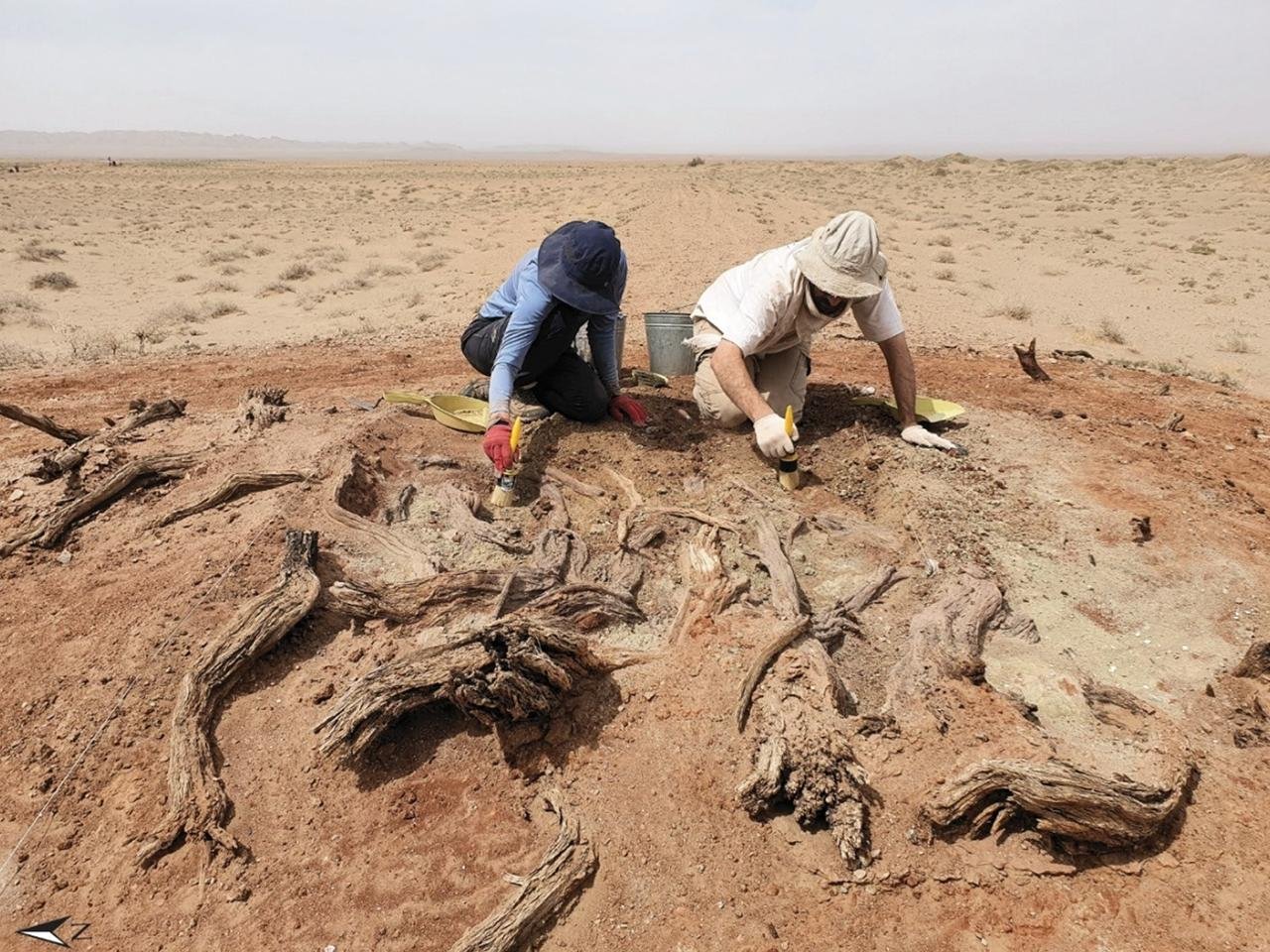
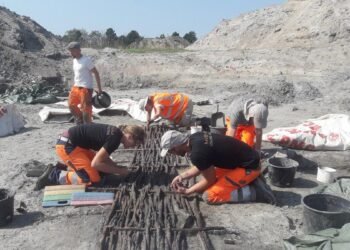
Excavation at G05 at area (A). Large branches exposed at the elevated garrison corner. (Photo: M. Ullman). Credit: D Golan et al., Land (2025)

The international research was carried out by Professor Gideon Shelach-Lavi and Mr. Dan Golan of the Hebrew University of Jerusalem’s Department of Asian Studies, in collaboration with Professor Chunag Amartuvshin of the National University of Mongolia and Professor William Honeychurch of Yale University. The study combined satellite imagery, ground surveys, and targeted excavations to investigate the structure in Mongolia’s Ömnögovi province.

According to the findings, the Gobi Wall was constructed primarily during the 11th to 13th centuries CE, under the Xi Xia dynasty, or Western Xia Empire. The Tangut-led empire controlled parts of Western China and southern Mongolia at the time. The main construction of the wall took place during a period of significant geopolitical transformation, when frontier defense and territorial management were crucial to the survival of the empire.
Secrets of the mysterious Gobi wall revealed: archaeologists uncover imperial purpose behind 200-mile structure
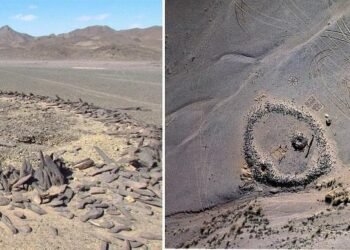
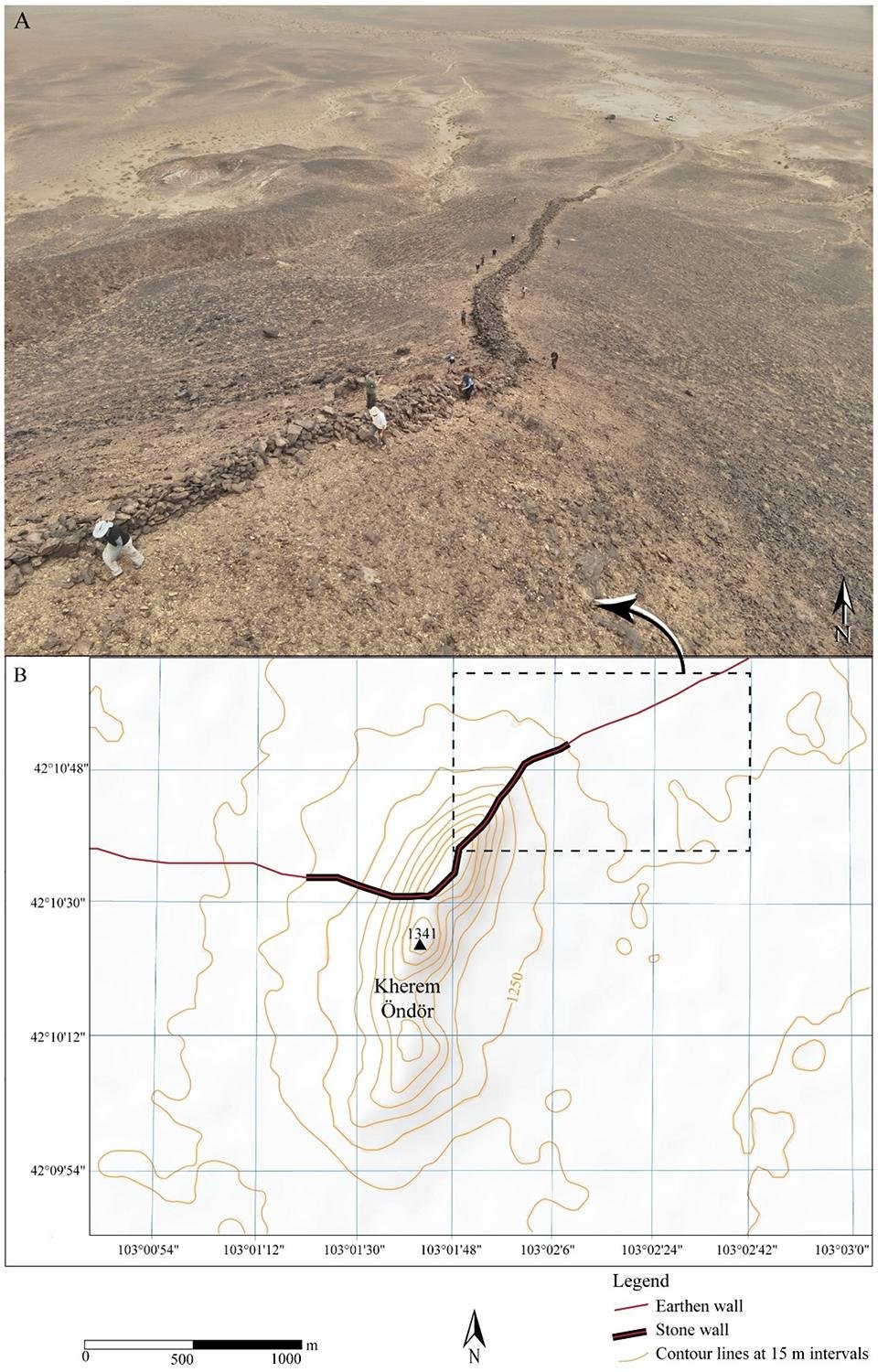
Black stone wall section. (A) Aerial drone photograph showing the preserved stone wall section traversing the hillside. (B) Topographic map illustrating the wall’s strategic placement across the Kherem Öndör peak, with differentiated earthen (red line) and stone wall (black) segments. Credit: D Golan et al., Land (2025)

The study arrives at an unanticipated conclusion: that the Gobi Wall was part of a broader network of watchtowers, forts, trenches, and garrisons. These elements were identified on natural landforms such as mountain passes and sand dunes and were placed along routes chosen depending upon the availability of key resources such as water and wood. The wall itself was built with locally sourced materials like rammed earth, stone, and timber—a remarkable feat given the harsh environment and remote position of the region.

Secrets of the mysterious Gobi wall revealed: archaeologists uncover imperial purpose behind 200-mile structure
The wall surrounding garrison G06. (A) enclosure wall depicting wood use on both sides. (B) exposed section of the interior part of the enclosure wall, depicting extensive use of wood. Credit: D Golan et al., Land (2025)

Excavations at key sites, like two garrisons designated as G05 and G10, found ceramics, coins, and remains of animals spanning nearly two thousand years, from the 2nd century BCE to the 19th century CE. While these finds indicate that the region was inhabited periodically over the centuries, radiocarbon dates and numismatic evidence attest that the principal period of use for the wall was at the height of Xi Xia’s rule.


RelatedStories

Rich medieval Christians buried ‘closer to God’ even with leprosy or tuberculosis, archaeologists find

Rich medieval Christians buried ‘closer to God’ even with leprosy or tuberculosis, archaeologists find

February 12, 2026
Viking Age mass grave with dismembered bodies and trepanned giant found near Cambridge

Viking Age mass grave with dismembered bodies and trepanned giant found near Cambridge

February 11, 2026

The researchers argue that the function of the wall extended far beyond defense. “It exemplifies a mode of Xi Xia statecraft that used architectural investments to manage resources, population movement, and territorial boundaries,” they wrote. Rather than viewing frontier walls as rigid boundaries, the researchers propose viewing them as zones of control and interaction, dynamic infrastructures that shifted in response to political and environmental needs.

This new interpretation has broader implications for how scholars conceive of ancient infrastructure networks across Inner Asia and beyond. With these findings, the Gobi Wall joins the ranks of the world’s great historical infrastructures, not just for its dimensions and endurance, but for its role in shaping the politics and ecology of the time.

More information: Golan, D., Shelach-Lavi, G., Amartuvshin, C., Zhang, Z., Wachtel, I., Chen, J., … Honeychurch, W. (2025). Exploring the Gobi Wall: Archaeology of a large-scale medieval frontier system in the Mongolian desert. Land, 14(5), 1087. doi:10.3390/land14051087
Share374Tweet234Share66ShareSend

You May Also Like...

New study reveals how Londoners used weekly death data to Survive the Great Plague of 1665
Archaeology

New study reveals how Londoners used weekly death data to survive the Great Plague of 1665

February 18, 2026
3D metrological analysis connects dispersed Egyptian artifacts and recovers their lost histories
Archaeology

3D metrological analysis connects dispersed Egyptian artifacts and recovers their lost histories

February 17, 2026
Neolithic study finds gender roles in Europe were distinct yet remarkably flexible
Anthropology

Neolithic study finds gender roles in Europe were distinct yet remarkably flexible

February 17, 2026
Chalcolithic cornets at Teleilat Ghassul reveal ritual lamp use in Jordan’s prehistoric communities
Archaeology

Chalcolithic cornets at Teleilat Ghassul reveal ritual lamp use in Jordan’s prehistoric communities

February 16, 2026
DNA study reveals 3,000 years of genetic stability in Europe’s Low Countries before Bell Beaker expansion
Anthropology

DNA study reveals 3,000 years of genetic stability in Europe’s Low Countries before Bell Beaker expansion

February 16, 2026
Second Temple period stone vessel workshop unearthed on Mount Scopus after antiquities theft arrests
Archaeology

Second Temple period stone vessel workshop unearthed on Mount Scopus after antiquities theft arrests

February 16, 2026

Follow us


Instagram
244K

Facebook
118K

Threads
45K

LinkedIn
14K

Twitter
6K

YouTube
1K
  • Trending
  • Comments
  • Latest
Shipwreck Salvage. Credit: rawpixel.com / Public Domain

2,000-year-old shipwreck discovered off Turkish coast with remarkably preserved stacked ceramics

July 2, 2025
Viking age DNA reveals 9,000-year-old HIV-resistant gene originating near the Black Sea

Viking age DNA reveals 9,000-year-old HIV-resistant gene originating near the Black Sea

May 18, 2025
A new study suggests the mysterious Voynich Manuscript may be a medieval cipher

A new study suggests the mysterious Voynich Manuscript may be a medieval cipher

January 3, 2026
Moses may be named in ancient Egyptian mine inscriptions, sparking debate over earliest biblical references

Moses may be named in ancient Egyptian mine inscriptions, sparking debate over earliest biblical references

July 31, 2025
Mystery of Armenia’s 6,000-year-old dragon stones solved

Mystery of Armenia’s 6,000-year-old dragon stones solved

September 23, 2025
3D analysis reveals Shroud of Turin image likely came from sculpture, not Jesus’ body

3D analysis reveals Shroud of Turin image likely came from sculpture, not Jesus’ body

Moses may be named in ancient Egyptian mine inscriptions, sparking debate over earliest biblical references

Moses may be named in ancient Egyptian mine inscriptions, sparking debate over earliest biblical references

$1 million prize offered to decipher 5,300-year-old Indus Valley script

$1 million prize offered to decipher 5,300-year-old Indus Valley script

Oldest ever genetic data from a human relative found in 2-million-year-old fossilized teeth

Oldest ever genetic data from a human relative found in 2-million-year-old fossilized teeth

Exceptionally large Roman shoes discovered at Magna fort near Hadrian’s Wall

Exceptionally large Roman shoes discovered at Magna fort near Hadrian’s Wall

New study reveals how Londoners used weekly death data to Survive the Great Plague of 1665

New study reveals how Londoners used weekly death data to survive the Great Plague of 1665

February 18, 2026
3D metrological analysis connects dispersed Egyptian artifacts and recovers their lost histories

3D metrological analysis connects dispersed Egyptian artifacts and recovers their lost histories

February 17, 2026
Neolithic study finds gender roles in Europe were distinct yet remarkably flexible

Neolithic study finds gender roles in Europe were distinct yet remarkably flexible

February 17, 2026
Chalcolithic cornets at Teleilat Ghassul reveal ritual lamp use in Jordan’s prehistoric communities

Chalcolithic cornets at Teleilat Ghassul reveal ritual lamp use in Jordan’s prehistoric communities

February 16, 2026
DNA study reveals 3,000 years of genetic stability in Europe’s Low Countries before Bell Beaker expansion

DNA study reveals 3,000 years of genetic stability in Europe’s Low Countries before Bell Beaker expansion

February 16, 2026

Archaeology News online magazine

Archaeology News is an international online magazine that covers all aspects of archaeology.


Categories

  • Academics
    • Books
    • Conferences
    • Universities
  • Articles
  • Download
  • Game
  • News
    • Anthropology
    • Archaeology
    • Paleontology
  • Quiz
  • Tours

Subscribe to our newsletter

© 2024 - Archaeology News Online Magazine. All Rights Reserved.

  • About
  • Privacy Policy
  • Terms of Use
  • Donation
  • Contact

Manage Consent
To provide the best experiences, we use technologies like cookies to store and/or access device information. Consenting to these technologies will allow us to process data such as browsing behavior or unique IDs on this site. Not consenting or withdrawing consent, may adversely affect certain features and functions.
Functional Always active
The technical storage or access is strictly necessary for the legitimate purpose of enabling the use of a specific service explicitly requested by the subscriber or user, or for the sole purpose of carrying out the transmission of a communication over an electronic communications network.
Preferences
The technical storage or access is necessary for the legitimate purpose of storing preferences that are not requested by the subscriber or user.
Statistics
The technical storage or access that is used exclusively for statistical purposes. The technical storage or access that is used exclusively for anonymous statistical purposes. Without a subpoena, voluntary compliance on the part of your Internet Service Provider, or additional records from a third party, information stored or retrieved for this purpose alone cannot usually be used to identify you.
Marketing
The technical storage or access is required to create user profiles to send advertising, or to track the user on a website or across several websites for similar marketing purposes.
  • Manage options
  • Manage services
  • Manage {vendor_count} vendors
  • Read more about these purposes
View preferences
  • {title}
  • {title}
  • {title}
  • Home
  • News
    • Archaeology
    • Anthropology
    • Paleontology
  • Academic
    • Books
    • Conferences
    • Universities
  • Articles
  • VR Tours
  • Quiz & Game
  • Download
  • Encyclopedia
  • Forum

About  .  Contact  .  Donation

© 2024 - Archaeology News Online Magazine. All Rights Reserved