• About
  • Privacy Policy
  • Terms of Use
  • Donation
  • Contact
No Result
View All Result
Archaeology News
  • Home
  • News
    • Archaeology
    • Anthropology
    • Paleontology
  • Academics
    • Books
    • Conferences
    • Universities
  • Articles
  • VR Tours
  • Quiz & Game
  • Download
  • Encyclopedia
  • Forum
Archaeology News
No Result
View All Result
Home News Anthropology

Archaeologists find prehistoric headless skeletons in a settlement trench

Dario Radley by Dario Radley
January 12, 2023
A A
Share on FacebookShare on Linkedin.Share on RedditShare on Whatsapp

Archaeologists from the Collaborative Research Center (CRC) 1266 of Kiel University (CAU) and the Archaeological Institute of the Slovak Academy of Sciences (Nitra) unearthed the remains of 38 individuals in a ditch surrounding the settlement during this year’s excavation in Vráble, Slovakia. Their well-preserved skeletons were jumbled together, and all of them, with the exception of a young child, were missing their heads.
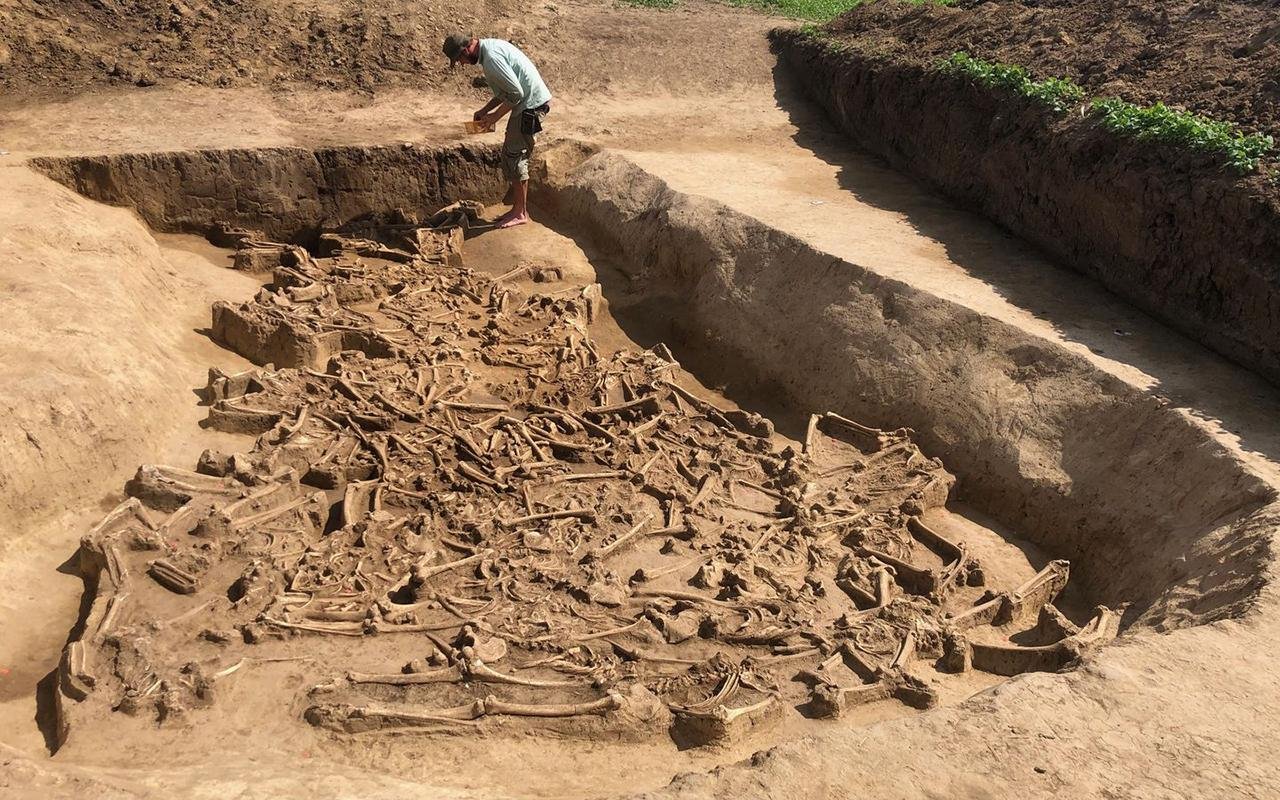
Archaeologists find prehistoric headless skeletons in a settlement trench
Uncovering and recovering such a find is a special challenge for archaeologists. Credit: Prof. Dr. Martin Furholt, Institute for Pre- and Protohistoric Archaeology/Kiel University

Future investigations will focus on how, when, and why these people’s heads were removed. The team discovered headless skeletons there last year. “We assumed to find more human skeletons, but this exceeded all imaginations,” reports project leader Prof. Dr. Martin Furholt.

An important Neolithic settlement site

A significant Neolithic settlement site Vráble-Ve’lke Lehemby (5,250-4,950 BCE) was one of the largest Early Neolithic settlement in Central Europe and has been a research focus of the CRC 1266 for several years. The archaeological artifacts are associated with the Linear Pottery Culture (LBK). Geomagnetic measurements were used to identify 313 houses in three neighboring villages. Up to 80 houses were inhabited at the same time, which was an exceptional population density for the time period.

The southwestern of the three settlements was separated from the others by a 1.3 km-long double ditch. Some areas were reinforced with palisades, which should not be interpreted as a defensive structure, but rather as a boundary marking of the village area.


RelatedStories

Ancient human sacrifices unearthed at Puémape temple site in Peru

Ancient human sacrifices unearthed at Puémape temple site in Peru

September 6, 2025
Circle of Lost Children: Hittite infant burials discovered in ritual structure at Uşaklı Höyük

Circle of Lost Children: Hittite infant burials discovered in ritual structure at Uşaklı Höyük

August 25, 2025

During the summer of 2022, the Slovak-German team discovered the remains of at least 38 people distributed across an area of around 15 square meters. One on top of the other, side by side, stretched out on their stomachs, crouched on their sides, on their backs with their limbs splayed out—the position of the skeletons does not suggest that the dead were carefully buried.   Instead, the positions indicate that the majority of them were thrown or rolled into the ditch.

With the exception of one infant, all of them are missing their heads, including their lower jaws. “In mass graves with an unclear positioning, the identification of an individual is usually based on the skull, so for us this year’s find represents a particularly challenging excavation situation,” explains Martin Furholt.

Many unresolved questions: massacre, head-hunters, or peaceful skull cult

While the skeletons were being found, the first questions arose: Were these people killed violently, perhaps even decapitated? How and when were the heads removed? Or did the removal of the heads take place only after the corpses had decomposed? Are there any indications of the causes of death, such as disease? In what order were they placed into the ditch, could they have died at the same time? Or is it not a single mass burial at all, but the result of several events, perhaps even over many generations? A few clues to answering these questions already exist.

“Several individual bones out of anatomical position suggest that the temporal sequence might have been more complex. It is possible that already-skeletonized bodies were pushed into the middle of the trench to make room for new ones,” anthropologist Dr. Katharina Fuchs of Kiel University elaborates.

“In some skeletons, the first cervical vertebra is preserved, indicating careful removal of the head rather than beheading in the violent, ruthless sense—but these are all very preliminary observations that remain to be confirmed with further investigation.”

Interdisciplinary examinations of the skeletons should provide answers
An important part of further research is to find out more about the dead.  Were they all of a similar age or a cross-section of society? Were they related to each other or to other Vráble dead? Were they natives or did they come from far away? Did they share a similar diet? Can any social significance be inferred from the treatment of the dead?

Answers can only be found in the interaction of detailed archaeological and osteological investigations, aDNA analyses, radiocarbon dating, and stable isotope analyses. The Kiel interdisciplinary research network of the Johanna Mestorf Academy, the CRC 1266, and the Cluster of Excellence ROOTS, in collaboration with the Slowakian Academy of Sciences in Nitra, offers excellent conditions for this further research.

Further considerations on meaning and interpretation are only meaningful based on such interdisciplinary research results.

“It may seem obvious to assume a massacre with human sacrifices, perhaps even in connection with magical or religious ideas. Warlike conflicts may also play a role, for example, conflicts between village communities, or even within this large settlement. Did these people fall victim to head-hunters, or did their fellow villagers practice a special death cult that had nothing to do with interpersonal violence? There are many possibilities and it is important to remain open to new insights and ideas. But it is indisputable that this find is absolutely unique for the European Neolithic so far,” explains project leader Dr. Maria Wunderlich. — Kiel University
ShareTweetShareShareSend

You May Also Like...

DNA confirms identity and violent death of Béla, the assassinated duke of Macsó
Anthropology

DNA confirms identity and violent death of Béla, the assassinated duke of Macsó

November 8, 2025
Archaeologists reveal the forgotten 16th-century city beneath modern Gothenburg
Archaeology

Archaeologists reveal the forgotten 16th-century city beneath modern Gothenburg

November 8, 2025
Misread medieval tale misled generations of historians about the Black Death's spread, study finds
Archaeology

Misread medieval tale misled generations of historians about the Black Death’s spread, study finds

November 7, 2025
Signatures meant more in Mesopotamia than they do now − what cylinder seals say about ancient and modern life
Archaeology

Signatures meant more in Mesopotamia than they do now − what cylinder seals say about ancient and modern life

November 7, 2025
Daily life uncovered in Hellenistic military settlement at Pyla-Vigla, Cyprus
Archaeology

New discoveries reveal daily life in a Hellenistic military settlement at Pyla-Vigla, Cyprus

November 7, 2025
Viking treasures unearthed in Sweden reveal a society in transition
Archaeology

Viking treasures unearthed in Sweden reveal a society in transition

November 6, 2025

Follow us


Instagram
245K

Facebook
117K

Threads
45K

LinkedIn
14K

Twitter
6K

YouTube
1K
  • Trending
  • Comments
  • Latest
Shipwreck Salvage. Credit: rawpixel.com / Public Domain

2,000-year-old shipwreck discovered off Turkish coast with remarkably preserved stacked ceramics

July 2, 2025
Viking age DNA reveals 9,000-year-old HIV-resistant gene originating near the Black Sea

Viking age DNA reveals 9,000-year-old HIV-resistant gene originating near the Black Sea

May 18, 2025
Complete copy of the Canopus Decree unearthed in Egypt after 150 years

Complete copy of the Canopus Decree unearthed in Egypt after 150 years

September 13, 2025
Mystery of Armenia’s 6,000-year-old dragon stones solved

Mystery of Armenia’s 6,000-year-old dragon stones solved

September 23, 2025
Moses may be named in ancient Egyptian mine inscriptions, sparking debate over earliest biblical references

Moses may be named in ancient Egyptian mine inscriptions, sparking debate over earliest biblical references

July 31, 2025
Moses may be named in ancient Egyptian mine inscriptions, sparking debate over earliest biblical references

Moses may be named in ancient Egyptian mine inscriptions, sparking debate over earliest biblical references

3D analysis reveals Shroud of Turin image likely came from sculpture, not Jesus’ body

3D analysis reveals Shroud of Turin image likely came from sculpture, not Jesus’ body

$1 million prize offered to decipher 5,300-year-old Indus Valley script

$1 million prize offered to decipher 5,300-year-old Indus Valley script

Oldest ever genetic data from a human relative found in 2-million-year-old fossilized teeth

Oldest ever genetic data from a human relative found in 2-million-year-old fossilized teeth

Exceptionally large Roman shoes discovered at Magna fort near Hadrian’s Wall

Exceptionally large Roman shoes discovered at Magna fort near Hadrian’s Wall

DNA confirms identity and violent death of Béla, the assassinated duke of Macsó

DNA confirms identity and violent death of Béla, the assassinated duke of Macsó

November 8, 2025
Archaeologists reveal the forgotten 16th-century city beneath modern Gothenburg

Archaeologists reveal the forgotten 16th-century city beneath modern Gothenburg

November 8, 2025
Misread medieval tale misled generations of historians about the Black Death's spread, study finds

Misread medieval tale misled generations of historians about the Black Death’s spread, study finds

November 7, 2025
Signatures meant more in Mesopotamia than they do now − what cylinder seals say about ancient and modern life

Signatures meant more in Mesopotamia than they do now − what cylinder seals say about ancient and modern life

November 7, 2025
Daily life uncovered in Hellenistic military settlement at Pyla-Vigla, Cyprus

New discoveries reveal daily life in a Hellenistic military settlement at Pyla-Vigla, Cyprus

November 7, 2025

Archaeology News online magazine

Archaeology News is an international online magazine that covers all aspects of archaeology.


Categories

  • Academics
    • Books
    • Conferences
    • Universities
  • Articles
  • Download
  • Game
  • News
    • Anthropology
    • Archaeology
    • Paleontology
  • Quiz
  • Tours

Subscribe to our newsletter

© 2024 - Archaeology News Online Magazine. All Rights Reserved.

  • About
  • Privacy Policy
  • Terms of Use
  • Donation
  • Contact

Welcome Back!

Login to your account below

Forgotten Password? Sign Up

Create New Account!

Fill the forms below to register

All fields are required. Log In

Retrieve your password

Please enter your username or email address to reset your password.

Log In

Add New Playlist

Manage Consent
To provide the best experiences, we use technologies like cookies to store and/or access device information. Consenting to these technologies will allow us to process data such as browsing behavior or unique IDs on this site. Not consenting or withdrawing consent, may adversely affect certain features and functions.
Functional Always active
The technical storage or access is strictly necessary for the legitimate purpose of enabling the use of a specific service explicitly requested by the subscriber or user, or for the sole purpose of carrying out the transmission of a communication over an electronic communications network.
Preferences
The technical storage or access is necessary for the legitimate purpose of storing preferences that are not requested by the subscriber or user.
Statistics
The technical storage or access that is used exclusively for statistical purposes. The technical storage or access that is used exclusively for anonymous statistical purposes. Without a subpoena, voluntary compliance on the part of your Internet Service Provider, or additional records from a third party, information stored or retrieved for this purpose alone cannot usually be used to identify you.
Marketing
The technical storage or access is required to create user profiles to send advertising, or to track the user on a website or across several websites for similar marketing purposes.
Manage options Manage services Manage {vendor_count} vendors Read more about these purposes
View preferences
{title} {title} {title}
  • Home
  • News
    • Archaeology
    • Anthropology
    • Paleontology
  • Academics
    • Books
    • Conferences
    • Universities
  • Articles
  • VR Tours
  • Quiz & Game
  • Download
  • Encyclopedia
  • Forum

About  .  Contact  .  Donation

© 2024 - Archaeology News Online Magazine. All Rights Reserved