• About
  • Privacy Policy
  • Terms of Use
  • Donation
  • Contact
No Result
View All Result
Archaeology News
  • Home
  • News
    • Archaeology
    • Anthropology
    • Paleontology
  • Academic
    • Books
    • Conferences
    • Universities
  • Articles
  • VR Tours
  • Quiz & Game
  • Download
  • Encyclopedia
  • Forum
Archaeology News
No Result
View All Result
Home News Archaeology

A vast Roman road network identified in England

by Dario Radley
August 7, 2023

Archaeologists from the University of Exeter have unearthed an extensive Roman road network that spanned the regions of Devon and Cornwall, connecting significant settlements with military forts across the two counties.

A vast Roman road network identified in England
The full network of Roman roads in South West Britain. Credit: Parcero-Oubina et al., Journal of Computer Applications in Archaeology, 2023

This intricate network, linking not only local territories but also reaching wider Britannia, has been revealed through the use of advanced geographical modeling techniques, including laser scans from the Environment Agency’s National LiDAR Programme. The findings have the potential to reshape our understanding of the Roman road infrastructure in southern Britain.

For over 70 years, published maps of the Roman road network in southern Britain have remained largely unchanged, suggesting limited evidence for a system of long-distance roads west of Exeter, the Roman Isca.

However, the recent availability of comprehensive LiDAR coverage for Britain has transformed the scope of research into the Roman road network’s development within the province, particularly in the southwestern counties inhabited by the Dumnonii people.

Dr. Christopher Smart, an archaeologist at the University of Exeter, emphasized the significance of this breakthrough, stating, “The recent availability of seamless LiDAR coverage for Britain has provided the means to transform our understanding of the Roman road network that developed within the province, and nowhere more so than in the far southwestern counties, in the territory of the Dumnonii.”

RelatedStories

Rare medieval seal from the UK bears 'Richard’s Secret' inscription and Roman-era gemstone

Rare medieval seal from the UK bears ‘Richard’s Secret’ inscription and Roman-era gemstone

February 1, 2026
1,900-year-old Roman unguentarium shows human feces used as medicine with thyme to mask smell

1,900-year-old Roman unguentarium shows human feces used as medicine with thyme to mask smell

January 29, 2026

The research, conducted in collaboration with Dr. João Fonte and other specialists in landscape archaeology and geospatial technologies, has brought to light sections of the road previously uncharted. This discovery reveals that North Tawton played a pivotal role in connecting vital areas through the Roman road network, suggesting a more intricate and strategic system than previously believed.

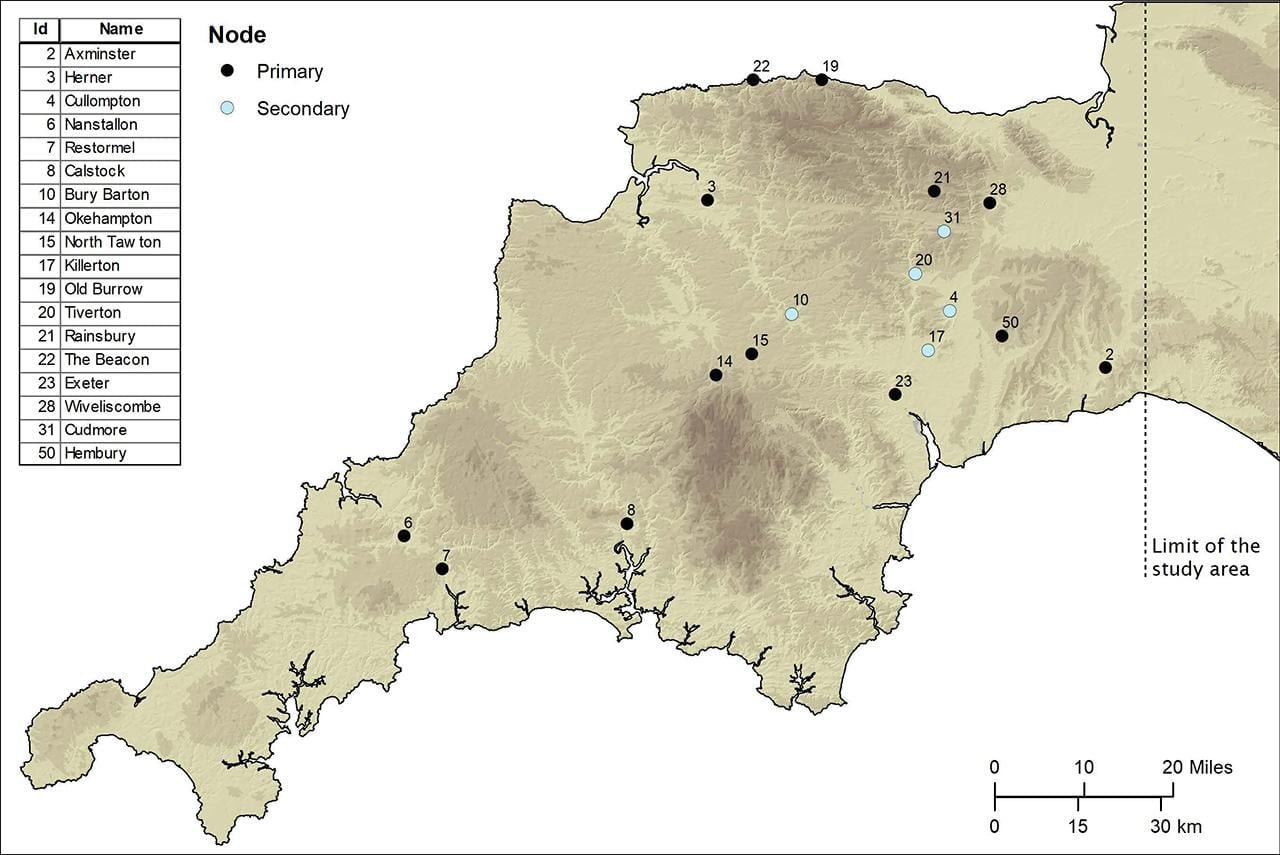
The Geographic Information System (GIS) predictive model developed by the researchers was key in filling gaps in the existing knowledge about the network’s layout. By applying methods such as Least Cost Paths, focal mobility networks, and transit corridors, the team identified primary and secondary nodes across Devon and Cornwall. These nodes encompassed not only well-known military forts like Old Burrow and The Beacon at Martinhoe but also settlements such as Exeter and North Tawton.

The researchers’ findings imply that the Roman road network was a complex amalgamation of pre-existing Prehistoric routes, Roman military campaign roads, and civilian roads constructed during peacetime. This evolutionary model is supported by the network’s connections that extended beyond military supply routes, suggesting broader societal and logistical purposes. The Roman road network’s primary intent appears to have been to facilitate the movement of animal-drawn vehicles and circumvent areas prone to flooding.
A vast Roman road network identified in England
Primary and secondary nodes in the study area. Credit: University of Exeter

This innovation not only enabled better connectivity between settlements but also suggests the possibility of previously unknown settlements yet to be discovered. Dr. Smart further highlighted the implications of this discovery for future archaeological research, stating, “This network, identified by the scans and the GIS-enabled modeling, may serve to predict the location of settlements that are as yet unknown to us.”

The research, documented in the Journal of Computer Applications in Archaeology, showcases the remarkable engineering prowess of the Romans and the ways in which their road infrastructure influenced settlement patterns and societal connectivity.

More information: Cesar Parcero-Oubina et al, (2023). Remote Sensing and GIS Modelling of Roman Roads in South West Britain, Journal of Computer Applications in Archaeology. DOI: 10.5334/jcaa.109
Share1Tweet1ShareShareSend

You May Also Like...

Unexpected discovery: sand layer beneath Ishtar Temple in Assur reveals city’s founding and ancient ritual practices
Archaeology

Unexpected discovery: sand layer beneath Ishtar Temple in Assur reveals city’s founding and ancient ritual practices

February 2, 2026
Isotope analysis of sacrificial horses uncovers long-distance animal networks in Iron Age Spain
Archaeology

Analysis of sacrificial horses at Casas del Turuñuelo uncovers long-distance animal networks in Iron Age Spain

February 2, 2026
Rare medieval seal from the UK bears 'Richard’s Secret' inscription and Roman-era gemstone
Archaeology

Rare medieval seal from the UK bears ‘Richard’s Secret’ inscription and Roman-era gemstone

February 1, 2026
Elite Late Bronze Age tombs at Hala Sultan Tekke reveal Cyprus’s vast ancient trade network
Archaeology

Elite Late Bronze Age tombs at Hala Sultan Tekke reveal Cyprus’s vast ancient trade network

February 1, 2026
Neanderthals in Spain deliberately deposited animal skulls in cave, revealing symbolic behavior
Anthropology

Neanderthals in Spain deliberately deposited animal skulls in cave, revealing symbolic behavior

January 31, 2026
Mysterious Medieval tunnel found inside 6,000 year old Neolithic ditch in Germany
Archaeology

Mysterious Medieval tunnel found inside 6,000 year old Neolithic ditch in Germany

January 31, 2026

Follow us


Instagram
244K

Facebook
118K

Threads
45K

LinkedIn
14K

Twitter
6K

YouTube
1K
  • Trending
  • Comments
  • Latest
Shipwreck Salvage. Credit: rawpixel.com / Public Domain

2,000-year-old shipwreck discovered off Turkish coast with remarkably preserved stacked ceramics

July 2, 2025
Viking age DNA reveals 9,000-year-old HIV-resistant gene originating near the Black Sea

Viking age DNA reveals 9,000-year-old HIV-resistant gene originating near the Black Sea

May 18, 2025
A new study suggests the mysterious Voynich Manuscript may be a medieval cipher

A new study suggests the mysterious Voynich Manuscript may be a medieval cipher

January 3, 2026
Moses may be named in ancient Egyptian mine inscriptions, sparking debate over earliest biblical references

Moses may be named in ancient Egyptian mine inscriptions, sparking debate over earliest biblical references

July 31, 2025
Mystery of Armenia’s 6,000-year-old dragon stones solved

Mystery of Armenia’s 6,000-year-old dragon stones solved

September 23, 2025
3D analysis reveals Shroud of Turin image likely came from sculpture, not Jesus’ body

3D analysis reveals Shroud of Turin image likely came from sculpture, not Jesus’ body

Moses may be named in ancient Egyptian mine inscriptions, sparking debate over earliest biblical references

Moses may be named in ancient Egyptian mine inscriptions, sparking debate over earliest biblical references

$1 million prize offered to decipher 5,300-year-old Indus Valley script

$1 million prize offered to decipher 5,300-year-old Indus Valley script

Oldest ever genetic data from a human relative found in 2-million-year-old fossilized teeth

Oldest ever genetic data from a human relative found in 2-million-year-old fossilized teeth

Exceptionally large Roman shoes discovered at Magna fort near Hadrian’s Wall

Exceptionally large Roman shoes discovered at Magna fort near Hadrian’s Wall

Unexpected discovery: sand layer beneath Ishtar Temple in Assur reveals city’s founding and ancient ritual practices

Unexpected discovery: sand layer beneath Ishtar Temple in Assur reveals city’s founding and ancient ritual practices

February 2, 2026
Isotope analysis of sacrificial horses uncovers long-distance animal networks in Iron Age Spain

Analysis of sacrificial horses at Casas del Turuñuelo uncovers long-distance animal networks in Iron Age Spain

February 2, 2026
Rare medieval seal from the UK bears 'Richard’s Secret' inscription and Roman-era gemstone

Rare medieval seal from the UK bears ‘Richard’s Secret’ inscription and Roman-era gemstone

February 1, 2026
Elite Late Bronze Age tombs at Hala Sultan Tekke reveal Cyprus’s vast ancient trade network

Elite Late Bronze Age tombs at Hala Sultan Tekke reveal Cyprus’s vast ancient trade network

February 1, 2026
Neanderthals in Spain deliberately deposited animal skulls in cave, revealing symbolic behavior

Neanderthals in Spain deliberately deposited animal skulls in cave, revealing symbolic behavior

January 31, 2026

Archaeology News online magazine

Archaeology News is an international online magazine that covers all aspects of archaeology.


Categories

  • Academics
    • Books
    • Conferences
    • Universities
  • Articles
  • Download
  • Game
  • News
    • Anthropology
    • Archaeology
    • Paleontology
  • Quiz
  • Tours

Subscribe to our newsletter

© 2024 - Archaeology News Online Magazine. All Rights Reserved.

  • About
  • Privacy Policy
  • Terms of Use
  • Donation
  • Contact

Welcome Back!

Login to your account below

Forgotten Password? Sign Up

Create New Account!

Fill the forms below to register

All fields are required. Log In

Retrieve your password

Please enter your username or email address to reset your password.

Log In

Add New Playlist

Manage Consent
To provide the best experiences, we use technologies like cookies to store and/or access device information. Consenting to these technologies will allow us to process data such as browsing behavior or unique IDs on this site. Not consenting or withdrawing consent, may adversely affect certain features and functions.
Functional Always active
The technical storage or access is strictly necessary for the legitimate purpose of enabling the use of a specific service explicitly requested by the subscriber or user, or for the sole purpose of carrying out the transmission of a communication over an electronic communications network.
Preferences
The technical storage or access is necessary for the legitimate purpose of storing preferences that are not requested by the subscriber or user.
Statistics
The technical storage or access that is used exclusively for statistical purposes. The technical storage or access that is used exclusively for anonymous statistical purposes. Without a subpoena, voluntary compliance on the part of your Internet Service Provider, or additional records from a third party, information stored or retrieved for this purpose alone cannot usually be used to identify you.
Marketing
The technical storage or access is required to create user profiles to send advertising, or to track the user on a website or across several websites for similar marketing purposes.
  • Manage options
  • Manage services
  • Manage {vendor_count} vendors
  • Read more about these purposes
View preferences
  • {title}
  • {title}
  • {title}
  • Home
  • News
    • Archaeology
    • Anthropology
    • Paleontology
  • Academic
    • Books
    • Conferences
    • Universities
  • Articles
  • VR Tours
  • Quiz & Game
  • Download
  • Encyclopedia
  • Forum

About  .  Contact  .  Donation

© 2024 - Archaeology News Online Magazine. All Rights Reserved