• About
  • Privacy Policy
  • Terms of Use
  • Donation
  • Contact
No Result
View All Result
Archaeology News
  • Home
  • News
    • Archaeology
    • Anthropology
    • Paleontology
  • Academic
    • Books
    • Conferences
    • Universities
  • Articles
  • VR Tours
  • Quiz & Game
  • Download
  • Encyclopedia
  • Forum
Archaeology News
No Result
View All Result
Home News Anthropology

Pre-Mongolian elite woman’s grave with silk cloak found in abandoned fortress

by Dario Radley
August 15, 2024

A recent archaeological excavation in Mongolia’s Dornod Province has uncovered a remarkable elite tomb dating from the post-Khitan and pre-Mongol periods.

Pre-Mongolian elite woman’s grave with silk cloak found in abandoned fortress
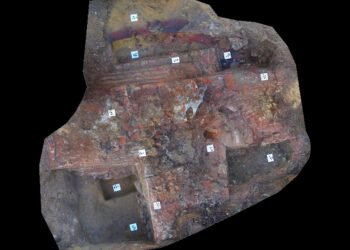
Drone photo of the place of the discovery in the northeast of Mongolia. Credit: Amartuvshin Chunag et al., Archaeological Research in Asia (2024)

The discovery, made by the Joint Mongolian-Israeli-American Archaeological Project, sheds light on the social structure, trade networks, and funerary practices of the 12th and 13th centuries, a time between the collapse of the Khitan-Liao Empire and the rise of the Mongol Empire under Genghis Khan.

The Khitan-Liao Empire, which existed from 916 to 1125 CE, once dominated large areas of what is now central and eastern Mongolia. However, following its fall, the historical record becomes sparse, particularly concerning the period leading up to the establishment of the Mongol Empire in 1206 CE. This lack of documentation has left a significant gap in understanding the social and political landscape of Mongolia during this transitional period.

The excavation took place at the ancient fortified complex of Khar Nuur, located near the northeastern border of Mongolia, about 1.4 kilometers west of Lake Khar Nuur. This site, known for its extensive network of walls and fortifications that stretched over 4,000 kilometers, was once a strategic stronghold of the Khitan Empire. The particular focus of this discovery was “Cluster 27,” a circular structure within the larger complex that contained a smaller rectangular enclosure.

Pre-Mongolian elite woman’s grave with silk cloak found in abandoned fortress
Khar Nuur grave plan, including a profile view and three elevation measurements. Credit: Amartuvshin Chunag et al., Archaeological Research in Asia (2024)

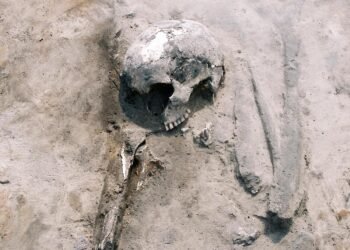
During the 2018 excavation, archaeologists discovered a well-preserved tomb embedded within the outer wall of this enclosure. The tomb, which dates between 1158 and 1214 CE based on radiocarbon analysis, contained the remains of an elite woman, aged between 40 and 60 years. The woman was buried in a wooden coffin made of larch or pine, oriented toward the northeast, and adorned with a yellow silk cloak and a headdress similar to traditional medieval hats known as bogtag malgai.

RelatedStories

Rich medieval Christians buried ‘closer to God’ even with leprosy or tuberculosis, archaeologists find

Rich medieval Christians buried ‘closer to God’ even with leprosy or tuberculosis, archaeologists find

February 12, 2026
Viking Age mass grave with dismembered bodies and trepanned giant found near Cambridge

Viking Age mass grave with dismembered bodies and trepanned giant found near Cambridge

February 11, 2026

The grave also contained a variety of valuable artifacts, indicating the high status of the woman. Among the grave goods were a silver cup, a bronze vessel, a gold bracelet, coral and glass beads, and golden earrings. Notably, many of these items were not of local origin. For example, the silk likely came from southern China, while the wood used in the coffin was sourced from trees native to regions 150 to 300 kilometers away.

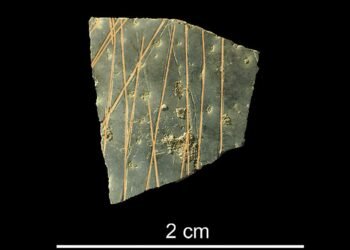
One particularly unique find was a small bronze cup, decorated with geometric figures and finely incised lines, which has no clear parallel among other medieval objects found in Mongolia, suggesting a connection to an unidentified craft tradition.
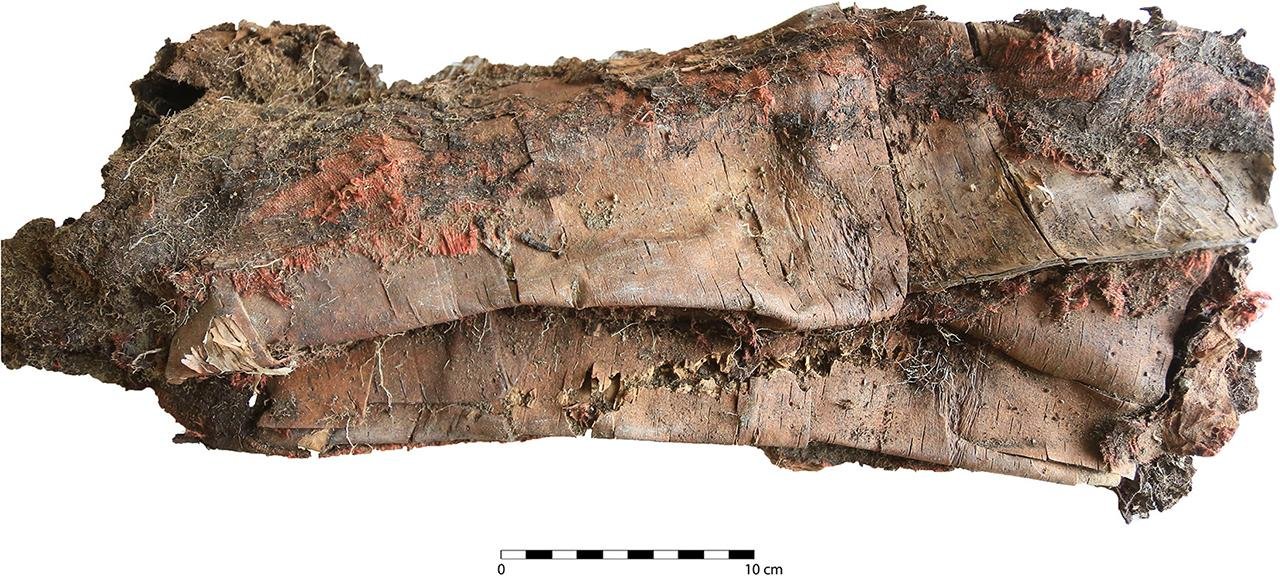
Pre-Mongolian elite woman’s grave with silk cloak found in abandoned fortress
Remains of a birch bark object, likely the headgear belonging to a woman. Credit: Amartuvshin Chunag et al., Archaeological Research in Asia (2024)

Professor Gideon Shelach-Lavi, a co-author of the study, said: “The richness of the grave is surprising, especially considering its modest size and in comparison to other known graves of this era.” Shelach-Lavi also pointed out the diversity of the artifacts and materials found in the tomb, which suggest a complex network of connections that are not well-documented in historical records.

The discovery of this elite tomb in a location that had been abandoned after the fall of the Khitan Empire raises intriguing questions about the site’s continued cultural and symbolic importance. The reuse of the fortress’s walls for burial during a period of political transition suggests that these ancient fortifications were not only military centers but also held lasting cultural significance for the local communities.

The burial practices and the mix of local and imported goods reflect a society in transition, influenced by both its nomadic traditions and the cultural exchanges with neighboring civilizations. The results of this research were published in Archaeological Research in Asia.


More information: Amartuvshin Chunag et al, (2024). An elite grave of the pre-Mongol period, from Dornod Province, Mongolia, Archaeological Research in Asia. DOI: 10.1016/j.ara.2024.100537

Share3Tweet2ShareShareSend

You May Also Like...

Chalcolithic cornets at Teleilat Ghassul reveal ritual lamp use in Jordan’s prehistoric communities
Archaeology

Chalcolithic cornets at Teleilat Ghassul reveal ritual lamp use in Jordan’s prehistoric communities

February 16, 2026
DNA study reveals 3,000 years of genetic stability in Europe’s Low Countries before Bell Beaker expansion
Anthropology

DNA study reveals 3,000 years of genetic stability in Europe’s Low Countries before Bell Beaker expansion

February 16, 2026
Second Temple period stone vessel workshop unearthed on Mount Scopus after antiquities theft arrests
Archaeology

Second Temple period stone vessel workshop unearthed on Mount Scopus after antiquities theft arrests

February 16, 2026
10,000 years of rock art discovered at Umm Arak Plateau in Egypt’s southern Sinai
Archaeology

10,000 years of rock art discovered at Umm Arak Plateau in Egypt’s southern Sinai

February 15, 2026
Drone surveys reveal Roman forum and previously unknown monumental theater at Fioccaglia
Archaeology

Drone surveys reveal Roman forum and previously unknown monumental theater at Fioccaglia

February 15, 2026
Earliest known burial in Northern Britain identified as young girl through DNA analysis
Anthropology

Earliest known burial in Northern Britain identified as young girl through DNA analysis

February 14, 2026

Follow us


Instagram
244K

Facebook
118K

Threads
45K

LinkedIn
14K

Twitter
6K

YouTube
1K
  • Trending
  • Comments
  • Latest
Shipwreck Salvage. Credit: rawpixel.com / Public Domain

2,000-year-old shipwreck discovered off Turkish coast with remarkably preserved stacked ceramics

July 2, 2025
Viking age DNA reveals 9,000-year-old HIV-resistant gene originating near the Black Sea

Viking age DNA reveals 9,000-year-old HIV-resistant gene originating near the Black Sea

May 18, 2025
A new study suggests the mysterious Voynich Manuscript may be a medieval cipher

A new study suggests the mysterious Voynich Manuscript may be a medieval cipher

January 3, 2026
Moses may be named in ancient Egyptian mine inscriptions, sparking debate over earliest biblical references

Moses may be named in ancient Egyptian mine inscriptions, sparking debate over earliest biblical references

July 31, 2025
Mystery of Armenia’s 6,000-year-old dragon stones solved

Mystery of Armenia’s 6,000-year-old dragon stones solved

September 23, 2025
3D analysis reveals Shroud of Turin image likely came from sculpture, not Jesus’ body

3D analysis reveals Shroud of Turin image likely came from sculpture, not Jesus’ body

Moses may be named in ancient Egyptian mine inscriptions, sparking debate over earliest biblical references

Moses may be named in ancient Egyptian mine inscriptions, sparking debate over earliest biblical references

$1 million prize offered to decipher 5,300-year-old Indus Valley script

$1 million prize offered to decipher 5,300-year-old Indus Valley script

Oldest ever genetic data from a human relative found in 2-million-year-old fossilized teeth

Oldest ever genetic data from a human relative found in 2-million-year-old fossilized teeth

Exceptionally large Roman shoes discovered at Magna fort near Hadrian’s Wall

Exceptionally large Roman shoes discovered at Magna fort near Hadrian’s Wall

Chalcolithic cornets at Teleilat Ghassul reveal ritual lamp use in Jordan’s prehistoric communities

Chalcolithic cornets at Teleilat Ghassul reveal ritual lamp use in Jordan’s prehistoric communities

February 16, 2026
DNA study reveals 3,000 years of genetic stability in Europe’s Low Countries before Bell Beaker expansion

DNA study reveals 3,000 years of genetic stability in Europe’s Low Countries before Bell Beaker expansion

February 16, 2026
Second Temple period stone vessel workshop unearthed on Mount Scopus after antiquities theft arrests

Second Temple period stone vessel workshop unearthed on Mount Scopus after antiquities theft arrests

February 16, 2026
10,000 years of rock art discovered at Umm Arak Plateau in Egypt’s southern Sinai

10,000 years of rock art discovered at Umm Arak Plateau in Egypt’s southern Sinai

February 15, 2026
Drone surveys reveal Roman forum and previously unknown monumental theater at Fioccaglia

Drone surveys reveal Roman forum and previously unknown monumental theater at Fioccaglia

February 15, 2026

Archaeology News online magazine

Archaeology News is an international online magazine that covers all aspects of archaeology.


Categories

  • Academics
    • Books
    • Conferences
    • Universities
  • Articles
  • Download
  • Game
  • News
    • Anthropology
    • Archaeology
    • Paleontology
  • Quiz
  • Tours

Subscribe to our newsletter

© 2024 - Archaeology News Online Magazine. All Rights Reserved.

  • About
  • Privacy Policy
  • Terms of Use
  • Donation
  • Contact

Manage Consent
To provide the best experiences, we use technologies like cookies to store and/or access device information. Consenting to these technologies will allow us to process data such as browsing behavior or unique IDs on this site. Not consenting or withdrawing consent, may adversely affect certain features and functions.
Functional Always active
The technical storage or access is strictly necessary for the legitimate purpose of enabling the use of a specific service explicitly requested by the subscriber or user, or for the sole purpose of carrying out the transmission of a communication over an electronic communications network.
Preferences
The technical storage or access is necessary for the legitimate purpose of storing preferences that are not requested by the subscriber or user.
Statistics
The technical storage or access that is used exclusively for statistical purposes. The technical storage or access that is used exclusively for anonymous statistical purposes. Without a subpoena, voluntary compliance on the part of your Internet Service Provider, or additional records from a third party, information stored or retrieved for this purpose alone cannot usually be used to identify you.
Marketing
The technical storage or access is required to create user profiles to send advertising, or to track the user on a website or across several websites for similar marketing purposes.
  • Manage options
  • Manage services
  • Manage {vendor_count} vendors
  • Read more about these purposes
View preferences
  • {title}
  • {title}
  • {title}
  • Home
  • News
    • Archaeology
    • Anthropology
    • Paleontology
  • Academic
    • Books
    • Conferences
    • Universities
  • Articles
  • VR Tours
  • Quiz & Game
  • Download
  • Encyclopedia
  • Forum

About  .  Contact  .  Donation

© 2024 - Archaeology News Online Magazine. All Rights Reserved