• About
  • Privacy Policy
  • Terms of Use
  • Donation
  • Contact
No Result
View All Result
Archaeology News
  • Home
  • News
    • Archaeology
    • Anthropology
    • Paleontology
  • Academic
    • Books
    • Conferences
    • Universities
  • Articles
  • VR Tours
  • Quiz & Game
  • Download
  • Encyclopedia
  • Forum
Archaeology News
No Result
View All Result
Home News Archaeology

Rare 14th-century gauntlet unearthed in Oslo’s medieval harbor

by Dario Radley
August 25, 2024

A rare iron gauntlet from the 14th century has been unearthed during an archaeological excavation at Oslo’s former harbor, adding to the rich tapestry of discoveries made in the area. This exceptional find was made by archaeologists from the Norwegian Institute for Cultural Heritage Research (NIKU), who have been excavating the Bispevika area since 2019.

Rare 14th-century gauntlet unearthed in Oslo's medieval harbor
Remains of a medieval iron gauntlet discovered in Oslo. Credit: Norwegian Institute for Cultural Heritage Research

Oslo was originally founded as a medieval city and port around 1050 by King Harald Hardraade. In 1624, after a devastating fire that destroyed much of the city, King Christian IV of Denmark and Norway decided to move Oslo to a location across the fjord, closer to the Akershus Fortress. The city was renamed Christiania and retained this name until 1925 when it reverted to Oslo.

The harbor area, which played a crucial role in the city’s medieval history, has been the focus of extensive archaeological investigations since 2019. Over the centuries, as the sea receded, the old harbor expanded, leading to the construction of docks and warehouses. These excavations have uncovered a wealth of artifacts, including ceramics, footwear, ropes, remains of slaughtered animals, shipwrecks, and an impressive collection of weapons.

The recent find of a rare iron gauntlet, possibly belonging to a medieval knight, was a surprising and valuable discovery. These gauntlets, typically made of iron, were designed to protect the hands and wrists of soldiers and knights who had upgraded from chainmail to plate armor in the early 14th century. However, such finds are exceedingly rare due to the rapid corrosion of metal and the medieval practice of recycling and reforging iron.
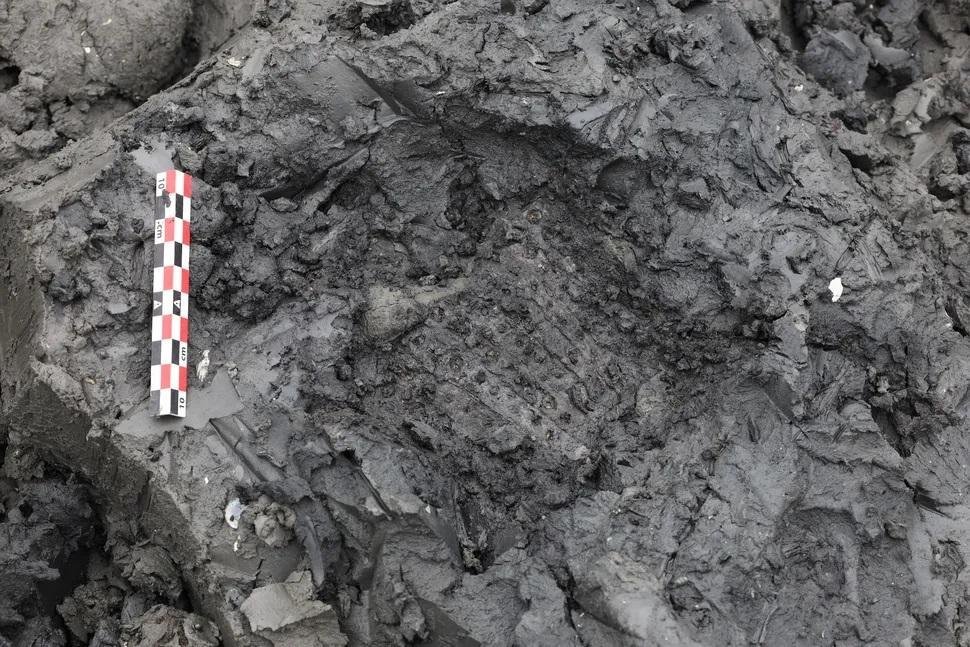
Rare 14th-century gauntlet unearthed in Oslo's medieval harbor
The gauntlet impression. Credit: Norwegian Institute for Cultural Heritage Research

According to Håvard Hegdal, an archaeologist at NIKU and the excavation’s project manager, the gauntlet was found approximately 40 meters offshore. “It could only have fallen from a ship, although we don’t have a clear explanation for why that might have happened,” Hegdal said in an email to Live Science. He also noted that the gauntlet was found beneath a layer of blue clay, which they dated to around 1380. This suggests it may have been lost during a significant quick clay landslide and the subsequent waves.


RelatedStories

Rare 10th-century bronze wheel cross found in Brandenburg reveals early Christian influence among Slavic populations

Rare 10th-century bronze wheel cross found in Brandenburg reveals early Christian influence among Slavic populations

January 25, 2026
Intact Roman helmet from the First Punic War recovered from the sea

Intact Roman helmet from the First Punic War recovered from the sea

September 8, 2025

Despite its age, little remains of the gauntlet today. What survives is mostly an imprint of the armor, with small rivets and a possible buckle visible in X-rays. This imprint was enough for the archaeologists to identify the object as a gauntlet.

The exact circumstances of how the gauntlet ended up at the bottom of the harbor remain a mystery. Hegdal expressed skepticism about it being lost in battle, stating, “The gauntlet would never have been left lying in the streets in medieval Oslo. This is an extremely expensive object. An ordinary person would never own something like this.” He suggested it might have been discarded due to damage or simply lost due to unfortunate circumstances.

The area has yielded numerous other weapons, including daggers, swords, spears, and axes. Understanding the full story behind these finds is challenging due to the loss of many Norwegian documents in a fire in 1728. Oslo’s medieval city laws were not preserved, further complicating efforts to piece together the city’s history.

“Many Norwegian medieval documents were burned in Copenhagen in the 1700s. The city law for Oslo is not preserved,” Hegdal told Science Norway. Despite these challenges, the ongoing excavations by NIKU, which are set to conclude in November, continue to shed new light on Oslo’s past.

More information: Norwegian Institute for Cultural Heritage Research

Share:

Share on Facebook Share on X (Twitter) Share on LinkedIn Share on Pinterest Share on WhatsApp Share on Email

You May Also Like...

2,300-year-old Iron Age riverside structure discovered beneath German city astonishes archaeologists
Archaeology

2,300-year-old Iron Age riverside structure discovered beneath German city

May 22, 2026
100 Abbasid-era gold jewelry pieces found at ancient Dariyah site in Saudi Arabia
Archaeology

100 Abbasid-era gold jewelry pieces found at ancient Dariyah site in Saudi Arabia

May 22, 2026
Neanderthals gathered shellfish like modern humans 115,000 years ago, study finds
Anthropology

Neanderthals gathered shellfish like modern humans 115,000 years ago, study finds

May 21, 2026
Ancient pigeons were already living alongside humans 3,400 years ago, study finds
Archaeology

Ancient pigeons were already living alongside humans 3,400 years ago, study finds

May 21, 2026
Ancient Venetic sanctuary with rare inscriptions unearthed beneath road project in Italy
Archaeology

Ancient Venetic sanctuary with rare inscriptions unearthed beneath road project in Italy

May 21, 2026
1,000-year-old dingo burial in Australia reveals deep ties between Barkindji people and dingoes
Archaeology

1,000-year-old ritually buried dingo in Australia reveals deep ties between Barkindji people and dingoes

May 20, 2026

Follow us


Instagram
242K

Facebook
117K

Threads
46K

LinkedIn
14K

Twitter
6K

YouTube
1K
2,300-year-old Iron Age riverside structure discovered beneath German city astonishes archaeologists

2,300-year-old Iron Age riverside structure discovered beneath German city

May 22, 2026
100 Abbasid-era gold jewelry pieces found at ancient Dariyah site in Saudi Arabia

100 Abbasid-era gold jewelry pieces found at ancient Dariyah site in Saudi Arabia

May 22, 2026
Neanderthals gathered shellfish like modern humans 115,000 years ago, study finds

Neanderthals gathered shellfish like modern humans 115,000 years ago, study finds

May 21, 2026
Ancient pigeons were already living alongside humans 3,400 years ago, study finds

Ancient pigeons were already living alongside humans 3,400 years ago, study finds

May 21, 2026

Archaeology News online magazine

Archaeology News is an international online magazine that covers all aspects of archaeology.


Categories

  • Academics
    • Books
    • Conferences
    • Universities
  • Articles
  • Download
  • Game
  • News
    • Anthropology
    • Archaeology
    • Paleontology
  • Quiz
  • Tours

Subscribe to our newsletter

© 2024 - Archaeology News Online Magazine. All Rights Reserved.

  • About
  • Privacy Policy
  • Terms of Use
  • Donation
  • Contact

Manage Consent
To provide the best experiences, we use technologies like cookies to store and/or access device information. Consenting to these technologies will allow us to process data such as browsing behavior or unique IDs on this site. Not consenting or withdrawing consent, may adversely affect certain features and functions.
Functional Always active
The technical storage or access is strictly necessary for the legitimate purpose of enabling the use of a specific service explicitly requested by the subscriber or user, or for the sole purpose of carrying out the transmission of a communication over an electronic communications network.
Preferences
The technical storage or access is necessary for the legitimate purpose of storing preferences that are not requested by the subscriber or user.
Statistics
The technical storage or access that is used exclusively for statistical purposes. The technical storage or access that is used exclusively for anonymous statistical purposes. Without a subpoena, voluntary compliance on the part of your Internet Service Provider, or additional records from a third party, information stored or retrieved for this purpose alone cannot usually be used to identify you.
Marketing
The technical storage or access is required to create user profiles to send advertising, or to track the user on a website or across several websites for similar marketing purposes.
  • Manage options
  • Manage services
  • Manage {vendor_count} vendors
  • Read more about these purposes
View preferences
  • {title}
  • {title}
  • {title}
  • Home
  • News
    • Archaeology
    • Anthropology
    • Paleontology
  • Academic
    • Books
    • Conferences
    • Universities
  • Articles
  • VR Tours
  • Quiz & Game
  • Download
  • Encyclopedia
  • Forum

About  .  Contact  .  Donation

© 2024 - Archaeology News Online Magazine. All Rights Reserved