• About
  • Privacy Policy
  • Terms of Use
  • Donation
  • Contact
No Result
View All Result
Archaeology News
  • Home
  • News
    • Archaeology
    • Anthropology
    • Paleontology
  • Academic
    • Books
    • Conferences
    • Universities
  • Articles
  • VR Tours
  • Quiz & Game
  • Download
  • Encyclopedia
  • Forum
Archaeology News
No Result
View All Result
Home News Archaeology

Early evidence of writing found at La Peña del Castro, Spain

by Dario Radley
February 26, 2025

Archaeologists have made a groundbreaking find at La Peña del Castro, an Iron Age settlement in La Ercina, León. They’ve unearthed one of the oldest known examples of writing in the region. A team from the University of León identified a Celtiberian alphabet inscription on a spindle whorl, a tool for textile production. This discovery, dating to the 1st century BCE, sheds new light on writing practices in the Iberian Peninsula before the Roman conquest.

Early evidence of writing found at La Peña del Castro, Spain
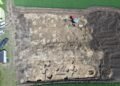
The site of the find at Peña del Castro, an Iron Age settlement in La Ercina, León. Credit: Eduardo González Gómez de Agüero/(This image is used under the terms of the CC BY-NC license for non-commercial, educational, and informational purposes. If you are the copyright holder and have any concerns regarding its use, please contact us for prompt removal.)

The team uncovered the spindle whorl in 2017. It’s made of talc, a locally sourced material. This suggests the object was produced on-site, indicating that the settlement may have had residents capable of creating and understanding written symbols. They found the object in a storage area next to other items like a basket of seeds, cured beef, and various tools. These findings point to the community’s complex economic and social activities.

The symbols carved into the spindle whorl form a sharp angle similar to those seen in other Celtiberian and Vaccean settlements. Experts suggest this inscription might represent a property mark, which was common in nearby cultures during the period of growing social differentiation. But the unique context of the find, along with its careful carving, suggests it might also have had symbolic meaning or indicated the status of its owner.

This find stands out not just because of its rarity, but also because researchers previously thought writing in the northern Iberian Peninsula during the Iron Age was almost nonexistent. Before the Roman conquest, Iron Age cultures in this area, including those in the Cantabrian Mountains, didn’t leave behind any written records. This discovery challenges that idea and adds to the growing body of evidence suggesting that some communities could read and write, or at least had a basic form of writing long before Roman influence.

Early evidence of writing found at La Peña del Castro, Spain
The symbols carved into the spindle whorl form a sharp angle. Credit: Eduardo González Gómez de Agüero/(This image is used under the terms of the CC BY-NC license for non-commercial, educational, and informational purposes. If you are the copyright holder and have any concerns regarding its use, please contact us for prompt removal.)

The inscription stands as one of the earliest examples of alphabetic writing found in the León province. It is part of a broader trend of increasing cultural and social complexity observed at La Peña del Castro. Excavations at the site from 2013 to 2019 uncovered a community characterized by population growth, economic surplus, and enhanced trade interactions. This inscription highlights the site’s evolving social structure, where writing might have served to show ownership or played a part in social rituals.

RelatedStories

Ancient herpesvirus genomes reveal a 2,500-year history of human infection

Ancient herpesvirus genomes reveal a 2,500-year history of human infection

January 4, 2026
A new study suggests the mysterious Voynich Manuscript may be a medieval cipher

A new study suggests the mysterious Voynich Manuscript may be a medieval cipher

January 3, 2026

This finding is crucial as it suggests that foreign populations or cultural exchanges might have played a role in spreading writing traditions in the region. While there’s no definitive evidence connecting the people of La Peña del Castro to the Vaccean or other nearby groups, the inscription’s style suggests a cultural connection.

Published in the journal Paleohispánica, this research adds a fresh perspective to our knowledge of pre-Roman writing in Spain. Researchers hope that ongoing excavations and research will provide more context and evidence to reveal the social, political, and economic transformations that took place in this area during the Iron Age.


More information: Universidad de León
González Gómez de Agüero, E. (2024). Marcas incisas en una fusayola de La Peña del Castro (León). Palaeohispanica. Revista Sobre Lenguas y Culturas de La Hispania Antigua, 24. doi:10.36707/palaeohispanica.v24i1.636
Share1Tweet1ShareShareSend

You May Also Like...

Republican-era tombs and a Hercules shrine unearthed in eastern Rome reveal centuries of suburban life
Archaeology

Republican-era tombs and a Hercules shrine unearthed in eastern Rome reveal centuries of suburban life

January 23, 2026
Oldest known rock art dated to 67,800 years discovered in Sulawesi cave
Archaeology

Oldest known rock art dated to 67,800 years discovered in Sulawesi cave

January 20, 2026
Roman marching camps discovered in Saxony-Anhalt reveal early military advances deep into Germania
Archaeology

Roman marching camps discovered in Saxony-Anhalt reveal early military advances deep into Germania

January 15, 2026
Casablanca fossils dated 773,000 years back reveal African origin of last common ancestor of humans and Neanderthals
Anthropology

Casablanca fossils dated 773,000 years back reveal African origin of last common ancestor of humans and Neanderthals

January 10, 2026
60,000-year-old poison arrows from South Africa reveal the world’s earliest poisoned weapons and advanced hunting techniques
Archaeology

60,000-year-old poison arrows from South Africa reveal the world’s earliest poisoned weapons and advanced hunting techniques

January 8, 2026
Inscribed clay cylinders reveal Nebuchadnezzar II’s restoration of the Kish Ziggurat
Archaeology

Inscribed clay cylinders reveal Nebuchadnezzar II’s restoration of the Kish Ziggurat

January 7, 2026

Follow us


Instagram
244K

Facebook
118K

Threads
45K

LinkedIn
14K

Twitter
6K

YouTube
1K
  • Trending
  • Comments
  • Latest
Shipwreck Salvage. Credit: rawpixel.com / Public Domain

2,000-year-old shipwreck discovered off Turkish coast with remarkably preserved stacked ceramics

July 2, 2025
Viking age DNA reveals 9,000-year-old HIV-resistant gene originating near the Black Sea

Viking age DNA reveals 9,000-year-old HIV-resistant gene originating near the Black Sea

May 18, 2025
A new study suggests the mysterious Voynich Manuscript may be a medieval cipher

A new study suggests the mysterious Voynich Manuscript may be a medieval cipher

January 3, 2026
Moses may be named in ancient Egyptian mine inscriptions, sparking debate over earliest biblical references

Moses may be named in ancient Egyptian mine inscriptions, sparking debate over earliest biblical references

July 31, 2025
Mystery of Armenia’s 6,000-year-old dragon stones solved

Mystery of Armenia’s 6,000-year-old dragon stones solved

September 23, 2025
3D analysis reveals Shroud of Turin image likely came from sculpture, not Jesus’ body

3D analysis reveals Shroud of Turin image likely came from sculpture, not Jesus’ body

Moses may be named in ancient Egyptian mine inscriptions, sparking debate over earliest biblical references

Moses may be named in ancient Egyptian mine inscriptions, sparking debate over earliest biblical references

$1 million prize offered to decipher 5,300-year-old Indus Valley script

$1 million prize offered to decipher 5,300-year-old Indus Valley script

Oldest ever genetic data from a human relative found in 2-million-year-old fossilized teeth

Oldest ever genetic data from a human relative found in 2-million-year-old fossilized teeth

Exceptionally large Roman shoes discovered at Magna fort near Hadrian’s Wall

Exceptionally large Roman shoes discovered at Magna fort near Hadrian’s Wall

Republican-era tombs and a Hercules shrine unearthed in eastern Rome reveal centuries of suburban life

Republican-era tombs and a Hercules shrine unearthed in eastern Rome reveal centuries of suburban life

January 23, 2026
Oldest known rock art dated to 67,800 years discovered in Sulawesi cave

Oldest known rock art dated to 67,800 years discovered in Sulawesi cave

January 20, 2026
Roman marching camps discovered in Saxony-Anhalt reveal early military advances deep into Germania

Roman marching camps discovered in Saxony-Anhalt reveal early military advances deep into Germania

January 15, 2026
Casablanca fossils dated 773,000 years back reveal African origin of last common ancestor of humans and Neanderthals

Casablanca fossils dated 773,000 years back reveal African origin of last common ancestor of humans and Neanderthals

January 10, 2026
60,000-year-old poison arrows from South Africa reveal the world’s earliest poisoned weapons and advanced hunting techniques

60,000-year-old poison arrows from South Africa reveal the world’s earliest poisoned weapons and advanced hunting techniques

January 8, 2026

Archaeology News online magazine

Archaeology News is an international online magazine that covers all aspects of archaeology.


Categories

  • Academics
    • Books
    • Conferences
    • Universities
  • Articles
  • Download
  • Game
  • News
    • Anthropology
    • Archaeology
    • Paleontology
  • Quiz
  • Tours

Subscribe to our newsletter

© 2024 - Archaeology News Online Magazine. All Rights Reserved.

  • About
  • Privacy Policy
  • Terms of Use
  • Donation
  • Contact

Welcome Back!

Login to your account below

Forgotten Password? Sign Up

Create New Account!

Fill the forms below to register

All fields are required. Log In

Retrieve your password

Please enter your username or email address to reset your password.

Log In

Add New Playlist

Manage Consent
To provide the best experiences, we use technologies like cookies to store and/or access device information. Consenting to these technologies will allow us to process data such as browsing behavior or unique IDs on this site. Not consenting or withdrawing consent, may adversely affect certain features and functions.
Functional Always active
The technical storage or access is strictly necessary for the legitimate purpose of enabling the use of a specific service explicitly requested by the subscriber or user, or for the sole purpose of carrying out the transmission of a communication over an electronic communications network.
Preferences
The technical storage or access is necessary for the legitimate purpose of storing preferences that are not requested by the subscriber or user.
Statistics
The technical storage or access that is used exclusively for statistical purposes. The technical storage or access that is used exclusively for anonymous statistical purposes. Without a subpoena, voluntary compliance on the part of your Internet Service Provider, or additional records from a third party, information stored or retrieved for this purpose alone cannot usually be used to identify you.
Marketing
The technical storage or access is required to create user profiles to send advertising, or to track the user on a website or across several websites for similar marketing purposes.
  • Manage options
  • Manage services
  • Manage {vendor_count} vendors
  • Read more about these purposes
View preferences
  • {title}
  • {title}
  • {title}
  • Home
  • News
    • Archaeology
    • Anthropology
    • Paleontology
  • Academic
    • Books
    • Conferences
    • Universities
  • Articles
  • VR Tours
  • Quiz & Game
  • Download
  • Encyclopedia
  • Forum

About  .  Contact  .  Donation

© 2024 - Archaeology News Online Magazine. All Rights Reserved