• About
  • Privacy Policy
  • Terms of Use
  • Donation
  • Contact
No Result
View All Result
Archaeology News
  • Home
  • News
    • Archaeology
    • Anthropology
    • Paleontology
  • Academic
    • Books
    • Conferences
    • Universities
  • Articles
  • VR Tours
  • Quiz & Game
  • Download
  • Encyclopedia
  • Forum
Archaeology News
No Result
View All Result
Home News Archaeology

Bronze Age pottery reveals El Argar’s economic and political frontiers

by Dario Radley
March 17, 2025

A trailblazing study conducted by researchers from the Autonomous University of Barcelona (UAB) and the Max Planck Institute for Social Anthropology mapped out the economic and political borders of the territory of El Argar, the Bronze Age site credited with being the first state-level society in the Iberian Peninsula. The research provides insight into how El Argar exerted dominance over neighboring communities that were less centralized in their social structure, including those of La Mancha and Valencia, 4,000 years ago.
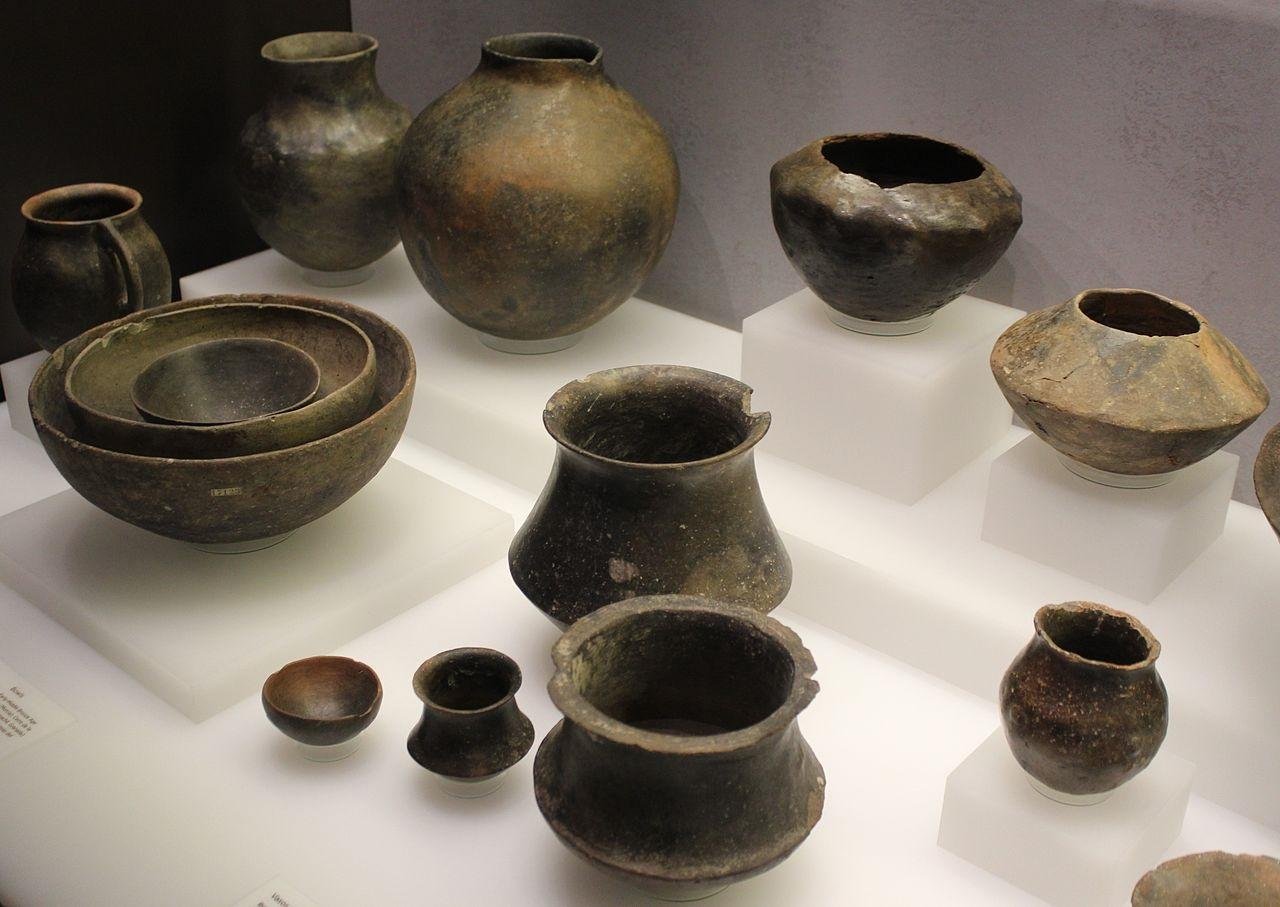
Bronze Age pottery reveals El Argar's economic and political frontiers
Argaric pottery. Credit: Miguel Hermoso Cuesta, CC BY-SA 4.0

The study, published in the Journal of Archaeological Method and Theory, analyzes ceramic production and circulation in the borderland between present-day Murcia, allowing researchers to reconstruct the interaction dynamics of these groups between 2200 and 1550 BCE.

Until now, archaeological studies have paid little attention to the concept of borders, even though these played a key role in forming early states. “Any effort to understand the consolidation of the first states in recent prehistory must take into account how political boundaries were created and maintained,” said Roberto Risch, professor in the Department of Prehistory at UAB and coordinator of the study.

By focusing on how pottery was produced and distributed throughout the area, the researchers identified clear economic and political borders that separated El Argar from its neighboring societies. Such findings suggest that El Argar regulated ceramic distribution in a way that strengthened its dominance over less centralized communities. “We have been able to observe active zones of exchange and negotiation, in which power relations and social differences could be traced through the circulation of pottery vessels,” explained Adrià Moreno Gil, a researcher at the Max Planck Institute for Social Anthropology and lead author of the study.
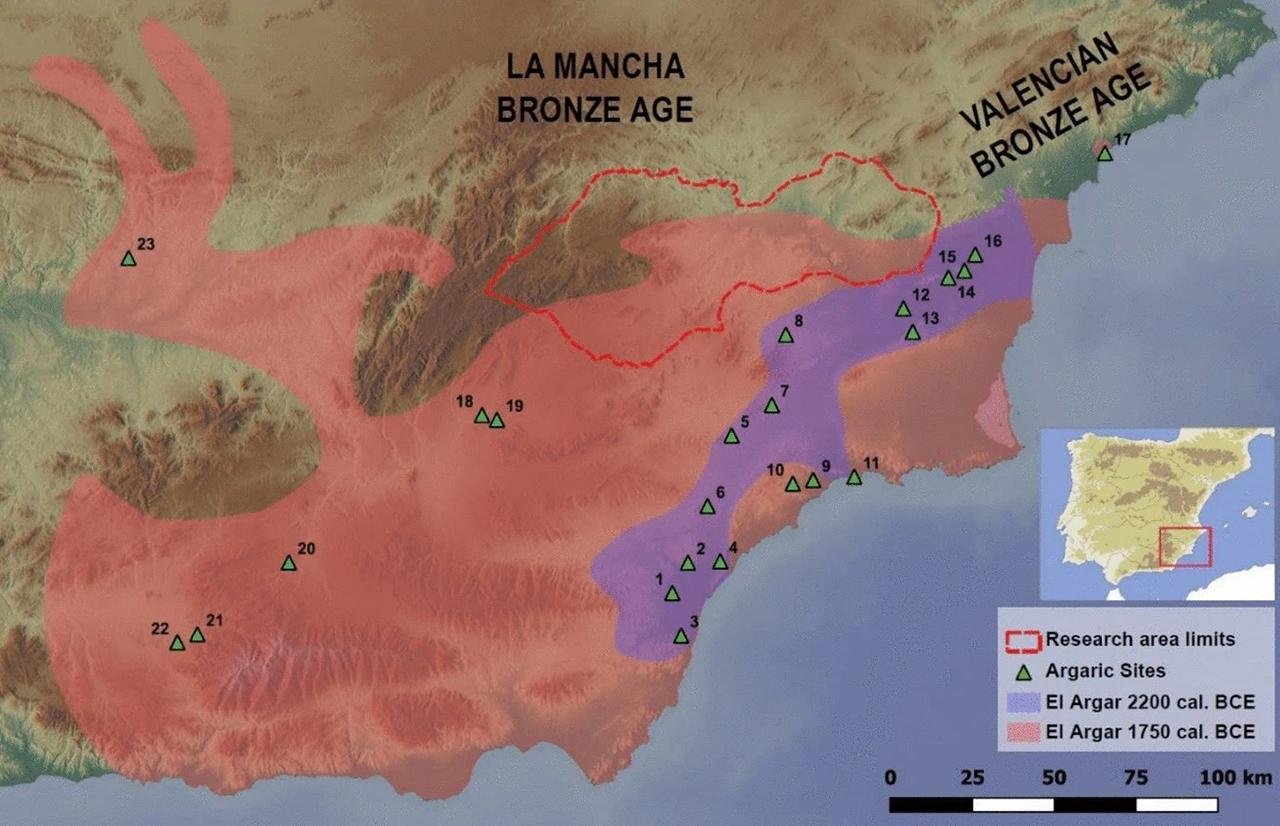
Bronze Age pottery reveals El Argar's economic and political frontiers
El Argar core area (purple) and maximum expansion area ca. 1750 BCE (red), middle and upper Segura valley, and main Argaric settlements. Credit: Autonomous University of Barcelona

The research reveals the main divergence in ceramic production characteristics between El Argar and its neighboring regions. Argaric ceramics, made from clay extracted from the coastal mountains of Murcia and Almería, were more commonly found in southern sites of the study area and indicate a large-scale ceramic distribution network likely controlled by central settlements of El Argar.

RelatedStories

Scientists uncover Ireland’s largest prehistoric hillfort settlement, reshaping views of Bronze Age society

Scientists uncover Ireland’s largest prehistoric hillfort settlement, reshaping views of Bronze Age society

January 1, 2026
A 4,000-year-old sheep may reveal how the Bronze Age plague spread across Eurasia

A 4,000-year-old sheep may reveal how the Bronze Age plague spread across Eurasia

December 28, 2025

However, in the northern part of the research area, small-scale pottery workshops using locally sourced clay were more common. This indicates a fundamental divide in economic organization: El Argar operated a centralized production and trade system, while the other settlements tended to sustain more localized and domestically scaled economies.

To reach these results, the team combined extensive field surveys, petrographic analysis of the ceramic materials, and spatial modeling using geographical information systems (GIS). This enabled them to map production and circulation areas with unprecedented detail. According to Carla Garrido García, a doctoral researcher at UAB and co-author of the work, “Our study demonstrates that the analysis of ceramics is a key tool for understanding economic exchanges, social relations, and the configuration of border spaces between political and economic entities.”

This study provides compelling evidence that the first state structures in Western Europe, including El Argar, had developed quite sophisticated economic and political systems much earlier than was previously thought. The results of the current research significantly enhance our understanding of El Argar and pave the way for proposing a model for studying other early state societies.

More information: Autonomous University of Barcelona

Moreno Gil, A., Garrido García, C., Bonora Soriano, B. et al. (2025). Bronze Age Frontiers and Pottery Circulation: Political and Economic Relations at the Northern Fringes of El Argar, Southeast Iberia, ca. 2200–1550 BCE. J Archaeol Method Theory 32, 36. doi:10.1007/s10816-025-09702-y

Share2Tweet1ShareShareSend

You May Also Like...

5,500-year-old human skeleton in Colombia reveals earliest evidence of syphilis in the Americas
Anthropology

5,500-year-old human skeleton in Colombia reveals earliest evidence of syphilis in the Americas

January 23, 2026
Republican-era tombs and a Hercules shrine unearthed in eastern Rome reveal centuries of suburban life
Archaeology

Republican-era tombs and a Hercules shrine unearthed in eastern Rome reveal centuries of suburban life

January 23, 2026
New study finds evidence that Aztec King Moctezuma kept a zoo for ritual purposes
Archaeology

New study finds evidence that Aztec King Moctezuma kept a zoo for ritual purposes

January 22, 2026
Roman basilica designed by Vitruvius identified in Fano, ending centuries of debate
Archaeology

Roman basilica designed by Vitruvius identified in Fano, ending centuries of debate

January 21, 2026
Oldest known rock art dated to 67,800 years discovered in Sulawesi cave
Archaeology

Oldest known rock art dated to 67,800 years discovered in Sulawesi cave

January 20, 2026
Elite Anglo-Saxon sand burials and sacrificed horse grave found near Sizewell nuclear site in England
Anthropology

Elite Anglo-Saxon sand burials and sacrificed horse grave found near Sizewell nuclear site in England

January 19, 2026

Follow us


Instagram
244K

Facebook
118K

Threads
45K

LinkedIn
14K

Twitter
6K

YouTube
1K
  • Trending
  • Comments
  • Latest
Shipwreck Salvage. Credit: rawpixel.com / Public Domain

2,000-year-old shipwreck discovered off Turkish coast with remarkably preserved stacked ceramics

July 2, 2025
Viking age DNA reveals 9,000-year-old HIV-resistant gene originating near the Black Sea

Viking age DNA reveals 9,000-year-old HIV-resistant gene originating near the Black Sea

May 18, 2025
A new study suggests the mysterious Voynich Manuscript may be a medieval cipher

A new study suggests the mysterious Voynich Manuscript may be a medieval cipher

January 3, 2026
Moses may be named in ancient Egyptian mine inscriptions, sparking debate over earliest biblical references

Moses may be named in ancient Egyptian mine inscriptions, sparking debate over earliest biblical references

July 31, 2025
Mystery of Armenia’s 6,000-year-old dragon stones solved

Mystery of Armenia’s 6,000-year-old dragon stones solved

September 23, 2025
3D analysis reveals Shroud of Turin image likely came from sculpture, not Jesus’ body

3D analysis reveals Shroud of Turin image likely came from sculpture, not Jesus’ body

Moses may be named in ancient Egyptian mine inscriptions, sparking debate over earliest biblical references

Moses may be named in ancient Egyptian mine inscriptions, sparking debate over earliest biblical references

$1 million prize offered to decipher 5,300-year-old Indus Valley script

$1 million prize offered to decipher 5,300-year-old Indus Valley script

Oldest ever genetic data from a human relative found in 2-million-year-old fossilized teeth

Oldest ever genetic data from a human relative found in 2-million-year-old fossilized teeth

Exceptionally large Roman shoes discovered at Magna fort near Hadrian’s Wall

Exceptionally large Roman shoes discovered at Magna fort near Hadrian’s Wall

5,500-year-old human skeleton in Colombia reveals earliest evidence of syphilis in the Americas

5,500-year-old human skeleton in Colombia reveals earliest evidence of syphilis in the Americas

January 23, 2026
Republican-era tombs and a Hercules shrine unearthed in eastern Rome reveal centuries of suburban life

Republican-era tombs and a Hercules shrine unearthed in eastern Rome reveal centuries of suburban life

January 23, 2026
New study finds evidence that Aztec King Moctezuma kept a zoo for ritual purposes

New study finds evidence that Aztec King Moctezuma kept a zoo for ritual purposes

January 22, 2026
Roman basilica designed by Vitruvius identified in Fano, ending centuries of debate

Roman basilica designed by Vitruvius identified in Fano, ending centuries of debate

January 21, 2026
Oldest known rock art dated to 67,800 years discovered in Sulawesi cave

Oldest known rock art dated to 67,800 years discovered in Sulawesi cave

January 20, 2026

Archaeology News online magazine

Archaeology News is an international online magazine that covers all aspects of archaeology.


Categories

  • Academics
    • Books
    • Conferences
    • Universities
  • Articles
  • Download
  • Game
  • News
    • Anthropology
    • Archaeology
    • Paleontology
  • Quiz
  • Tours

Subscribe to our newsletter

© 2024 - Archaeology News Online Magazine. All Rights Reserved.

  • About
  • Privacy Policy
  • Terms of Use
  • Donation
  • Contact

Welcome Back!

Login to your account below

Forgotten Password? Sign Up

Create New Account!

Fill the forms below to register

All fields are required. Log In

Retrieve your password

Please enter your username or email address to reset your password.

Log In

Add New Playlist

Manage Consent
To provide the best experiences, we use technologies like cookies to store and/or access device information. Consenting to these technologies will allow us to process data such as browsing behavior or unique IDs on this site. Not consenting or withdrawing consent, may adversely affect certain features and functions.
Functional Always active
The technical storage or access is strictly necessary for the legitimate purpose of enabling the use of a specific service explicitly requested by the subscriber or user, or for the sole purpose of carrying out the transmission of a communication over an electronic communications network.
Preferences
The technical storage or access is necessary for the legitimate purpose of storing preferences that are not requested by the subscriber or user.
Statistics
The technical storage or access that is used exclusively for statistical purposes. The technical storage or access that is used exclusively for anonymous statistical purposes. Without a subpoena, voluntary compliance on the part of your Internet Service Provider, or additional records from a third party, information stored or retrieved for this purpose alone cannot usually be used to identify you.
Marketing
The technical storage or access is required to create user profiles to send advertising, or to track the user on a website or across several websites for similar marketing purposes.
  • Manage options
  • Manage services
  • Manage {vendor_count} vendors
  • Read more about these purposes
View preferences
  • {title}
  • {title}
  • {title}
  • Home
  • News
    • Archaeology
    • Anthropology
    • Paleontology
  • Academic
    • Books
    • Conferences
    • Universities
  • Articles
  • VR Tours
  • Quiz & Game
  • Download
  • Encyclopedia
  • Forum

About  .  Contact  .  Donation

© 2024 - Archaeology News Online Magazine. All Rights Reserved