• About
  • Privacy Policy
  • Terms of Use
  • Donation
  • Contact
No Result
View All Result
Archaeology News
  • Home
  • News
    • Archaeology
    • Anthropology
    • Paleontology
  • Academic
    • Books
    • Conferences
    • Universities
  • Articles
  • VR Tours
  • Quiz & Game
  • Download
  • Encyclopedia
  • Forum
Archaeology News
No Result
View All Result
Home News Archaeology

First Roman aqueduct in Slovakia discovered beneath Rusovce Manor

by Dario Radley
March 24, 2025

Archaeological excavations at Bratislava’s historic Rusovce Manor have uncovered a remarkable Roman aqueduct dating back to the 2nd century CE. It is the first of its kind in Slovakia, providing new insight into the Roman-era infrastructure and settlement history of the area.
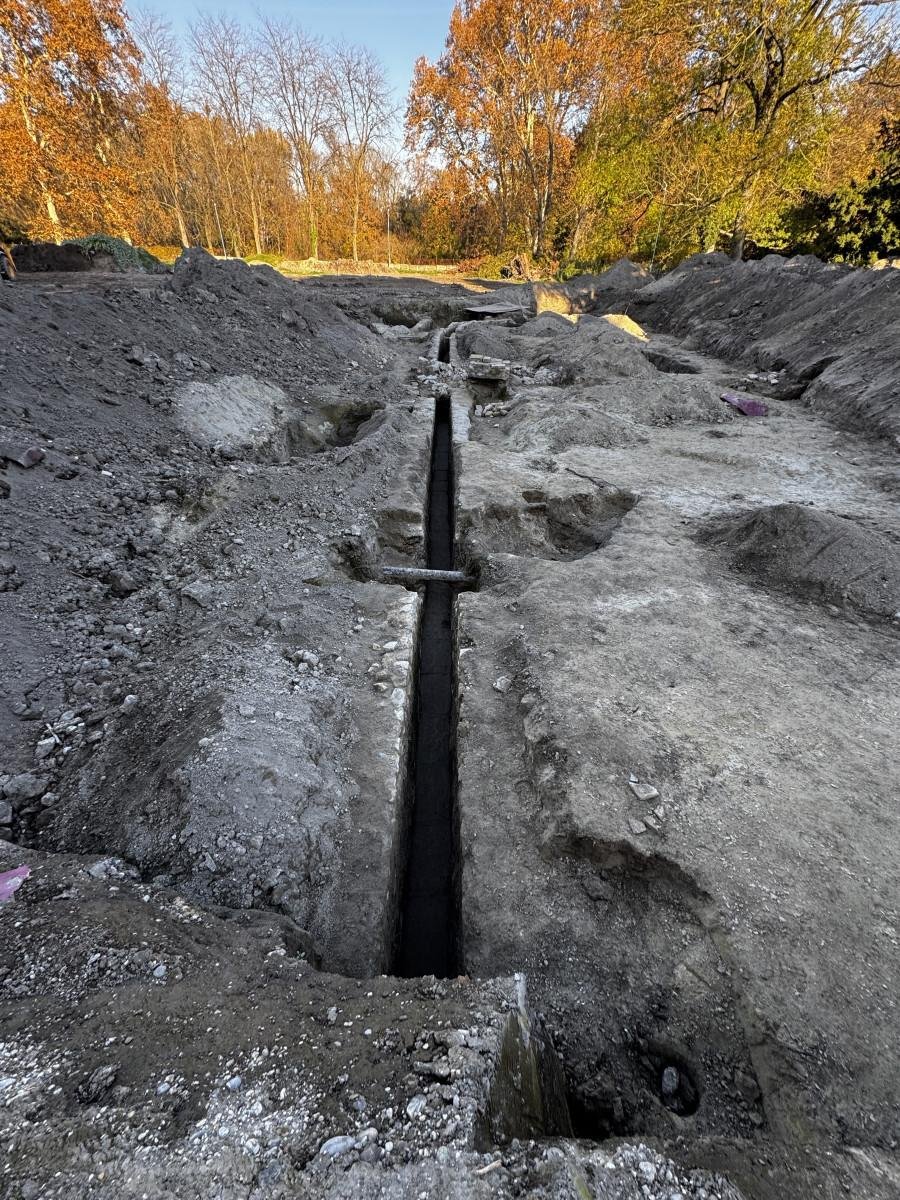
First Roman aqueduct in Slovakia discovered beneath Rusovce Manor
The aqueduct was discovered on the grounds of the Rusovce Mansion. Credit: University of Trnava

Rusovce Manor, a Neo-Gothic mansion from the 19th century, is built on the site of a 16th-century manor house. The area also has a rich history, as it was the location of Gerulata, an imperial Roman camp that formed part of the Danubian Limes—the Roman Empire’s frontier defense system. The manor house and its park are currently undergoing extensive restoration work. While excavating hard, an archaeological team from the Classical Archaeology Department of Trnava University led by Associate Professor Erik Hrnčiarik unearthed an ancient aqueduct beneath the manor grounds.

The 100-foot-long aqueduct was constructed using stone and Roman bricks known as tegulae. The system was built with a gentle incline in the construction to convey water to an ancient building, likely a soldiers’ bathhouse at Gerulata. While researchers have not pinpointed exactly where the bathhouse stood, historical markers suggest that it was built beneath the southern wing of the present manor. Regrettably, the original structure was destroyed during the construction of later medieval and modern buildings.

According to Associate Professor Hrnčiarik, “The state of preservation of the aqueduct is extraordinary. We have documented 38 meters of the aqueduct so far. Its preservation is extraordinary. Calculations indicate that the Romans used at least 51 tons of stone and over 80 tegulae. Some of the bricks bear manufacturers’ stamps, while others feature paw prints left by animals as they were left drying in the sun.” There are inscriptions on a few of the bricks, one of which is “C Val Const Kar.” This has been interpreted by experts as indicating the workshop of Gaius Valerius Constans who worked in Carnuntum (modern Austria). This means that the aqueduct was built during the 2nd century CE and functioned until the end of the century before being buried, thus preserved for nearly two thousand years.

Finding an aqueduct in a heritage protection zone, near structures listed as UNESCO World Heritage Sites, compels us to carefully consider its conservation. The Slovak Monuments Board, in collaboration with the Office of the Government of the Slovak Republic, has decided to leave the aqueduct in its original location. A technical service building project near the site has been adjusted to ensure it does not disturb the old monument.

RelatedStories

Rare Late Roman mosaic with Solomon’s Knot discovered beneath modern İzmir

Rare Late Roman mosaic with Solomon’s Knot discovered beneath modern İzmir

January 7, 2026
Archaeologists uncover 2,000-year-old workshops and Roman necropolis in Egypt’s western Nile Delta

Archaeologists uncover 2,000-year-old workshops and Roman necropolis in Egypt’s western Nile Delta

December 31, 2025

Apart from the aqueduct, archaeologists also discovered other items from different historical periods, including Roman ceramics—terra sigillata, which is high-end pottery imported from France and Germany—window glass, a silver armlet, and an ancient coin pouch. Remains of early medieval and Iron Age settlements were also unearthed at the location, further proving the long and rich history of Rusovce.

One of the most intriguing non-Roman artifacts at the site is a medieval kiln, which was initially used to produce bricks but was later repurposed for lime burning. “We believe the kiln was used to process marble statues and reliefs found in the abandoned Roman camp nearby,” said Tomáš Kolon, another archaeologist from the University of Trnava. A large underground circular structure, identified as an early modern icehouse, was also discovered. This feature, probably used by the Zichy family —who owned the manor in the 19th century— stored ice during winter for summer use to preserve food and chill beverages.

Excavation at Rusovce Manor is ongoing, and current work is focused on the area around the former servants’ quarters in the park. Once this phase is complete, archaeologists will resume work at the manor, carrying out further rescue excavations in the spring.

More information: University of Trnava

Share2Tweet2ShareShareSend

You May Also Like...

Inscribed clay cylinders reveal Nebuchadnezzar II’s restoration of the Kish Ziggurat
Archaeology

Inscribed clay cylinders reveal Nebuchadnezzar II’s restoration of the Kish Ziggurat

January 7, 2026
Rare Late Roman mosaic with Solomon’s Knot discovered beneath modern İzmir
Archaeology

Rare Late Roman mosaic with Solomon’s Knot discovered beneath modern İzmir

January 7, 2026
1130 depiction of Saxons, Jutes, and Angles crossing the sea to Britain. Credit: Wikimedia / CC BY-SA 4.0. Roots of medieval migration into England uncovered by large-scale bioarchaeological study
Anthropology

Roots of medieval migration into England uncovered by large-scale bioarchaeological study

January 6, 2026
Rare Celtic gold coins found in Swiss bog may reveal ancient ritual offerings
Archaeology

Rare Celtic gold coins found in Swiss bog may reveal ancient ritual offerings

January 5, 2026
Rare medieval gold ring unearthed in Tønsberg
Archaeology

Rare medieval gold ring unearthed in Tønsberg reveals beliefs and craftsmanship of its time

January 5, 2026
Ancient herpesvirus genomes reveal a 2,500-year history of human infection
Anthropology

Ancient herpesvirus genomes reveal a 2,500-year history of human infection

January 4, 2026

Follow us


Instagram
244K

Facebook
118K

Threads
45K

LinkedIn
14K

Twitter
6K

YouTube
1K
  • Trending
  • Comments
  • Latest
Shipwreck Salvage. Credit: rawpixel.com / Public Domain

2,000-year-old shipwreck discovered off Turkish coast with remarkably preserved stacked ceramics

July 2, 2025
Viking age DNA reveals 9,000-year-old HIV-resistant gene originating near the Black Sea

Viking age DNA reveals 9,000-year-old HIV-resistant gene originating near the Black Sea

May 18, 2025
A new study suggests the mysterious Voynich Manuscript may be a medieval cipher

A new study suggests the mysterious Voynich Manuscript may be a medieval cipher

January 3, 2026
Moses may be named in ancient Egyptian mine inscriptions, sparking debate over earliest biblical references

Moses may be named in ancient Egyptian mine inscriptions, sparking debate over earliest biblical references

July 31, 2025
Mystery of Armenia’s 6,000-year-old dragon stones solved

Mystery of Armenia’s 6,000-year-old dragon stones solved

September 23, 2025
3D analysis reveals Shroud of Turin image likely came from sculpture, not Jesus’ body

3D analysis reveals Shroud of Turin image likely came from sculpture, not Jesus’ body

Moses may be named in ancient Egyptian mine inscriptions, sparking debate over earliest biblical references

Moses may be named in ancient Egyptian mine inscriptions, sparking debate over earliest biblical references

$1 million prize offered to decipher 5,300-year-old Indus Valley script

$1 million prize offered to decipher 5,300-year-old Indus Valley script

Oldest ever genetic data from a human relative found in 2-million-year-old fossilized teeth

Oldest ever genetic data from a human relative found in 2-million-year-old fossilized teeth

Exceptionally large Roman shoes discovered at Magna fort near Hadrian’s Wall

Exceptionally large Roman shoes discovered at Magna fort near Hadrian’s Wall

Inscribed clay cylinders reveal Nebuchadnezzar II’s restoration of the Kish Ziggurat

Inscribed clay cylinders reveal Nebuchadnezzar II’s restoration of the Kish Ziggurat

January 7, 2026
Rare Late Roman mosaic with Solomon’s Knot discovered beneath modern İzmir

Rare Late Roman mosaic with Solomon’s Knot discovered beneath modern İzmir

January 7, 2026
1130 depiction of Saxons, Jutes, and Angles crossing the sea to Britain. Credit: Wikimedia / CC BY-SA 4.0. Roots of medieval migration into England uncovered by large-scale bioarchaeological study

Roots of medieval migration into England uncovered by large-scale bioarchaeological study

January 6, 2026
Rare Celtic gold coins found in Swiss bog may reveal ancient ritual offerings

Rare Celtic gold coins found in Swiss bog may reveal ancient ritual offerings

January 5, 2026
Rare medieval gold ring unearthed in Tønsberg

Rare medieval gold ring unearthed in Tønsberg reveals beliefs and craftsmanship of its time

January 5, 2026

Archaeology News online magazine

Archaeology News is an international online magazine that covers all aspects of archaeology.


Categories

  • Academics
    • Books
    • Conferences
    • Universities
  • Articles
  • Download
  • Game
  • News
    • Anthropology
    • Archaeology
    • Paleontology
  • Quiz
  • Tours

Subscribe to our newsletter

© 2024 - Archaeology News Online Magazine. All Rights Reserved.

  • About
  • Privacy Policy
  • Terms of Use
  • Donation
  • Contact

Welcome Back!

Login to your account below

Forgotten Password? Sign Up

Create New Account!

Fill the forms below to register

All fields are required. Log In

Retrieve your password

Please enter your username or email address to reset your password.

Log In

Add New Playlist

Manage Consent
To provide the best experiences, we use technologies like cookies to store and/or access device information. Consenting to these technologies will allow us to process data such as browsing behavior or unique IDs on this site. Not consenting or withdrawing consent, may adversely affect certain features and functions.
Functional Always active
The technical storage or access is strictly necessary for the legitimate purpose of enabling the use of a specific service explicitly requested by the subscriber or user, or for the sole purpose of carrying out the transmission of a communication over an electronic communications network.
Preferences
The technical storage or access is necessary for the legitimate purpose of storing preferences that are not requested by the subscriber or user.
Statistics
The technical storage or access that is used exclusively for statistical purposes. The technical storage or access that is used exclusively for anonymous statistical purposes. Without a subpoena, voluntary compliance on the part of your Internet Service Provider, or additional records from a third party, information stored or retrieved for this purpose alone cannot usually be used to identify you.
Marketing
The technical storage or access is required to create user profiles to send advertising, or to track the user on a website or across several websites for similar marketing purposes.
  • Manage options
  • Manage services
  • Manage {vendor_count} vendors
  • Read more about these purposes
View preferences
  • {title}
  • {title}
  • {title}
  • Home
  • News
    • Archaeology
    • Anthropology
    • Paleontology
  • Academic
    • Books
    • Conferences
    • Universities
  • Articles
  • VR Tours
  • Quiz & Game
  • Download
  • Encyclopedia
  • Forum

About  .  Contact  .  Donation

© 2024 - Archaeology News Online Magazine. All Rights Reserved