• About
  • Privacy Policy
  • Terms of Use
  • Donation
  • Contact
No Result
View All Result
Archaeology News
  • Home
  • News
    • Archaeology
    • Anthropology
    • Paleontology
  • Academic
    • Books
    • Conferences
    • Universities
  • Articles
  • VR Tours
  • Quiz & Game
  • Download
  • Encyclopedia
  • Forum
Archaeology News
No Result
View All Result
Home News Anthropology

Ancient Xiaohe boat burials reveal symbolic water journey into the afterlife, new study finds

by Dario Radley
June 14, 2025

A recent study by archaeologist Dr. Gino Caspari is providing new information about the enigmatic Xiaohe culture of the Tarim Basin, an extraordinary Bronze Age civilization with unique funeral practices and remarkable preservation of organic material. Flourishing between 1400 and 1950 BCE in today’s Xinjiang, China, the Xiaohe culture has fascinated archaeologists for decades with its boat coffins, cattle remains, and distinctive grave markers—traits found in a cemetery buried deep within one of the driest regions on Earth.
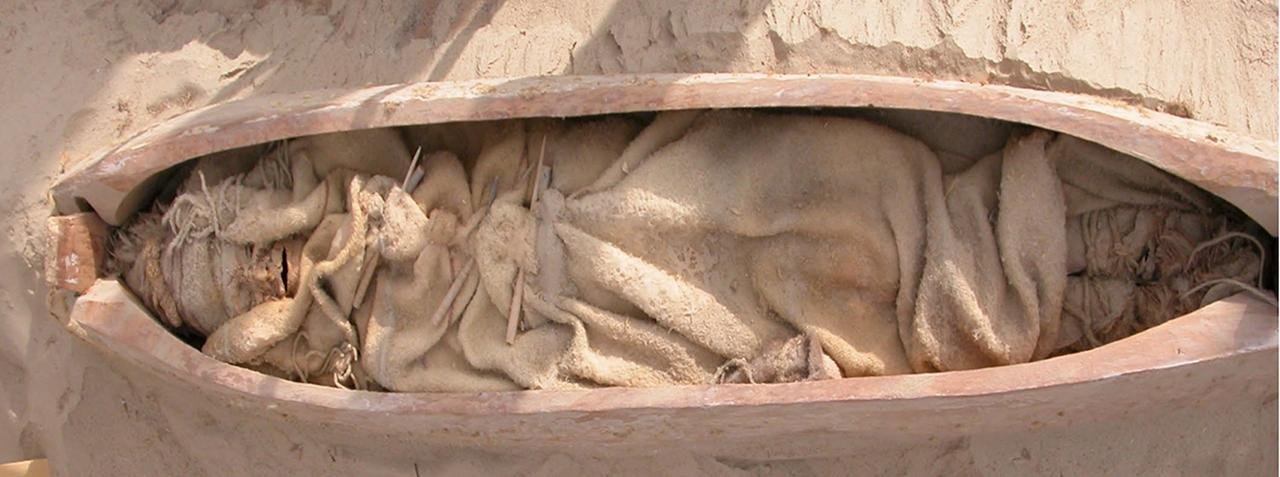
Ancient Xiaohe boat burials reveal symbolic water journey into the afterlife, new study finds
Boat-shaped wooden coffin (Burial XHM66, layer 4) from the Xiaohe culture, uncovered in the Tarim Basin. Credit: Fan Zhang et al. / CC BY-SA 4.0

The Xiaohe burial site was originally discovered in the early 1900s and partially excavated by Swedish archaeologist Folke Bergman in 1934. However, it was not until the early 2000s that the cemetery was excavated extensively under the supervision of the Xinjiang Institute of Archaeology. Overall, the archaeologists discovered 167 new graves in addition to the initial 12, but estimates suggest that the cemetery could have originally contained up to 350 burials—many of which were destroyed by erosion and environmental damage over time.

With a focus on symbolic interpretation, Dr. Caspari’s recent research revisits these burials. “The funerary ritual is completely different from those of the surrounding cultures, and that is part of the fascination of this culture,” he said. The idea that Xiaohe’s burial customs reflect a complex spiritual worldview centered on water symbolism is supported by his research, which is rooted in both material evidence and broader cultural context.

Ancient Xiaohe boat burials reveal symbolic water journey into the afterlife, new study finds
An idealized depiction of the boat-type burial at Xiaohe with two types of posts associated with the coffins: Left) Oval-shaped end with flat extrusions. Right) Rounded end without extrusions (Illustration by Anja Schorneck). Credit: Caspari, G., Asian Archaeology (2025)

Most distinctive of the funerary rites are the narrow, canoe-shaped coffins buried in sand pits, generally surrounded by upright wooden poles at their heads. These poles have been described as vulva- or phallic-shaped, painted red or with dark-tipped ends. Surprisingly, gender symbolism for these markers is not always aligned consistently—phallic posts sometimes appear over female burials and vice versa—suggesting a symbolic rather than literal meaning.

Ancient Xiaohe boat burials reveal symbolic water journey into the afterlife, new study finds
An artistic conceptualization of the mirror world of Xiaohe (Illustration by Anja Schorneck). Credit: Caspari, G., Asian Archaeology (2025)

In a context shaped by seasonal river oases and dependent upon careful management of water, Xiaohe society developed a combined economy of agriculture and pastoralism. Their deep cultural connection to water, Caspari argues, extended into their religious beliefs. The boat-like coffins and attached poles may have stood for paddles and mooring posts, tools designed to guide and anchor the deceased on a mirrored afterlife journey—a theme that appears in other ancient cultures, such as those of the Scandinavian Bronze Age and Ancient Egypt.


RelatedStories

How ancient communities adapted their diets and farming strategies in prehistoric Poland

How ancient communities adapted their diets and farming strategies in prehistoric Poland

February 26, 2026
Oldest indigo-dyed textiles and nålbinding technique found in Bronze Age Anatolia

Oldest indigo-dyed textiles and nålbinding technique found in Bronze Age Anatolia

February 21, 2026

No human remains were found in one of the site’s odd constructions, a rectangular platform covered in layers of cattle skulls and hides, which may have had a purpose other than burial rituals. Heavily used cattle remains across the cemetery also underscore the symbolic and economic value of this animal to the Xiaohe community.

Despite the discoveries of the excavations and ongoing research, there is still much that is not yet known about the Xiaohe culture. To this day, we have no idea why they ultimately died out around 1400 BCE. Nonetheless, the Xiaohe site remains a window into the symbolic and practical lifeways of a Bronze Age people who flourished in the harsh conditions of the Tarim Basin.


More information: Caspari, G. (2025). Reflections on water: funerary practice and symbolism at the Bronze Age site of Xiaohe. asian archaeol. doi.:10.1007/s41826-025-00105-2
Share22Tweet14Share4ShareSend

You May Also Like...

Lost medieval hillfort discovered in Poland’s Włodawa Forest reveals 244 artifacts from the 10th–13th centuries
Archaeology

Medieval hillfort discovered in Poland’s Włodawa Forest reveals 244 artifacts from the 10th–13th centuries

February 27, 2026
Male Neanderthals and female Homo sapiens shaped ancient interbreeding in the modern human genome, study finds
Anthropology

Male Neanderthals and female humans shaped modern DNA through ancient interbreeding, study finds

February 27, 2026
Medieval monastery remains discovered beneath Borken’s historic center in Germany
Archaeology

Medieval monastery remains discovered beneath Borken’s historic center in Germany

February 26, 2026
How ancient communities adapted their diets and farming strategies in prehistoric Poland
Anthropology

How ancient communities adapted their diets and farming strategies in prehistoric Poland

February 26, 2026
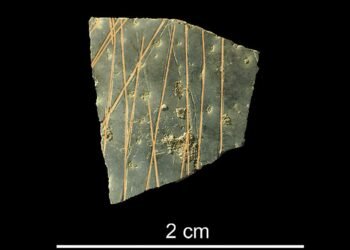
60,000-year-old ostrich eggshell engravings reveal humanity’s earliest geometric designs
Archaeology

60,000-year-old ostrich eggshell engravings reveal humanity’s earliest geometric designs

February 26, 2026
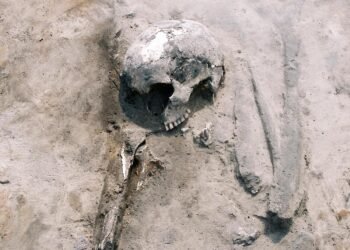
Mesolithic burials in Sweden show ancient fur and feather headgear uncovered by new microscopic analysis
Anthropology

Mesolithic burials in Sweden show ancient fur and feather headgear uncovered by new microscopic analysis

February 25, 2026

Follow us


Instagram
244K

Facebook
118K

Threads
46K

LinkedIn
14K

Twitter
6K

YouTube
1K
  • Trending
  • Comments
  • Latest
Shipwreck Salvage. Credit: rawpixel.com / Public Domain

2,000-year-old shipwreck discovered off Turkish coast with remarkably preserved stacked ceramics

July 2, 2025
Viking age DNA reveals 9,000-year-old HIV-resistant gene originating near the Black Sea

Viking age DNA reveals 9,000-year-old HIV-resistant gene originating near the Black Sea

May 18, 2025
A new study suggests the mysterious Voynich Manuscript may be a medieval cipher

A new study suggests the mysterious Voynich Manuscript may be a medieval cipher

January 3, 2026
Moses may be named in ancient Egyptian mine inscriptions, sparking debate over earliest biblical references

Moses may be named in ancient Egyptian mine inscriptions, sparking debate over earliest biblical references

July 31, 2025
Mystery of Armenia’s 6,000-year-old dragon stones solved

Mystery of Armenia’s 6,000-year-old dragon stones solved

September 23, 2025
3D analysis reveals Shroud of Turin image likely came from sculpture, not Jesus’ body

3D analysis reveals Shroud of Turin image likely came from sculpture, not Jesus’ body

Moses may be named in ancient Egyptian mine inscriptions, sparking debate over earliest biblical references

Moses may be named in ancient Egyptian mine inscriptions, sparking debate over earliest biblical references

$1 million prize offered to decipher 5,300-year-old Indus Valley script

$1 million prize offered to decipher 5,300-year-old Indus Valley script

Oldest ever genetic data from a human relative found in 2-million-year-old fossilized teeth

Oldest ever genetic data from a human relative found in 2-million-year-old fossilized teeth

Exceptionally large Roman shoes discovered at Magna fort near Hadrian’s Wall

Exceptionally large Roman shoes discovered at Magna fort near Hadrian’s Wall

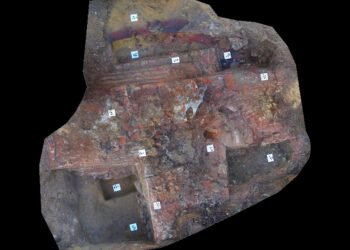
Lost medieval hillfort discovered in Poland’s Włodawa Forest reveals 244 artifacts from the 10th–13th centuries

Medieval hillfort discovered in Poland’s Włodawa Forest reveals 244 artifacts from the 10th–13th centuries

February 27, 2026
Male Neanderthals and female Homo sapiens shaped ancient interbreeding in the modern human genome, study finds

Male Neanderthals and female humans shaped modern DNA through ancient interbreeding, study finds

February 27, 2026
Medieval monastery remains discovered beneath Borken’s historic center in Germany

Medieval monastery remains discovered beneath Borken’s historic center in Germany

February 26, 2026
How ancient communities adapted their diets and farming strategies in prehistoric Poland

How ancient communities adapted their diets and farming strategies in prehistoric Poland

February 26, 2026
60,000-year-old ostrich eggshell engravings reveal humanity’s earliest geometric designs

60,000-year-old ostrich eggshell engravings reveal humanity’s earliest geometric designs

February 26, 2026

Archaeology News online magazine

Archaeology News is an international online magazine that covers all aspects of archaeology.


Categories

  • Academics
    • Books
    • Conferences
    • Universities
  • Articles
  • Download
  • Game
  • News
    • Anthropology
    • Archaeology
    • Paleontology
  • Quiz
  • Tours

Subscribe to our newsletter

© 2024 - Archaeology News Online Magazine. All Rights Reserved.

  • About
  • Privacy Policy
  • Terms of Use
  • Donation
  • Contact

Manage Consent
To provide the best experiences, we use technologies like cookies to store and/or access device information. Consenting to these technologies will allow us to process data such as browsing behavior or unique IDs on this site. Not consenting or withdrawing consent, may adversely affect certain features and functions.
Functional Always active
The technical storage or access is strictly necessary for the legitimate purpose of enabling the use of a specific service explicitly requested by the subscriber or user, or for the sole purpose of carrying out the transmission of a communication over an electronic communications network.
Preferences
The technical storage or access is necessary for the legitimate purpose of storing preferences that are not requested by the subscriber or user.
Statistics
The technical storage or access that is used exclusively for statistical purposes. The technical storage or access that is used exclusively for anonymous statistical purposes. Without a subpoena, voluntary compliance on the part of your Internet Service Provider, or additional records from a third party, information stored or retrieved for this purpose alone cannot usually be used to identify you.
Marketing
The technical storage or access is required to create user profiles to send advertising, or to track the user on a website or across several websites for similar marketing purposes.
  • Manage options
  • Manage services
  • Manage {vendor_count} vendors
  • Read more about these purposes
View preferences
  • {title}
  • {title}
  • {title}
  • Home
  • News
    • Archaeology
    • Anthropology
    • Paleontology
  • Academic
    • Books
    • Conferences
    • Universities
  • Articles
  • VR Tours
  • Quiz & Game
  • Download
  • Encyclopedia
  • Forum

About  .  Contact  .  Donation

© 2024 - Archaeology News Online Magazine. All Rights Reserved