• About
  • Privacy Policy
  • Terms of Use
  • Donation
  • Contact
No Result
View All Result
Archaeology News
  • Home
  • News
    • Archaeology
    • Anthropology
    • Paleontology
  • Academic
    • Books
    • Conferences
    • Universities
  • Articles
  • VR Tours
  • Quiz & Game
  • Download
  • Encyclopedia
  • Forum
Archaeology News
No Result
View All Result
Home News Anthropology

Neanderthal genes linked to rare brain-skull disorder, study finds

by Dario Radley
July 27, 2025

A recent study shows that Neanderthal DNA from ancient times can cause a neurological condition known as Chiari Malformation Type I (CM-I), where a part of the brain protrudes through the base of the skull into the spinal canal. The condition, which results in headaches, dizziness, neck pain, and, in severe cases, death, could affect up to 1% of the population—far more than previously suspected.
Neanderthal genes linked to rare brain-skull disorder, study finds
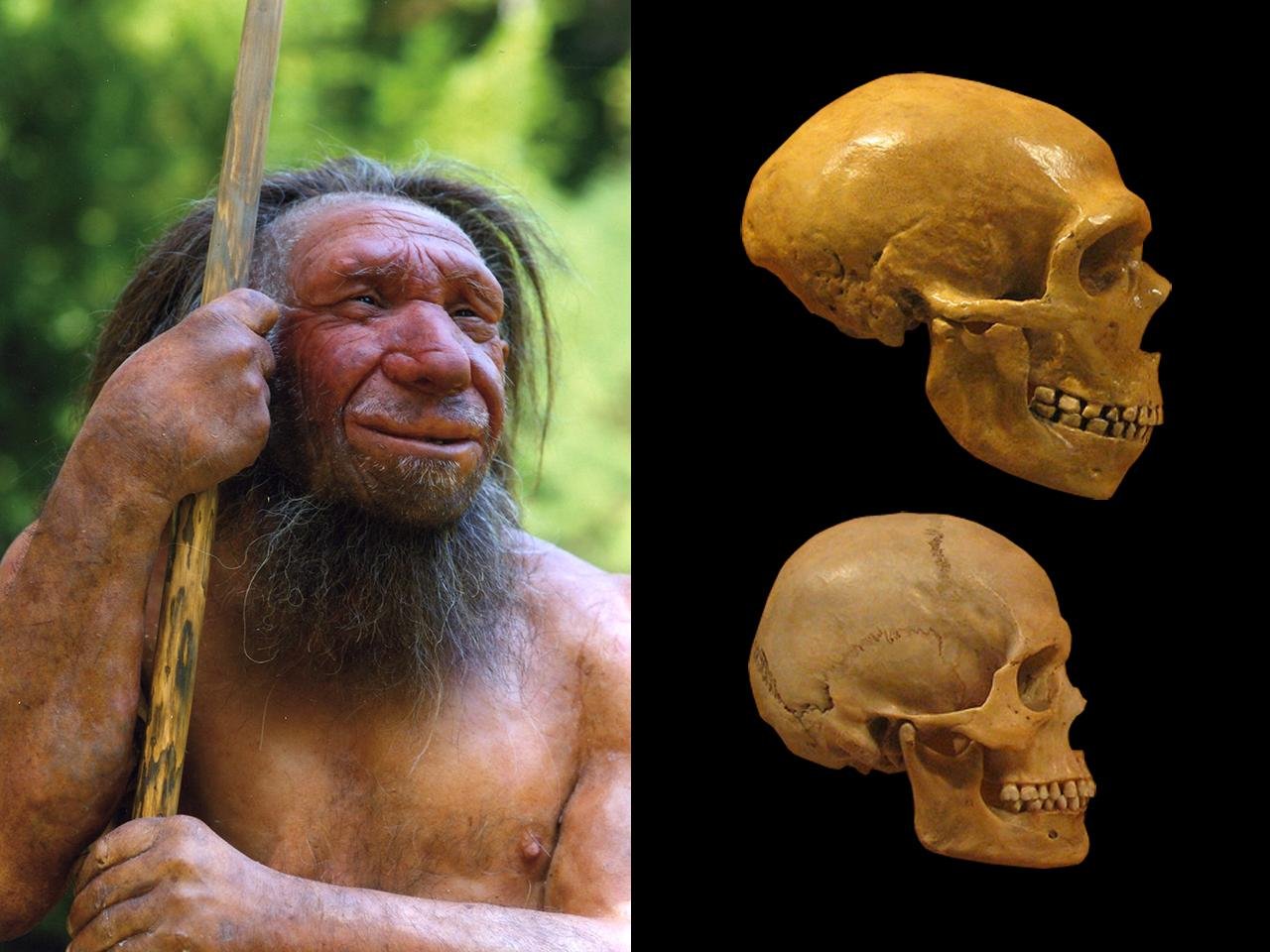
Left: Living reconstruction of Homo neanderthalensis at the Neanderthal Museum. Credit: Neanderthal Museum, Mettmann / CC BY-SA 4.0; Right: Comparison of Neanderthal (top) and modern human skulls (bottom) from the Cleveland Museum of Natural History. Credit: hairymuseummatt / CC BY-SA 2.0

CM-I occurs when the occipital bone at the back of the skull is smaller than usual to accommodate the brain, and this causes the lower part of the cerebellum to herniate downward. While the anatomical cause is known, its evolutionary origins have been unclear.

Researchers led by Dr. Kimberly Plomp at the University of the Philippines Diliman and Professor Mark Collard at Simon Fraser University have provided evidence that some people are likely to inherit skull shapes associated with CM-I due to Neanderthal ancestry. Their work, published in Evolution, Medicine, and Public Health, shows a genetic association based on interbreeding events that took place over 40,000 years ago.

The team used 3D CT scans and geometric morphometric analysis to examine 103 modern human skulls, of which 46 were of individuals with CM-I and 57 were of individuals without it. They then compared these scans with fossilized skulls of extinct human species like Homo erectus, Homo heidelbergensis, Neanderthals (Homo neanderthalensis), and early Homo sapiens.
Neanderthal genes linked to rare brain-skull disorder, study finds
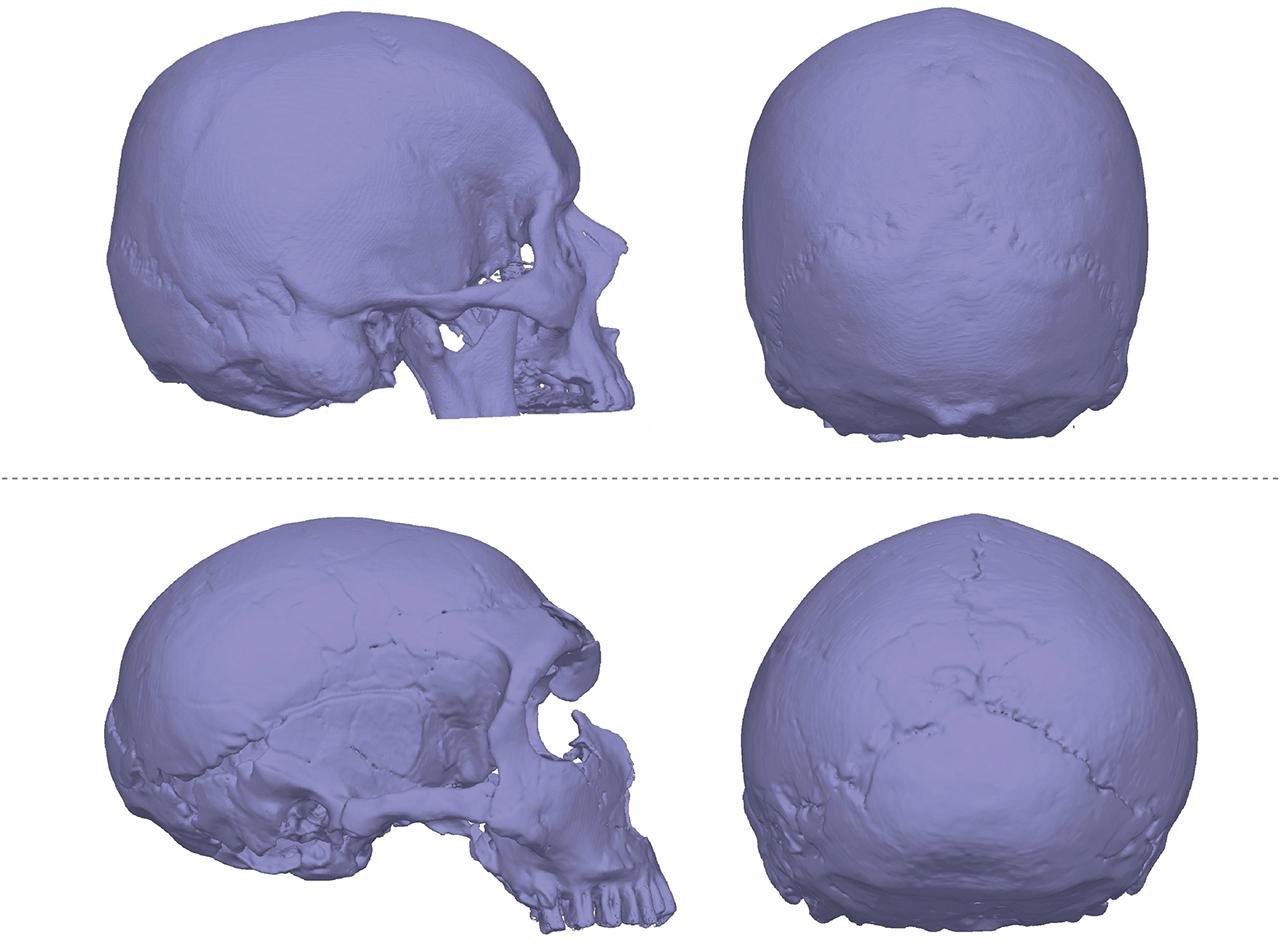
3D models of Homo sapiens (top two images) and Homo neanderthalensis (bottom two images) crania for visual comparison. Credit: K. Plomp et al., Evolution, Medicine, and Public Health (2025)

These results showed that patients with CM-I had Neanderthal-like skull shapes, in contrast to those without the condition. Significant differences were observed in reduced cranial vault height and a more forward-positioned foramen magnum. Skulls in Homo erectus and Homo heidelbergensis were similar to individuals without CM-I, and the scientists narrowed their hypothesis to focus specifically on Neanderthal DNA.

RelatedStories

Study of AI generated Neanderthal scenes reveals major gaps with modern archaeological research

Study of AI generated Neanderthal scenes reveals major gaps with modern archaeological research

February 8, 2026
Neanderthals in Spain deliberately deposited animal skulls in cave, revealing symbolic behavior

Neanderthals in Spain deliberately deposited animal skulls in cave, revealing symbolic behavior

January 31, 2026

“This validates what we would now call the Neanderthal Introgression Hypothesis,” Dr. Plomp said. Professor Collard later added in a conversation with Live Science, “If future research does confirm a link between Neanderthal genes and this disorder, then it might make sense to add screening for such genes to early childhood health assessments.”
Neanderthal genes linked to rare brain-skull disorder, study finds
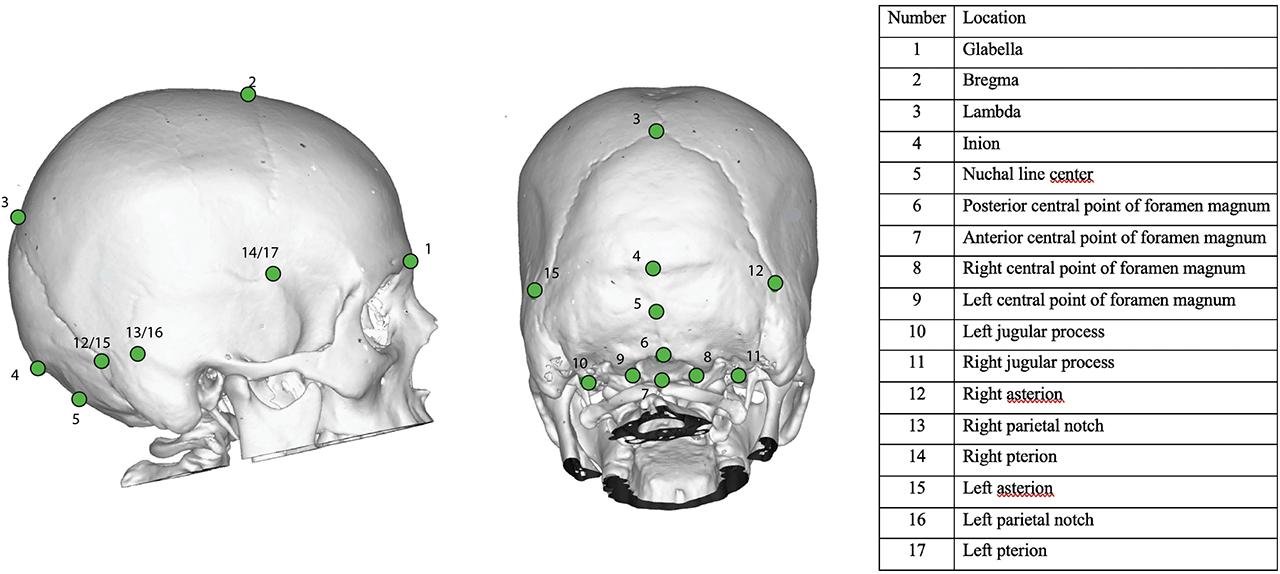
Landmarks used in the present study, shown on a CT-based 3D model of the cranium of living human without CM-I. Credit: K. Plomp et al., Evolution, Medicine, and Public Health (2025)

The theory that interbreeding between the archaic humans and modern Homo sapiens might result in some anatomical mismatches was first proposed in 2013 by the State University of Campinas’ Dr. Yvens Barbosa Fernandes. He argued that the modern human brain, which is rounded in shape, would not necessarily fit into skulls shaped under the influence of archaic DNA—specifically from Neanderthals, who had more elongated skulls.

Interestingly, Neanderthal DNA varies among populations. Non-African humans tend to have 1–2.3% Neanderthal DNA, with African populations having significantly less. This could suggest that CM-I is more common in European and Asian populations, but more studies are needed to confirm regional differences.

While the study strongly indicates a Neanderthal origin, scientists note limitations in the study, including a small fossil sample size. They also suggest future research should explore if cranial differences linked to CM-I develop early in life and how the brain and skull shapes interact in affected individuals.

Even with the evolutionary explanation, the study advanced CM-I knowledge. It identified several new anatomical features associated with the condition—findings that were made possible by employing modern 3D shape analysis.

More information: Plomp, K., Lewis, D., Buck, L., Bukhari, S., Rae, T., Gnanalingham, K., & Collard, M. (2025). A test of the Archaic Homo Introgression Hypothesis for the Chiari malformation type I. Evolution, Medicine, and Public Health, 13(1), 154–166. doi:10.1093/emph/eoaf009
Share35Tweet22Share6ShareSend

You May Also Like...

Oldest known sewn hide identified in Ice Age Oregon cave suggests early clothing
Archaeology

Oldest known sewn hide identified in Ice Age Oregon cave suggests early clothing

February 8, 2026
Study of AI generated Neanderthal scenes reveals major gaps with modern archaeological research
Archaeology

Study of AI generated Neanderthal scenes reveals major gaps with modern archaeological research

February 8, 2026
Great Basin cave burials not rare or uncommon, study finds
Anthropology

Great Basin cave burials not rare or uncommon, study finds

February 8, 2026
New 3D digital analysis maps Paleolithic engravings at Cova Matutano
Archaeology

New 3D method maps Paleolithic engravings at Cova Matutano

February 8, 2026
Rare deer skull headdress discovered in Germany highlights exchange between hunter-gatherers and Europe's first farmers
Archaeology

Rare deer skull headdress discovered in Germany highlights exchange between hunter-gatherers and Europe’s first farmers

February 7, 2026
Lost infant burial grounds in Ireland rediscovered through folklore and archaeology study
Anthropology

Lost infant burial grounds in Ireland rediscovered through folklore and archaeology study

February 7, 2026

Comments 0

  1. Editorial Team says:
    1 second ago

    Disclaimer: This website is a science-focused magazine that welcomes both academic and non-academic audiences. Comments are written by users and may include personal opinions or unverified claims. They do not necessarily reflect the views of our editorial team or rely on scientific evidence.

    Comment Policy: We kindly ask all commenters to engage respectfully. Comments that contain offensive, insulting, degrading, discriminatory, or racist content will be automatically removed.

    Reply

Leave a Reply Cancel reply

Your email address will not be published. Required fields are marked *

Follow us


Instagram
244K

Facebook
118K

Threads
45K

LinkedIn
14K

Twitter
6K

YouTube
1K
  • Trending
  • Comments
  • Latest
Shipwreck Salvage. Credit: rawpixel.com / Public Domain

2,000-year-old shipwreck discovered off Turkish coast with remarkably preserved stacked ceramics

July 2, 2025
Viking age DNA reveals 9,000-year-old HIV-resistant gene originating near the Black Sea

Viking age DNA reveals 9,000-year-old HIV-resistant gene originating near the Black Sea

May 18, 2025
A new study suggests the mysterious Voynich Manuscript may be a medieval cipher

A new study suggests the mysterious Voynich Manuscript may be a medieval cipher

January 3, 2026
Moses may be named in ancient Egyptian mine inscriptions, sparking debate over earliest biblical references

Moses may be named in ancient Egyptian mine inscriptions, sparking debate over earliest biblical references

July 31, 2025
Mystery of Armenia’s 6,000-year-old dragon stones solved

Mystery of Armenia’s 6,000-year-old dragon stones solved

September 23, 2025
3D analysis reveals Shroud of Turin image likely came from sculpture, not Jesus’ body

3D analysis reveals Shroud of Turin image likely came from sculpture, not Jesus’ body

Moses may be named in ancient Egyptian mine inscriptions, sparking debate over earliest biblical references

Moses may be named in ancient Egyptian mine inscriptions, sparking debate over earliest biblical references

$1 million prize offered to decipher 5,300-year-old Indus Valley script

$1 million prize offered to decipher 5,300-year-old Indus Valley script

Oldest ever genetic data from a human relative found in 2-million-year-old fossilized teeth

Oldest ever genetic data from a human relative found in 2-million-year-old fossilized teeth

Exceptionally large Roman shoes discovered at Magna fort near Hadrian’s Wall

Exceptionally large Roman shoes discovered at Magna fort near Hadrian’s Wall

Oldest known sewn hide identified in Ice Age Oregon cave suggests early clothing

Oldest known sewn hide identified in Ice Age Oregon cave suggests early clothing

February 8, 2026
Study of AI generated Neanderthal scenes reveals major gaps with modern archaeological research

Study of AI generated Neanderthal scenes reveals major gaps with modern archaeological research

February 8, 2026
Great Basin cave burials not rare or uncommon, study finds

Great Basin cave burials not rare or uncommon, study finds

February 8, 2026
New 3D digital analysis maps Paleolithic engravings at Cova Matutano

New 3D method maps Paleolithic engravings at Cova Matutano

February 8, 2026
Rare deer skull headdress discovered in Germany highlights exchange between hunter-gatherers and Europe's first farmers

Rare deer skull headdress discovered in Germany highlights exchange between hunter-gatherers and Europe’s first farmers

February 7, 2026

Archaeology News online magazine

Archaeology News is an international online magazine that covers all aspects of archaeology.


Categories

  • Academics
    • Books
    • Conferences
    • Universities
  • Articles
  • Download
  • Game
  • News
    • Anthropology
    • Archaeology
    • Paleontology
  • Quiz
  • Tours

Subscribe to our newsletter

© 2024 - Archaeology News Online Magazine. All Rights Reserved.

  • About
  • Privacy Policy
  • Terms of Use
  • Donation
  • Contact

Welcome Back!

Login to your account below

Forgotten Password? Sign Up

Create New Account!

Fill the forms below to register

All fields are required. Log In

Retrieve your password

Please enter your username or email address to reset your password.

Log In

Add New Playlist

Manage Consent
To provide the best experiences, we use technologies like cookies to store and/or access device information. Consenting to these technologies will allow us to process data such as browsing behavior or unique IDs on this site. Not consenting or withdrawing consent, may adversely affect certain features and functions.
Functional Always active
The technical storage or access is strictly necessary for the legitimate purpose of enabling the use of a specific service explicitly requested by the subscriber or user, or for the sole purpose of carrying out the transmission of a communication over an electronic communications network.
Preferences
The technical storage or access is necessary for the legitimate purpose of storing preferences that are not requested by the subscriber or user.
Statistics
The technical storage or access that is used exclusively for statistical purposes. The technical storage or access that is used exclusively for anonymous statistical purposes. Without a subpoena, voluntary compliance on the part of your Internet Service Provider, or additional records from a third party, information stored or retrieved for this purpose alone cannot usually be used to identify you.
Marketing
The technical storage or access is required to create user profiles to send advertising, or to track the user on a website or across several websites for similar marketing purposes.
  • Manage options
  • Manage services
  • Manage {vendor_count} vendors
  • Read more about these purposes
View preferences
  • {title}
  • {title}
  • {title}
  • Home
  • News
    • Archaeology
    • Anthropology
    • Paleontology
  • Academic
    • Books
    • Conferences
    • Universities
  • Articles
  • VR Tours
  • Quiz & Game
  • Download
  • Encyclopedia
  • Forum

About  .  Contact  .  Donation

© 2024 - Archaeology News Online Magazine. All Rights Reserved