• About
  • Privacy Policy
  • Terms of Use
  • Donation
  • Contact
No Result
View All Result
Archaeology News
  • Home
  • News
    • Archaeology
    • Anthropology
    • Paleontology
  • Academic
    • Books
    • Conferences
    • Universities
  • Articles
  • VR Tours
  • Quiz & Game
  • Download
  • Encyclopedia
  • Forum
Archaeology News
No Result
View All Result
Home News Archaeology

Archaeologists launch landmark study of Dzhetyasar culture settlements in Kazakhstan

by Dario Radley
September 18, 2025

Archaeologists are carrying out the largest-ever study of the Dzhetyasar culture, a medieval civilization that thrived in the lower reaches of the Syr Darya River. The expedition, which is a joint project between the A.Kh. Margulan Institute of Archaeology and the German Archaeological Institute, is also being supported by specialists from Korkyt Ata Kyzylorda University and the Karmakshy District Museum of History and Local Studies. Their research constitutes the first effort at large-scale, integrated exploration of these sites.

The Dzhetyasar culture emerged between the mid–1st millennium BCE and the early 9th century CE in the deltas of the Syr Darya and Kuandarya rivers. Archaeologists have discovered nearly fifty fortified settlements, hundreds of burial mounds, and irrigation networks at these locations. They are concentrated in the Dzhetyasar valley, from which the culture gets its name. Though the monuments were initially documented in 1946 and investigated intermittently in the mid-20th century, a comprehensive investigation of their cultural and historical significance in the context of Central Asia is only now underway.

At the focal point of the present investigation is Kara-Asar, one of the largest and most impressive Dzhetyasar sites. Situated on the eastern edge of the valley, the site stands 10–12 meters above the plain and is 140 by 150 meters in size. It has two distinct tiers: a raised central platform measuring approximately 40 by 40 meters, and an outer tier comprising dense residential quarters. The northern gate was originally the main entrance, while the lower fortification enclosed several hectares. The first tier rises to six to eight meters in height, and the upper platform reaches twelve meters.

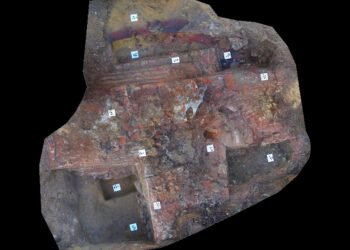
The archaeological excavations at Kara-Asar between 2024 and 2025 revealed nearly forty rooms dating to the 5th and 6th centuries CE. The first construction phase consisted of residential blocks designed around a central courtyard, suggesting a planned structure. The second phase showed well-preserved houses that contained hearths, benches, and adjoining streets. Surprisingly, doorways during the two phases followed similar construction traditions, with thresholds made of mudbrick or wood. The archaeologists further discovered an unusual practice in which cattle pelvic bones were placed beneath the door frames to hold the pivots of the central posts so that doors would swing smoothly.

The surface of Kara-Asar is covered with fragments of red-polished ceramics, evidence of prolonged settlement. Finds cover all three chronological stages of the Dzhetyasar cultural complex, bearing witness to the importance of this settlement over many centuries. Researchers believe that the evidence from Kara-Asar sheds light not only on the architecture of such fortified towns but also on the economic practices, domestic life, and social organization of the people who inhabited them.


RelatedStories

Ancient DNA reveals Golden Horde elites’ Mongolian roots and ties to Central Eurasian populations

Ancient DNA reveals Golden Horde elites’ Mongolian roots and ties to Central Eurasian populations

February 22, 2026
Rich medieval Christians buried ‘closer to God’ even with leprosy or tuberculosis, archaeologists find

Rich medieval Christians buried ‘closer to God’ even with leprosy or tuberculosis, archaeologists find

February 12, 2026

By reconstructing the construction systems and everyday traditions of the Dzhetyasar people, archaeologists hope to shed light on the cultural and historical role of these settlements in the wider development of Central Asia.

More information: Margulan Institute of Archaeology

Share9Tweet6Share2ShareSend

You May Also Like...

Mesolithic burials in Sweden show ancient fur and feather headgear uncovered by new microscopic analysis
Anthropology

Mesolithic burials in Sweden show ancient fur and feather headgear uncovered by new microscopic analysis

February 25, 2026
Greek inscription found in Syria’s Great Mosque of Homs may reveal lost Temple of the Sun in ancient Emesa
Archaeology

Greek inscription found in Syria’s Great Mosque of Homs may reveal lost Temple of the Sun in ancient Emesa

February 25, 2026
40,000-year-old European engravings reveal structured sign systems, study finds
Archaeology

40,000-year-old European engravings reveal structured sign systems, study finds

February 25, 2026
Iron Age mass killing in Serbia: 77 women and children found in 2,800-year-old grave at Gomolava
Anthropology

Iron Age mass killing in Serbia: 77 women and children found in 2,800-year-old grave at Gomolava

February 24, 2026
Old Kingdom tombs with 160 pottery vessels discovered at Qubbet el Hawa, Egypt
Archaeology

Old Kingdom tombs with 160 pottery vessels discovered at Qubbet el Hawa, Egypt

February 24, 2026
Genetic incompatibility between Homo sapiens and Neanderthals may have contributed to Neanderthal extinction
Anthropology

Did Preeclampsia contribute to Neanderthal extinction? new study explores a hidden reproductive risk

February 23, 2026

Comments 0

  1. Editorial Team says:
    1 second ago

    Disclaimer: This website is a science-focused magazine that welcomes both academic and non-academic audiences. Comments are written by users and may include personal opinions or unverified claims. They do not necessarily reflect the views of our editorial team or rely on scientific evidence.

    Comment Policy: We kindly ask all commenters to engage respectfully. Comments that contain offensive, insulting, degrading, discriminatory, or racist content will be automatically removed.

    Reply

Leave a Reply Cancel reply

Your email address will not be published. Required fields are marked *

Follow us


Instagram
244K

Facebook
118K

Threads
46K

LinkedIn
14K

Twitter
6K

YouTube
1K
  • Trending
  • Comments
  • Latest
Shipwreck Salvage. Credit: rawpixel.com / Public Domain

2,000-year-old shipwreck discovered off Turkish coast with remarkably preserved stacked ceramics

July 2, 2025
Viking age DNA reveals 9,000-year-old HIV-resistant gene originating near the Black Sea

Viking age DNA reveals 9,000-year-old HIV-resistant gene originating near the Black Sea

May 18, 2025
A new study suggests the mysterious Voynich Manuscript may be a medieval cipher

A new study suggests the mysterious Voynich Manuscript may be a medieval cipher

January 3, 2026
Moses may be named in ancient Egyptian mine inscriptions, sparking debate over earliest biblical references

Moses may be named in ancient Egyptian mine inscriptions, sparking debate over earliest biblical references

July 31, 2025
Mystery of Armenia’s 6,000-year-old dragon stones solved

Mystery of Armenia’s 6,000-year-old dragon stones solved

September 23, 2025
3D analysis reveals Shroud of Turin image likely came from sculpture, not Jesus’ body

3D analysis reveals Shroud of Turin image likely came from sculpture, not Jesus’ body

Moses may be named in ancient Egyptian mine inscriptions, sparking debate over earliest biblical references

Moses may be named in ancient Egyptian mine inscriptions, sparking debate over earliest biblical references

$1 million prize offered to decipher 5,300-year-old Indus Valley script

$1 million prize offered to decipher 5,300-year-old Indus Valley script

Oldest ever genetic data from a human relative found in 2-million-year-old fossilized teeth

Oldest ever genetic data from a human relative found in 2-million-year-old fossilized teeth

Exceptionally large Roman shoes discovered at Magna fort near Hadrian’s Wall

Exceptionally large Roman shoes discovered at Magna fort near Hadrian’s Wall

Mesolithic burials in Sweden show ancient fur and feather headgear uncovered by new microscopic analysis

Mesolithic burials in Sweden show ancient fur and feather headgear uncovered by new microscopic analysis

February 25, 2026
Greek inscription found in Syria’s Great Mosque of Homs may reveal lost Temple of the Sun in ancient Emesa

Greek inscription found in Syria’s Great Mosque of Homs may reveal lost Temple of the Sun in ancient Emesa

February 25, 2026
40,000-year-old European engravings reveal structured sign systems, study finds

40,000-year-old European engravings reveal structured sign systems, study finds

February 25, 2026
Iron Age mass killing in Serbia: 77 women and children found in 2,800-year-old grave at Gomolava

Iron Age mass killing in Serbia: 77 women and children found in 2,800-year-old grave at Gomolava

February 24, 2026
Old Kingdom tombs with 160 pottery vessels discovered at Qubbet el Hawa, Egypt

Old Kingdom tombs with 160 pottery vessels discovered at Qubbet el Hawa, Egypt

February 24, 2026

Archaeology News online magazine

Archaeology News is an international online magazine that covers all aspects of archaeology.


Categories

  • Academics
    • Books
    • Conferences
    • Universities
  • Articles
  • Download
  • Game
  • News
    • Anthropology
    • Archaeology
    • Paleontology
  • Quiz
  • Tours

Subscribe to our newsletter

© 2024 - Archaeology News Online Magazine. All Rights Reserved.

  • About
  • Privacy Policy
  • Terms of Use
  • Donation
  • Contact

Manage Consent
To provide the best experiences, we use technologies like cookies to store and/or access device information. Consenting to these technologies will allow us to process data such as browsing behavior or unique IDs on this site. Not consenting or withdrawing consent, may adversely affect certain features and functions.
Functional Always active
The technical storage or access is strictly necessary for the legitimate purpose of enabling the use of a specific service explicitly requested by the subscriber or user, or for the sole purpose of carrying out the transmission of a communication over an electronic communications network.
Preferences
The technical storage or access is necessary for the legitimate purpose of storing preferences that are not requested by the subscriber or user.
Statistics
The technical storage or access that is used exclusively for statistical purposes. The technical storage or access that is used exclusively for anonymous statistical purposes. Without a subpoena, voluntary compliance on the part of your Internet Service Provider, or additional records from a third party, information stored or retrieved for this purpose alone cannot usually be used to identify you.
Marketing
The technical storage or access is required to create user profiles to send advertising, or to track the user on a website or across several websites for similar marketing purposes.
  • Manage options
  • Manage services
  • Manage {vendor_count} vendors
  • Read more about these purposes
View preferences
  • {title}
  • {title}
  • {title}
  • Home
  • News
    • Archaeology
    • Anthropology
    • Paleontology
  • Academic
    • Books
    • Conferences
    • Universities
  • Articles
  • VR Tours
  • Quiz & Game
  • Download
  • Encyclopedia
  • Forum

About  .  Contact  .  Donation

© 2024 - Archaeology News Online Magazine. All Rights Reserved