• About
  • Privacy Policy
  • Terms of Use
  • Donation
  • Contact
No Result
View All Result
Archaeology News
  • Home
  • News
    • Archaeology
    • Anthropology
    • Paleontology
  • Academic
    • Books
    • Conferences
    • Universities
  • Articles
  • VR Tours
  • Quiz & Game
  • Download
  • Encyclopedia
  • Forum
Archaeology News
No Result
View All Result
Home News Anthropology

Ancient Jomon DNA reveals a lost East Asian lineage with the lowest Denisovan ancestry in the region

by Dario Radley
November 20, 2025

A new genetic study is rewriting what researchers know about early human migrations in East Asia, showing that the prehistoric Jomon people of Japan carried far less Denisovan DNA than any other ancient or modern population in the region. The findings suggest that at least one early lineage of modern humans in East Asia either never encountered Denisovans or interacted with them only rarely.

Ancient Jomon DNA reveals a lost East Asian lineage with the lowest Denisovan ancestry in the region
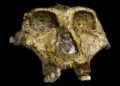
The 146,000-year-old cranium of an individual with Denisovan DNA discovered in China. Credit: Fu et al, Cell (2025); CC-by-4.0

The research, published in Current Biology, analyzed hundreds of ancient and modern genomes to trace how DNA from the Denisovans—an enigmatic group of archaic humans that lived in Eurasia between 200,000 and 30,000 years ago—became dispersed among different populations. While today Denisovan ancestry appears in many communities across East Asia, Oceania, Southeast Asia, and the Americas, it is unevenly distributed and genetically complex.

To untangle this pattern, researchers analyzed the genomes of 115 ancient individuals from East Asia, Siberia, the Americas, and West Eurasia, as well as genetic data from 279 modern-day humans. This large dataset allowed the team to reconstruct when different groups of early Homo sapiens interbred with genetically distinct Denisovan populations.

One of the clearest signals came from ancient mainland East Asians: people who lived in parts of China and Mongolia had the highest levels of Denisovan ancestry anywhere in Eurasia. Their DNA revealed contributions from multiple Denisovan groups, and indicated that the admixture events occurred before the Last Glacial Maximum, roughly 26,500 to 19,000 years ago. In contrast, ancient Western Eurasians showed very little Denisovan heritage, suggesting that the contact in this area was highly limited.

Ancient Jomon DNA reveals a lost East Asian lineage with the lowest Denisovan ancestry in the region
Diorama of Jomon people at Sannai Maruyama site. Credit: G41rn8 / CC BY-SA 4.0

Among all the populations studied, the Jomon people of prehistoric Japan were an outlier. Genetic material from individuals who lived between 16,000 and 3,000 years ago showed remarkably low Denisovan ancestry—much lower compared to the levels of ancient mainland East Asians and even below proportions seen in present-day East Asian populations. One Jomon individual who lived nearly 4,000 years ago carried only a fraction of the Denisovan DNA found in modern Japanese.


RelatedStories

DNA reveals extended hunter-gatherer family ties in 5,500-year-old Stone Age graves on Gotland

DNA reveals extended hunter-gatherer family ties in 5,500-year-old Stone Age graves on Gotland

February 18, 2026
DNA study reveals 3,000 years of genetic stability in Europe’s Low Countries before Bell Beaker expansion

DNA study reveals 3,000 years of genetic stability in Europe’s Low Countries before Bell Beaker expansion

February 16, 2026

These results point to a deep East Asian lineage that acquired little, if any, Denisovan ancestry. This lineage may have taken a different migration route into East Asia, according to the researchers, or reached regions where Denisovans were extremely sparse. The team notes that Denisovans were likely not evenly distributed across the continent, making encounters highly variable between groups.

Successive migrations into the islands are likely to have changed the genetic landscape of Japan. By the Kofun period (CE 300–710), large-scale movements from the East Asian mainland introduced more Denisovan ancestry into the archipelago and gradually diluted the earlier Jomon genetic profile.

Still, some major gaps in the timeline remain. For example, modern humans are known to have inhabited Japan at least as far back as 32,000 years ago, but the oldest Jomon genome analyzed so far comes from an individual who lived around 9,000 years ago. How the 23,000-year gap between these two dates is filled with ancient DNA, the researchers say, will help elucidate how early populations spread across East Asia and how their encounters with Denisovans shaped the genetic landscape seen today.

More information: Yang, J., Iasi, L. N. M., Fu, Q., Cooke, N. P., Kelso, J., Peyrégne, S., & Peter, B. M. (2025). An early East Asian lineage with unexpectedly low Denisovan ancestry. Current Biology: CB, 35(20), 4898-4908.e4. doi:10.1016/j.cub.2025.08.051
Share19Tweet12Share3ShareSend

You May Also Like...

Historic cannon unearthed during Hull’s Queen’s Gardens restoration in the UK
Archaeology

Historic cannon unearthed during Hull’s Queen’s Gardens restoration in England

February 18, 2026
DNA reveals extended hunter-gatherer family ties in 5,500-year-old Stone Age graves on Gotland
Anthropology

DNA reveals extended hunter-gatherer family ties in 5,500-year-old Stone Age graves on Gotland

February 18, 2026
Earliest shipwreck in Singapore reveals 14th century trading port and massive ceramic cargo
Archaeology

Earliest shipwreck in Singapore reveals 14th century trading port and massive ceramic cargo

February 18, 2026
New study reveals how Londoners used weekly death data to Survive the Great Plague of 1665
Archaeology

New study reveals how Londoners used weekly death data to survive the Great Plague of 1665

February 18, 2026
3D metrological analysis connects dispersed Egyptian artifacts and recovers their lost histories
Archaeology

3D metrological analysis connects dispersed Egyptian artifacts and recovers their lost histories

February 17, 2026
Neolithic study finds gender roles in Europe were distinct yet remarkably flexible
Anthropology

Neolithic study finds gender roles in Europe were distinct yet remarkably flexible

February 17, 2026

Comments 0

  1. Editorial Team says:
    1 second ago

    Disclaimer: This website is a science-focused magazine that welcomes both academic and non-academic audiences. Comments are written by users and may include personal opinions or unverified claims. They do not necessarily reflect the views of our editorial team or rely on scientific evidence.

    Comment Policy: We kindly ask all commenters to engage respectfully. Comments that contain offensive, insulting, degrading, discriminatory, or racist content will be automatically removed.

    Reply

Leave a Reply Cancel reply

Your email address will not be published. Required fields are marked *

Follow us


Instagram
244K

Facebook
118K

Threads
45K

LinkedIn
14K

Twitter
6K

YouTube
1K
  • Trending
  • Comments
  • Latest
Shipwreck Salvage. Credit: rawpixel.com / Public Domain

2,000-year-old shipwreck discovered off Turkish coast with remarkably preserved stacked ceramics

July 2, 2025
Viking age DNA reveals 9,000-year-old HIV-resistant gene originating near the Black Sea

Viking age DNA reveals 9,000-year-old HIV-resistant gene originating near the Black Sea

May 18, 2025
A new study suggests the mysterious Voynich Manuscript may be a medieval cipher

A new study suggests the mysterious Voynich Manuscript may be a medieval cipher

January 3, 2026
Moses may be named in ancient Egyptian mine inscriptions, sparking debate over earliest biblical references

Moses may be named in ancient Egyptian mine inscriptions, sparking debate over earliest biblical references

July 31, 2025
Mystery of Armenia’s 6,000-year-old dragon stones solved

Mystery of Armenia’s 6,000-year-old dragon stones solved

September 23, 2025
3D analysis reveals Shroud of Turin image likely came from sculpture, not Jesus’ body

3D analysis reveals Shroud of Turin image likely came from sculpture, not Jesus’ body

Moses may be named in ancient Egyptian mine inscriptions, sparking debate over earliest biblical references

Moses may be named in ancient Egyptian mine inscriptions, sparking debate over earliest biblical references

$1 million prize offered to decipher 5,300-year-old Indus Valley script

$1 million prize offered to decipher 5,300-year-old Indus Valley script

Oldest ever genetic data from a human relative found in 2-million-year-old fossilized teeth

Oldest ever genetic data from a human relative found in 2-million-year-old fossilized teeth

Exceptionally large Roman shoes discovered at Magna fort near Hadrian’s Wall

Exceptionally large Roman shoes discovered at Magna fort near Hadrian’s Wall

Historic cannon unearthed during Hull’s Queen’s Gardens restoration in the UK

Historic cannon unearthed during Hull’s Queen’s Gardens restoration in England

February 18, 2026
DNA reveals extended hunter-gatherer family ties in 5,500-year-old Stone Age graves on Gotland

DNA reveals extended hunter-gatherer family ties in 5,500-year-old Stone Age graves on Gotland

February 18, 2026
Earliest shipwreck in Singapore reveals 14th century trading port and massive ceramic cargo

Earliest shipwreck in Singapore reveals 14th century trading port and massive ceramic cargo

February 18, 2026
New study reveals how Londoners used weekly death data to Survive the Great Plague of 1665

New study reveals how Londoners used weekly death data to survive the Great Plague of 1665

February 18, 2026
3D metrological analysis connects dispersed Egyptian artifacts and recovers their lost histories

3D metrological analysis connects dispersed Egyptian artifacts and recovers their lost histories

February 17, 2026

Archaeology News online magazine

Archaeology News is an international online magazine that covers all aspects of archaeology.


Categories

  • Academics
    • Books
    • Conferences
    • Universities
  • Articles
  • Download
  • Game
  • News
    • Anthropology
    • Archaeology
    • Paleontology
  • Quiz
  • Tours

Subscribe to our newsletter

© 2024 - Archaeology News Online Magazine. All Rights Reserved.

  • About
  • Privacy Policy
  • Terms of Use
  • Donation
  • Contact

Manage Consent
To provide the best experiences, we use technologies like cookies to store and/or access device information. Consenting to these technologies will allow us to process data such as browsing behavior or unique IDs on this site. Not consenting or withdrawing consent, may adversely affect certain features and functions.
Functional Always active
The technical storage or access is strictly necessary for the legitimate purpose of enabling the use of a specific service explicitly requested by the subscriber or user, or for the sole purpose of carrying out the transmission of a communication over an electronic communications network.
Preferences
The technical storage or access is necessary for the legitimate purpose of storing preferences that are not requested by the subscriber or user.
Statistics
The technical storage or access that is used exclusively for statistical purposes. The technical storage or access that is used exclusively for anonymous statistical purposes. Without a subpoena, voluntary compliance on the part of your Internet Service Provider, or additional records from a third party, information stored or retrieved for this purpose alone cannot usually be used to identify you.
Marketing
The technical storage or access is required to create user profiles to send advertising, or to track the user on a website or across several websites for similar marketing purposes.
  • Manage options
  • Manage services
  • Manage {vendor_count} vendors
  • Read more about these purposes
View preferences
  • {title}
  • {title}
  • {title}
  • Home
  • News
    • Archaeology
    • Anthropology
    • Paleontology
  • Academic
    • Books
    • Conferences
    • Universities
  • Articles
  • VR Tours
  • Quiz & Game
  • Download
  • Encyclopedia
  • Forum

About  .  Contact  .  Donation

© 2024 - Archaeology News Online Magazine. All Rights Reserved