• About
  • Privacy Policy
  • Terms of Use
  • Donation
  • Contact
No Result
View All Result
Archaeology News
  • Home
  • News
    • Archaeology
    • Anthropology
    • Paleontology
  • Academic
    • Books
    • Conferences
    • Universities
  • Articles
  • VR Tours
  • Quiz & Game
  • Download
  • Encyclopedia
  • Forum
Archaeology News
No Result
View All Result
Home News Anthropology

4,000-year-old Kerma burial unearthed in Sudan’s Bayuda Desert

by Dario Radley
February 13, 2026

Polish archaeologists have excavated a 4,000-year-old grave in Sudan’s Bayuda Desert. The burial dates to the Kerma period, when a Nubian kingdom ruled parts of the Nile Valley between 2500 and 1500 BCE. The find adds new evidence about funerary customs and daily life in this region.
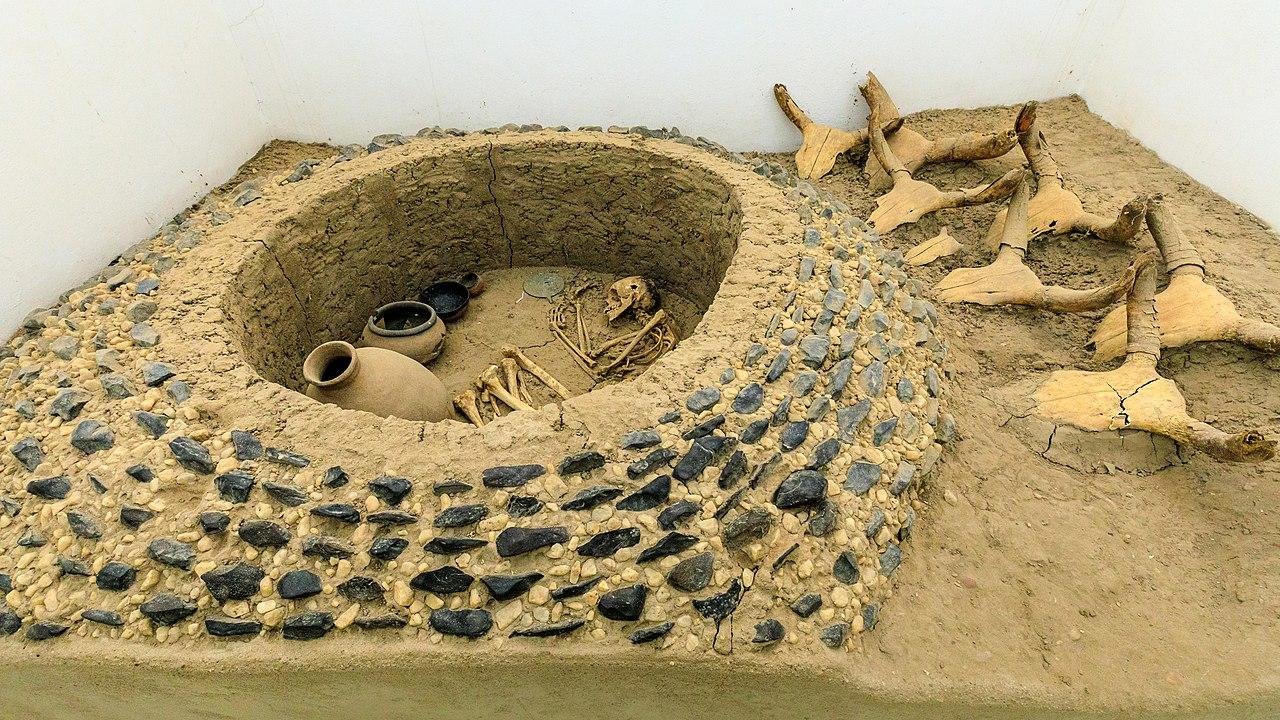
4,000-year-old Kerma burial unearthed in Sudan’s Bayuda Desert
A tumulus from Kerma c. 2450 BCE, National Museum of Sudan. Credit: Matthias Gehricke / CC BY-SA 4.0

The team works under Henryk Paner from the Polish Centre of Mediterranean Archaeology at the University of Warsaw. For more than six years, researchers have carried out fieldwork in central Sudan. Earlier excavations in the Bayuda Desert were limited and sporadic during the mid-20th century. Systematic research began only in the 21st century. The results of this study appeared in Azania: Archaeological Research in Africa.

Osteological analysis shows that the man died between the ages of 30 and 40. He stood slightly over 164 centimeters tall. His bones indicate a strong build with well-developed muscles. Researchers identified signs of physical strain consistent with heavy labor. The evidence points to long hours of work in semi-desert conditions and a limited diet. Animal remains at the site suggest close contact with livestock.

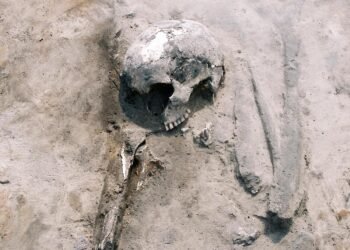
The grave itself was shallow and roughly oval. Rocky ground shaped the pit. The body lay on its back, with the head facing east and slightly north. The legs were bent sharply and turned to the right, with the feet resting on the pelvic bones. This posture appears in earlier Kerma burials and follows established burial customs.

4,000-year-old Kerma burial unearthed in Sudan’s Bayuda Desert
Sudan’s Bayuda Desert. Credit: Jozef Tóth / CC BY-SA 3.0

Archaeologists found two handmade ceramic vessels behind the body. One was a medium-sized jug with a spout placed close to ground level. The other was an inverted bowl. Near the neck, the team recovered 82 faience beads, likely part of a necklace worn at burial.

RelatedStories

Facial tattoos on Nubian toddlers: new evidence of faith, protection, and identity from 1,400 years ago

Facial tattoos on Nubian toddlers: new evidence of faith, protection, and identity from 1,400 years ago

December 27, 2025
Bronze Age Nubian women carried heavy loads on their heads, study reveals

Bronze Age Nubian women carried heavy loads on their heads, study reveals

April 24, 2025

Inside the jug, researchers found charred plant remains, fragments of animal bone, coprolites, and beetle parts. The jug showed no traces of burning. This detail suggests that people placed the burned material into the vessel after removing it from a hearth. The animal bones may represent leftovers from a funeral meal. Participants likely threw these remains into a fire before placing part of the debris in the grave.

Pottery played a social role in Kerma burials. Vessels served as containers for food and drink offerings and as markers of identity. Placing a bowl upside down or damaging a vessel formed part of ritual practice. Such actions likely marked the end of the object’s use in daily life and its association with the deceased.

Environmental analysis of the cemetery hill provides further context. Today the area lies within open desert. Data from mapping and sediment studies indicate that around 2000 BCE the landscape was less arid. Grasses, low shrubs, and scattered trees likely covered the area, forming a savannah environment.

This single burial combines archaeological, biological, and environmental data. Together, these strands of evidence reconstruct aspects of work, diet, ritual practice, and climate in ancient Nubia.

More information: PAP

ShareTweetShareShareSend

You May Also Like...

2,000-year-old Vietnamese tooth blackening practice found in Iron Age burial
Anthropology

2,000-year-old Vietnamese tooth blackening practice found in Iron Age burial

February 13, 2026
Rare Roman staircase and unique lararium discovered beneath Cologne’s MiQua Jewish Museum site
Archaeology

Rare Roman staircase and unique lararium discovered beneath Cologne’s MiQua Jewish Museum site

February 13, 2026
oldest Mithraic sanctuary in Bavaria discovered in Regensburg’s Roman old town
Archaeology

Oldest Mithraic sanctuary in Bavaria discovered in Regensburg’s Roman old town

February 12, 2026
Rich medieval Christians buried ‘closer to God’ even with leprosy or tuberculosis, archaeologists find
Anthropology

Rich medieval Christians buried ‘closer to God’ even with leprosy or tuberculosis, archaeologists find

February 12, 2026
Why bison hunters abandoned a long-used site 1,100 years ago due to severe droughts
Archaeology

Why bison hunters abandoned a long-used site 1,100 years ago due to severe droughts

February 11, 2026
Rare 3rd century terracotta female head discovered at Magna Roman Fort near Hadrian’s Wall
Archaeology

Rare 3rd century terracotta female head discovered at Magna Roman Fort near Hadrian’s Wall

February 11, 2026

Comments 0

  1. Editorial Team says:
    1 second ago

    Disclaimer: This website is a science-focused magazine that welcomes both academic and non-academic audiences. Comments are written by users and may include personal opinions or unverified claims. They do not necessarily reflect the views of our editorial team or rely on scientific evidence.

    Comment Policy: We kindly ask all commenters to engage respectfully. Comments that contain offensive, insulting, degrading, discriminatory, or racist content will be automatically removed.

    Reply

Leave a Reply Cancel reply

Your email address will not be published. Required fields are marked *

Follow us


Instagram
244K

Facebook
118K

Threads
45K

LinkedIn
14K

Twitter
6K

YouTube
1K
  • Trending
  • Comments
  • Latest
Shipwreck Salvage. Credit: rawpixel.com / Public Domain

2,000-year-old shipwreck discovered off Turkish coast with remarkably preserved stacked ceramics

July 2, 2025
Viking age DNA reveals 9,000-year-old HIV-resistant gene originating near the Black Sea

Viking age DNA reveals 9,000-year-old HIV-resistant gene originating near the Black Sea

May 18, 2025
A new study suggests the mysterious Voynich Manuscript may be a medieval cipher

A new study suggests the mysterious Voynich Manuscript may be a medieval cipher

January 3, 2026
Moses may be named in ancient Egyptian mine inscriptions, sparking debate over earliest biblical references

Moses may be named in ancient Egyptian mine inscriptions, sparking debate over earliest biblical references

July 31, 2025
Mystery of Armenia’s 6,000-year-old dragon stones solved

Mystery of Armenia’s 6,000-year-old dragon stones solved

September 23, 2025
3D analysis reveals Shroud of Turin image likely came from sculpture, not Jesus’ body

3D analysis reveals Shroud of Turin image likely came from sculpture, not Jesus’ body

Moses may be named in ancient Egyptian mine inscriptions, sparking debate over earliest biblical references

Moses may be named in ancient Egyptian mine inscriptions, sparking debate over earliest biblical references

$1 million prize offered to decipher 5,300-year-old Indus Valley script

$1 million prize offered to decipher 5,300-year-old Indus Valley script

Oldest ever genetic data from a human relative found in 2-million-year-old fossilized teeth

Oldest ever genetic data from a human relative found in 2-million-year-old fossilized teeth

Exceptionally large Roman shoes discovered at Magna fort near Hadrian’s Wall

Exceptionally large Roman shoes discovered at Magna fort near Hadrian’s Wall

4,000-year-old Kerma burial unearthed in Sudan’s Bayuda Desert

4,000-year-old Kerma burial unearthed in Sudan’s Bayuda Desert

February 13, 2026
2,000-year-old Vietnamese tooth blackening practice found in Iron Age burial

2,000-year-old Vietnamese tooth blackening practice found in Iron Age burial

February 13, 2026
Rare Roman staircase and unique lararium discovered beneath Cologne’s MiQua Jewish Museum site

Rare Roman staircase and unique lararium discovered beneath Cologne’s MiQua Jewish Museum site

February 13, 2026
oldest Mithraic sanctuary in Bavaria discovered in Regensburg’s Roman old town

Oldest Mithraic sanctuary in Bavaria discovered in Regensburg’s Roman old town

February 12, 2026
Rich medieval Christians buried ‘closer to God’ even with leprosy or tuberculosis, archaeologists find

Rich medieval Christians buried ‘closer to God’ even with leprosy or tuberculosis, archaeologists find

February 12, 2026

Archaeology News online magazine

Archaeology News is an international online magazine that covers all aspects of archaeology.


Categories

  • Academics
    • Books
    • Conferences
    • Universities
  • Articles
  • Download
  • Game
  • News
    • Anthropology
    • Archaeology
    • Paleontology
  • Quiz
  • Tours

Subscribe to our newsletter

© 2024 - Archaeology News Online Magazine. All Rights Reserved.

  • About
  • Privacy Policy
  • Terms of Use
  • Donation
  • Contact

Welcome Back!

Login to your account below

Forgotten Password? Sign Up

Create New Account!

Fill the forms below to register

All fields are required. Log In

Retrieve your password

Please enter your username or email address to reset your password.

Log In

Add New Playlist

Manage Consent
To provide the best experiences, we use technologies like cookies to store and/or access device information. Consenting to these technologies will allow us to process data such as browsing behavior or unique IDs on this site. Not consenting or withdrawing consent, may adversely affect certain features and functions.
Functional Always active
The technical storage or access is strictly necessary for the legitimate purpose of enabling the use of a specific service explicitly requested by the subscriber or user, or for the sole purpose of carrying out the transmission of a communication over an electronic communications network.
Preferences
The technical storage or access is necessary for the legitimate purpose of storing preferences that are not requested by the subscriber or user.
Statistics
The technical storage or access that is used exclusively for statistical purposes. The technical storage or access that is used exclusively for anonymous statistical purposes. Without a subpoena, voluntary compliance on the part of your Internet Service Provider, or additional records from a third party, information stored or retrieved for this purpose alone cannot usually be used to identify you.
Marketing
The technical storage or access is required to create user profiles to send advertising, or to track the user on a website or across several websites for similar marketing purposes.
  • Manage options
  • Manage services
  • Manage {vendor_count} vendors
  • Read more about these purposes
View preferences
  • {title}
  • {title}
  • {title}
  • Home
  • News
    • Archaeology
    • Anthropology
    • Paleontology
  • Academic
    • Books
    • Conferences
    • Universities
  • Articles
  • VR Tours
  • Quiz & Game
  • Download
  • Encyclopedia
  • Forum

About  .  Contact  .  Donation

© 2024 - Archaeology News Online Magazine. All Rights Reserved