• About
  • Privacy Policy
  • Terms of Use
  • Donation
  • Contact
No Result
View All Result
Archaeology News
  • Home
  • News
    • Archaeology
    • Anthropology
    • Paleontology
  • Academic
    • Books
    • Conferences
    • Universities
  • Articles
  • VR Tours
  • Quiz & Game
  • Download
  • Encyclopedia
  • Forum
Archaeology News
No Result
View All Result
Home News Anthropology

Bronze Age Nubian women carried heavy loads on their heads, study reveals

by Dario Radley
April 24, 2025

In the dry plains of ancient Nubia—modern-day Sudan—women were not just pillars of their households but true bearers of the community’s weight, according to a groundbreaking interdisciplinary study published in the Journal of Anthropological Archaeology.
Bronze Age Nubian women carried heavy loads on their heads, study reveals
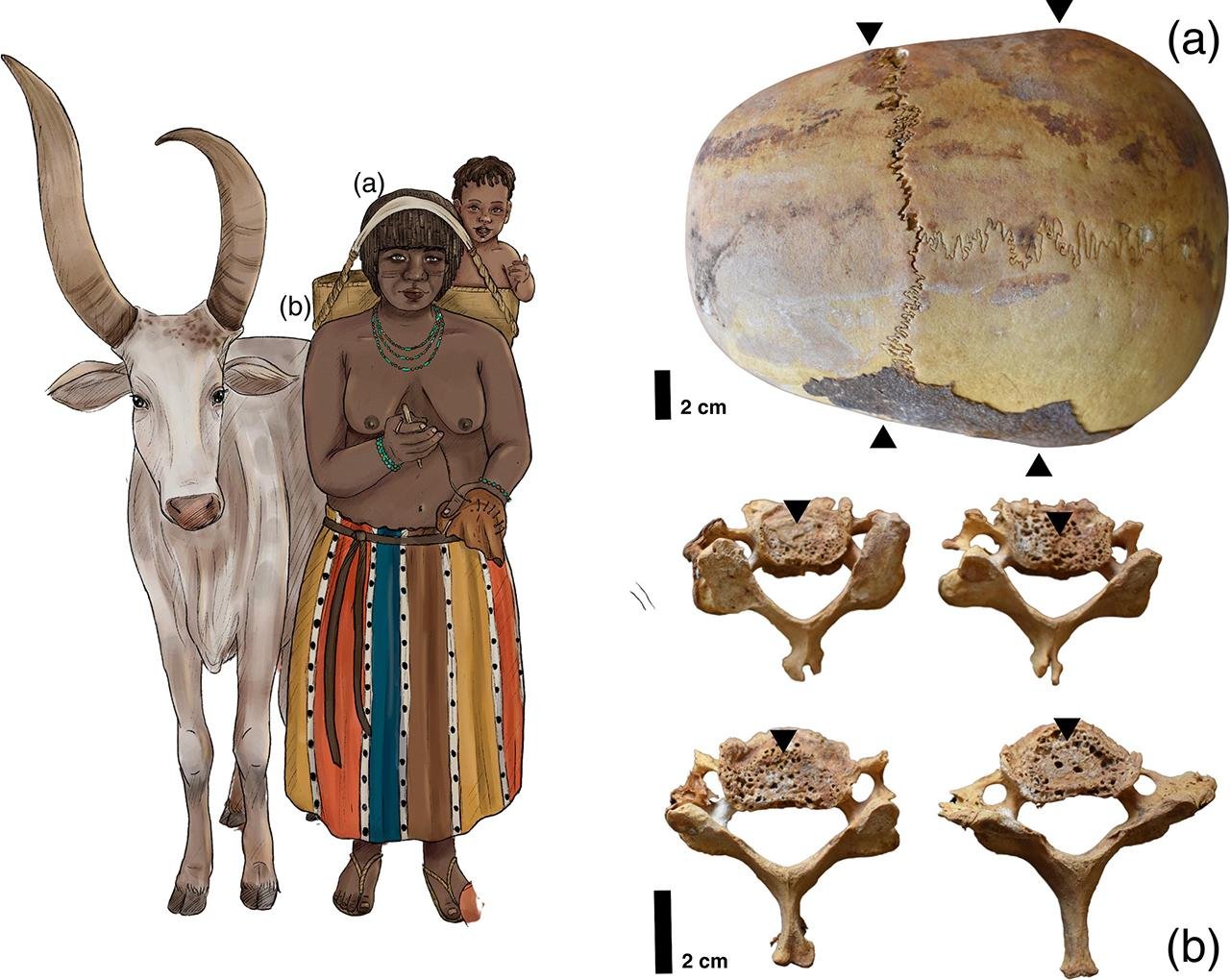
Artist’s illustration of Individual 8A2 (Illustration: Silvia Jiménez-Amorós and Jared Carballo-Pérez). These bodily practices, among others, could have eventually led to the observed postcoronal depression in her skull (a), as well as pathological levels of spondyloarthritis with lytic lesions in her cervical vertebrae (b). Credit: J. Carballo-Pérez et al., Journal of Anthropological Archaeology (2025)

The study, led by Jared Carballo of the Universitat Autònoma de Barcelona and Uroš Matić of the University of Essen, sheds much-needed light on the labor contributions of Nubian women 3,500 years ago during the Bronze Age.

The study centers on 30 individuals—14 women and 16 men—who were interred at Abu Fatima, a cemetery linked to the Kerma culture, a powerful Nubian kingdom contemporaneous with ancient Egypt. Analyzing skeletal remains alongside ethnographic and iconographic data, the researchers identified stark contrasts in the physical wear and tear on women and men, graphically detailing gendered labor roles firmly embedded in daily life.

Male skeletons had signs of shoulder strain and arthritis, particularly on the right, from repeated one-shoulder load carrying. Female skeletons showed extreme changes in their cervical vertebrae and skulls, typical of decades-long use of head straps—known as tumplines—used to carry heavy loads. These changes show years, even decades, of weight transfer from the forehead to the spine.

Bronze Age Nubian women carried heavy loads on their heads, study reveals
Caughnawaga Indians in Snowy Landscape, oil painting by Cornelius Krieghoff. Public domain

The most important discovery was “individual 8A2,” a woman over 50 years old, who was buried with high-status items such as an ostrich feather fan and a fine leather pillow. Despite these elite burial markers, the most pronounced evidence of tumpline use was presented by her bones, which had the deepest cranial depression and advanced cervical osteoarthritis. Biochemical analysis of her tooth enamel confirmed that she was a migrant, perhaps highlighting how she lived both as a carrier of physical burdens and cultural heritage.

RelatedStories

Bronze Age loom found inside ancient Spanish home reveals early textile production

Bronze Age loom found inside ancient Spanish home reveals early textile production

April 8, 2026
How ancient communities adapted their diets and farming strategies in prehistoric Poland

How ancient communities adapted their diets and farming strategies in prehistoric Poland

February 26, 2026

“This way of life is as common as it is overlooked by written history,” explains Carballo. “In some way, the study reveals how women literally have carried the weight of society on their heads for millennia.”

In fact, this research contradicts the male-centric narrative typically dominating prehistoric depictions of labor. While written history neglects the toil of women, Abu Fatima’s bones speak for themselves. The wear patterns on their bones offer a form of biography—evidence of repeated, hard labor influenced not just by survival but by social needs and inherited techniques.

Scholars note that this physical work was not exclusive to the lower classes. The case of individual 8A2 complicates assumptions that upper-class women were free from manual work. The researchers say that the persistence of head-loading techniques all over the globe—from Africa to the Himalayas and Latin America—testifies to a universal but lesser-understood type of endurance and skill.

Through a combination of skeletal analysis, ancient tomb imagery, and comparisons with contemporary ethnographic records, the study reveals new avenues for interpreting gendered labor, the physical implications of motherhood, and the intangible strength contained within women’s roles across the centuries.
More information: Autonomous University of Barcelona
Carballo-Pérez, J., Matić, U., Hall, R., Smith, S. T., & Schrader, S. A. (2025). Tumplines, baskets, and heavy burden? Interdisciplinary approach to load carrying in Bronze Age Abu Fatima, Sudan. Journal of Anthropological Archaeology, 77(101652), 101652. doi:10.1016/j.jaa.2024.101652
Share4Tweet3Share1ShareSend

You May Also Like...

Roman cemetery in Egypt reveals golden tongues, mummies, and rare Iliad papyrus
Anthropology

Roman cemetery in Egypt reveals golden tongues, mummies, and rare Iliad papyrus

April 19, 2026
Basel plague study finds young workers had highest death rates in 17th century outbreak
Anthropology

Basel plague study finds young workers had highest death rates in 17th century outbreak

April 17, 2026
Ancient DNA reveals male lineage and family ties in Neolithic Scotland tombs
Anthropology

Ancient DNA reveals male lineage and family ties in Neolithic Scotland tombs

April 16, 2026
Council houses reveal shift from royal rule to collective governance in Terminal Classic Maya society
Archaeology

Council houses reveal shift from royal rule to collective governance in Terminal Classic Maya society

April 11, 2026
Bronze Age loom found inside ancient Spanish home reveals early textile production
Archaeology

Bronze Age loom found inside ancient Spanish home reveals early textile production

April 8, 2026
Pompeii ash analysis reveals Romans burned wine and imported frankincense in household rituals
Archaeology

Pompeii ash analysis reveals Romans burned wine and imported frankincense in household rituals

April 3, 2026

Follow us


Instagram
244K

Facebook
118K

Threads
46K

LinkedIn
14K

Twitter
6K

YouTube
1K
  • Trending
  • Comments
  • Latest
Shipwreck Salvage. Credit: rawpixel.com / Public Domain

2,000-year-old shipwreck discovered off Turkish coast with remarkably preserved stacked ceramics

July 2, 2025
Viking age DNA reveals 9,000-year-old HIV-resistant gene originating near the Black Sea

Viking age DNA reveals 9,000-year-old HIV-resistant gene originating near the Black Sea

May 18, 2025
A new study suggests the mysterious Voynich Manuscript may be a medieval cipher

A new study suggests the mysterious Voynich Manuscript may be a medieval cipher

January 3, 2026
3D analysis reveals Shroud of Turin image likely came from sculpture, not Jesus’ body

3D analysis reveals Shroud of Turin image likely came from sculpture, not Jesus’ body

August 3, 2025
Moses may be named in ancient Egyptian mine inscriptions, sparking debate over earliest biblical references

Moses may be named in ancient Egyptian mine inscriptions, sparking debate over earliest biblical references

July 31, 2025
3D analysis reveals Shroud of Turin image likely came from sculpture, not Jesus’ body

3D analysis reveals Shroud of Turin image likely came from sculpture, not Jesus’ body

Moses may be named in ancient Egyptian mine inscriptions, sparking debate over earliest biblical references

Moses may be named in ancient Egyptian mine inscriptions, sparking debate over earliest biblical references

$1 million prize offered to decipher 5,300-year-old Indus Valley script

$1 million prize offered to decipher 5,300-year-old Indus Valley script

Oldest ever genetic data from a human relative found in 2-million-year-old fossilized teeth

Oldest ever genetic data from a human relative found in 2-million-year-old fossilized teeth

Exceptionally large Roman shoes discovered at Magna fort near Hadrian’s Wall

Exceptionally large Roman shoes discovered at Magna fort near Hadrian’s Wall

Roman cemetery in Egypt reveals golden tongues, mummies, and rare Iliad papyrus

Roman cemetery in Egypt reveals golden tongues, mummies, and rare Iliad papyrus

April 19, 2026
Basel plague study finds young workers had highest death rates in 17th century outbreak

Basel plague study finds young workers had highest death rates in 17th century outbreak

April 17, 2026
Ancient DNA reveals male lineage and family ties in Neolithic Scotland tombs

Ancient DNA reveals male lineage and family ties in Neolithic Scotland tombs

April 16, 2026
Council houses reveal shift from royal rule to collective governance in Terminal Classic Maya society

Council houses reveal shift from royal rule to collective governance in Terminal Classic Maya society

April 11, 2026
Bronze Age loom found inside ancient Spanish home reveals early textile production

Bronze Age loom found inside ancient Spanish home reveals early textile production

April 8, 2026

Archaeology News online magazine

Archaeology News is an international online magazine that covers all aspects of archaeology.


Categories

  • Academics
    • Books
    • Conferences
    • Universities
  • Articles
  • Download
  • Game
  • News
    • Anthropology
    • Archaeology
    • Paleontology
  • Quiz
  • Tours

Subscribe to our newsletter

© 2024 - Archaeology News Online Magazine. All Rights Reserved.

  • About
  • Privacy Policy
  • Terms of Use
  • Donation
  • Contact

Manage Consent
To provide the best experiences, we use technologies like cookies to store and/or access device information. Consenting to these technologies will allow us to process data such as browsing behavior or unique IDs on this site. Not consenting or withdrawing consent, may adversely affect certain features and functions.
Functional Always active
The technical storage or access is strictly necessary for the legitimate purpose of enabling the use of a specific service explicitly requested by the subscriber or user, or for the sole purpose of carrying out the transmission of a communication over an electronic communications network.
Preferences
The technical storage or access is necessary for the legitimate purpose of storing preferences that are not requested by the subscriber or user.
Statistics
The technical storage or access that is used exclusively for statistical purposes. The technical storage or access that is used exclusively for anonymous statistical purposes. Without a subpoena, voluntary compliance on the part of your Internet Service Provider, or additional records from a third party, information stored or retrieved for this purpose alone cannot usually be used to identify you.
Marketing
The technical storage or access is required to create user profiles to send advertising, or to track the user on a website or across several websites for similar marketing purposes.
  • Manage options
  • Manage services
  • Manage {vendor_count} vendors
  • Read more about these purposes
View preferences
  • {title}
  • {title}
  • {title}
  • Home
  • News
    • Archaeology
    • Anthropology
    • Paleontology
  • Academic
    • Books
    • Conferences
    • Universities
  • Articles
  • VR Tours
  • Quiz & Game
  • Download
  • Encyclopedia
  • Forum

About  .  Contact  .  Donation

© 2024 - Archaeology News Online Magazine. All Rights Reserved