• About
  • Privacy Policy
  • Terms of Use
  • Donation
  • Contact
No Result
View All Result
Archaeology News
  • Home
  • News
    • Archaeology
    • Anthropology
    • Paleontology
  • Academic
    • Books
    • Conferences
    • Universities
  • Articles
  • VR Tours
  • Quiz & Game
  • Download
  • Encyclopedia
  • Forum
Archaeology News
No Result
View All Result
Home News Anthropology

DNA study reveals 3,000 years of genetic stability in Europe’s Low Countries before Bell Beaker expansion

by Dario Radley
February 16, 2026

For decades, archaeologists described European prehistory as a sequence of large migrations and rapid genetic change. A new ancient DNA study shows a different pattern in the Low Countries. Communities living in what is now the Netherlands, Belgium, and northwestern Germany followed their own path for thousands of years. The results appear in Nature.
DNA study reveals 3,000 years of genetic stability in Europe’s Low Countries before Bell Beaker expansion
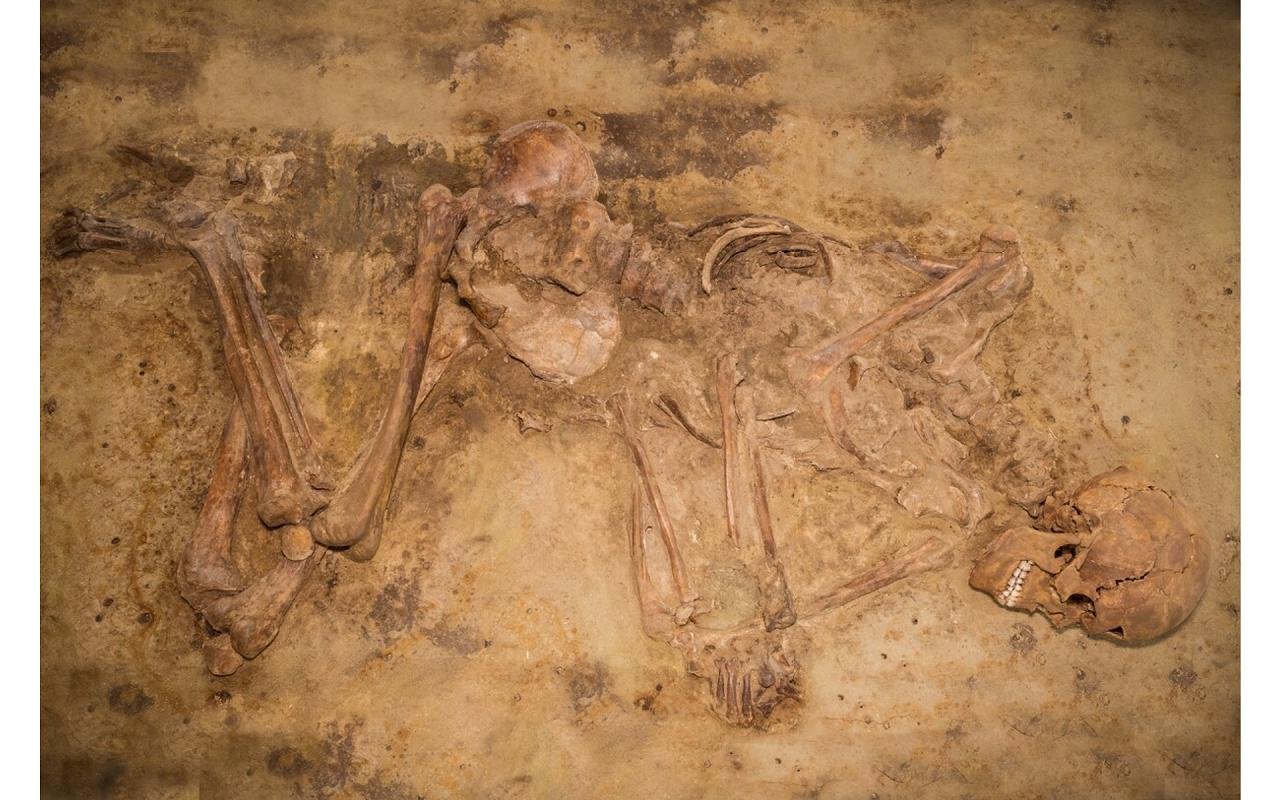
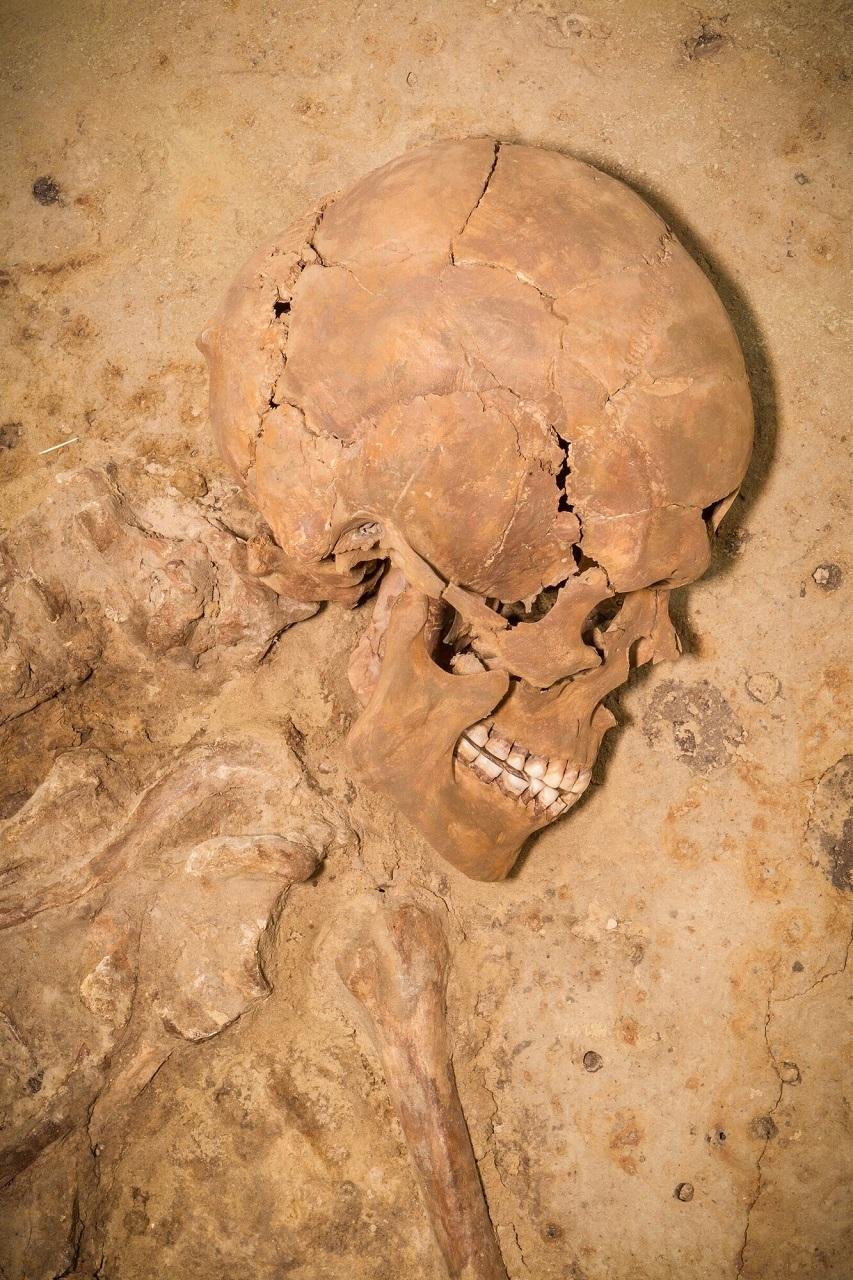
Crouched burial of a 40-year-old man in Oostwoud, identified by researchers as the earliest known Bell Beaker grave. Credit: Provinciaal Depot voor Archeologie Noord-Holland

Researchers examined genome-wide data from 112 individuals who lived between about 8500 and 1700 BCE in the Rhine Meuse region. Across much of Europe, the spread of farming between 6500 and 4000 BCE led to major ancestry turnover. Descendants of western Anatolian farmers mixed with local hunter gatherers, and in many areas farmer ancestry rose to 70 to 100 percent within a few centuries. In the wetlands and river plains of the Low Countries, this shift moved at a different pace.

Hunter gatherer ancestry remained high until around 3000 BCE. In several individuals, about half of their genetic profile still traced to local foragers. Archaeological work had already shown the late adoption of large scale farming in this region. The genetic data match those findings.

Small groups of farmers settled in what is now Zuid Limburg around 5500 BCE. These farmers descended from communities with roots in Anatolia who had moved through Central Europe over nearly 2,000 years. Contact between these southern settlements and northern foragers remained limited. Most communities in the delta continued to hunt, fish, and gather wild plants for a long period.
DNA study reveals 3,000 years of genetic stability in Europe’s Low Countries before Bell Beaker expansion
Credit: Provinciaal Depot voor Archeologie Noord-Holland

The landscape shaped these choices. The Rhine Meuse delta offered fish, waterfowl, large game, fruits, and seeds within a compact area. Rivers and coastal routes supported exchange between groups. People shared tools and pottery styles while keeping local ancestry. The early Neolithic farming system linked to the Linearbandkeramik culture did not replace older lifeways in these lowlands.


RelatedStories

Earliest known burial in Northern Britain identified as young girl through DNA analysis

Earliest known burial in Northern Britain identified as young girl through DNA analysis

February 14, 2026
Why bison hunters abandoned a long-used site 1,100 years ago due to severe droughts

Why bison hunters abandoned a long-used site 1,100 years ago due to severe droughts

February 11, 2026

Maternal ancestry reveals another pattern. Early farmer DNA in the northern delta entered mainly through women. Female individuals with Early European Farmer ancestry joined local communities. Male hunter gatherer lines remained dominant for centuries. Social ties appear to have formed without large scale population replacement.

Around 3000 BCE, the Corded Ware complex spread across wide parts of Europe. Archaeologists link this expansion to groups with steppe ancestry moving west between 3000 and 2500 BCE. In many regions, steppe ancestry rose sharply. In the western Rhine Meuse area, the picture differs. People adopted Corded Ware pottery and single burial customs. Genetic data from lowland settlements show little steppe ancestry overall. Some men carried Y chromosomes typical of early Corded Ware groups, yet most of their genome reflected local roots. Cultural change spread faster than genes.

A stronger genetic shift appears after 2500 BCE with the rise of the Bell Beaker culture. In the Lower Rhine Meuse region, new communities formed through mixing between local people, who contributed about 13 to 18 percent of the ancestry, and migrants linked to Corded Ware groups of both sexes. This blended population expanded across northwestern Europe.

In Great Britain, groups connected to the Rhine Meuse Bell Beaker network became the main source of a 90 to 100 percent replacement of earlier Neolithic ancestry. A region that long maintained continuity later played a central role in reshaping the genetic landscape of northwestern Europe.
More information: Leiden University
Publication: Olalde, I., Altena, E., Bourgeois, Q., Fokkens, H., Amkreutz, L., Baetsen, S., … Reich, D. (2026). Lasting Lower Rhine-Meuse forager ancestry shaped Bell Beaker expansion. Nature. doi:10.1038/s41586-026-10111-8
Share1Tweet1ShareShareSend

You May Also Like...

Chalcolithic cornets at Teleilat Ghassul reveal ritual lamp use in Jordan’s prehistoric communities
Archaeology

Chalcolithic cornets at Teleilat Ghassul reveal ritual lamp use in Jordan’s prehistoric communities

February 16, 2026
Second Temple period stone vessel workshop unearthed on Mount Scopus after antiquities theft arrests
Archaeology

Second Temple period stone vessel workshop unearthed on Mount Scopus after antiquities theft arrests

February 16, 2026
10,000 years of rock art discovered at Umm Arak Plateau in Egypt’s southern Sinai
Archaeology

10,000 years of rock art discovered at Umm Arak Plateau in Egypt’s southern Sinai

February 15, 2026
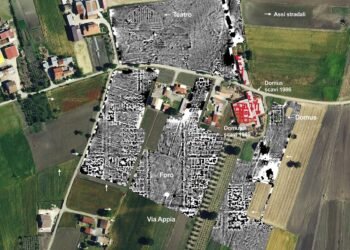
Drone surveys reveal Roman forum and previously unknown monumental theater at Fioccaglia
Archaeology

Drone surveys reveal Roman forum and previously unknown monumental theater at Fioccaglia

February 15, 2026
Earliest known burial in Northern Britain identified as young girl through DNA analysis
Anthropology

Earliest known burial in Northern Britain identified as young girl through DNA analysis

February 14, 2026
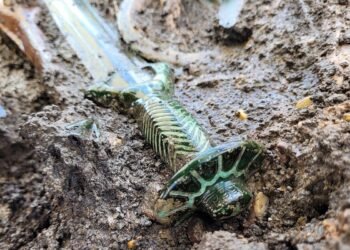
3,400-year-old Nördlingen bronze sword reveals advanced metalworking techniques
Archaeology

3,400-year-old Nördlingen bronze sword reveals advanced metalworking techniques

February 14, 2026

Comments 0

  1. Editorial Team says:
    1 second ago

    Disclaimer: This website is a science-focused magazine that welcomes both academic and non-academic audiences. Comments are written by users and may include personal opinions or unverified claims. They do not necessarily reflect the views of our editorial team or rely on scientific evidence.

    Comment Policy: We kindly ask all commenters to engage respectfully. Comments that contain offensive, insulting, degrading, discriminatory, or racist content will be automatically removed.

    Reply

Leave a Reply Cancel reply

Your email address will not be published. Required fields are marked *

Follow us


Instagram
244K

Facebook
118K

Threads
45K

LinkedIn
14K

Twitter
6K

YouTube
1K
  • Trending
  • Comments
  • Latest
Shipwreck Salvage. Credit: rawpixel.com / Public Domain

2,000-year-old shipwreck discovered off Turkish coast with remarkably preserved stacked ceramics

July 2, 2025
Viking age DNA reveals 9,000-year-old HIV-resistant gene originating near the Black Sea

Viking age DNA reveals 9,000-year-old HIV-resistant gene originating near the Black Sea

May 18, 2025
A new study suggests the mysterious Voynich Manuscript may be a medieval cipher

A new study suggests the mysterious Voynich Manuscript may be a medieval cipher

January 3, 2026
Moses may be named in ancient Egyptian mine inscriptions, sparking debate over earliest biblical references

Moses may be named in ancient Egyptian mine inscriptions, sparking debate over earliest biblical references

July 31, 2025
Mystery of Armenia’s 6,000-year-old dragon stones solved

Mystery of Armenia’s 6,000-year-old dragon stones solved

September 23, 2025
3D analysis reveals Shroud of Turin image likely came from sculpture, not Jesus’ body

3D analysis reveals Shroud of Turin image likely came from sculpture, not Jesus’ body

Moses may be named in ancient Egyptian mine inscriptions, sparking debate over earliest biblical references

Moses may be named in ancient Egyptian mine inscriptions, sparking debate over earliest biblical references

$1 million prize offered to decipher 5,300-year-old Indus Valley script

$1 million prize offered to decipher 5,300-year-old Indus Valley script

Oldest ever genetic data from a human relative found in 2-million-year-old fossilized teeth

Oldest ever genetic data from a human relative found in 2-million-year-old fossilized teeth

Exceptionally large Roman shoes discovered at Magna fort near Hadrian’s Wall

Exceptionally large Roman shoes discovered at Magna fort near Hadrian’s Wall

Chalcolithic cornets at Teleilat Ghassul reveal ritual lamp use in Jordan’s prehistoric communities

Chalcolithic cornets at Teleilat Ghassul reveal ritual lamp use in Jordan’s prehistoric communities

February 16, 2026
DNA study reveals 3,000 years of genetic stability in Europe’s Low Countries before Bell Beaker expansion

DNA study reveals 3,000 years of genetic stability in Europe’s Low Countries before Bell Beaker expansion

February 16, 2026
Second Temple period stone vessel workshop unearthed on Mount Scopus after antiquities theft arrests

Second Temple period stone vessel workshop unearthed on Mount Scopus after antiquities theft arrests

February 16, 2026
10,000 years of rock art discovered at Umm Arak Plateau in Egypt’s southern Sinai

10,000 years of rock art discovered at Umm Arak Plateau in Egypt’s southern Sinai

February 15, 2026
Drone surveys reveal Roman forum and previously unknown monumental theater at Fioccaglia

Drone surveys reveal Roman forum and previously unknown monumental theater at Fioccaglia

February 15, 2026

Archaeology News online magazine

Archaeology News is an international online magazine that covers all aspects of archaeology.


Categories

  • Academics
    • Books
    • Conferences
    • Universities
  • Articles
  • Download
  • Game
  • News
    • Anthropology
    • Archaeology
    • Paleontology
  • Quiz
  • Tours

Subscribe to our newsletter

© 2024 - Archaeology News Online Magazine. All Rights Reserved.

  • About
  • Privacy Policy
  • Terms of Use
  • Donation
  • Contact

Manage Consent
To provide the best experiences, we use technologies like cookies to store and/or access device information. Consenting to these technologies will allow us to process data such as browsing behavior or unique IDs on this site. Not consenting or withdrawing consent, may adversely affect certain features and functions.
Functional Always active
The technical storage or access is strictly necessary for the legitimate purpose of enabling the use of a specific service explicitly requested by the subscriber or user, or for the sole purpose of carrying out the transmission of a communication over an electronic communications network.
Preferences
The technical storage or access is necessary for the legitimate purpose of storing preferences that are not requested by the subscriber or user.
Statistics
The technical storage or access that is used exclusively for statistical purposes. The technical storage or access that is used exclusively for anonymous statistical purposes. Without a subpoena, voluntary compliance on the part of your Internet Service Provider, or additional records from a third party, information stored or retrieved for this purpose alone cannot usually be used to identify you.
Marketing
The technical storage or access is required to create user profiles to send advertising, or to track the user on a website or across several websites for similar marketing purposes.
  • Manage options
  • Manage services
  • Manage {vendor_count} vendors
  • Read more about these purposes
View preferences
  • {title}
  • {title}
  • {title}
  • Home
  • News
    • Archaeology
    • Anthropology
    • Paleontology
  • Academic
    • Books
    • Conferences
    • Universities
  • Articles
  • VR Tours
  • Quiz & Game
  • Download
  • Encyclopedia
  • Forum

About  .  Contact  .  Donation

© 2024 - Archaeology News Online Magazine. All Rights Reserved