• About
  • Privacy Policy
  • Terms of Use
  • Donation
  • Contact
No Result
View All Result
Archaeology News
  • Home
  • News
    • Archaeology
    • Anthropology
    • Paleontology
  • Academic
    • Books
    • Conferences
    • Universities
  • Articles
  • VR Tours
  • Quiz & Game
  • Download
  • Encyclopedia
  • Forum
Archaeology News
No Result
View All Result
Home News Archaeology

Chalcolithic cornets at Teleilat Ghassul reveal ritual lamp use in Jordan’s prehistoric communities

by Dario Radley
February 16, 2026

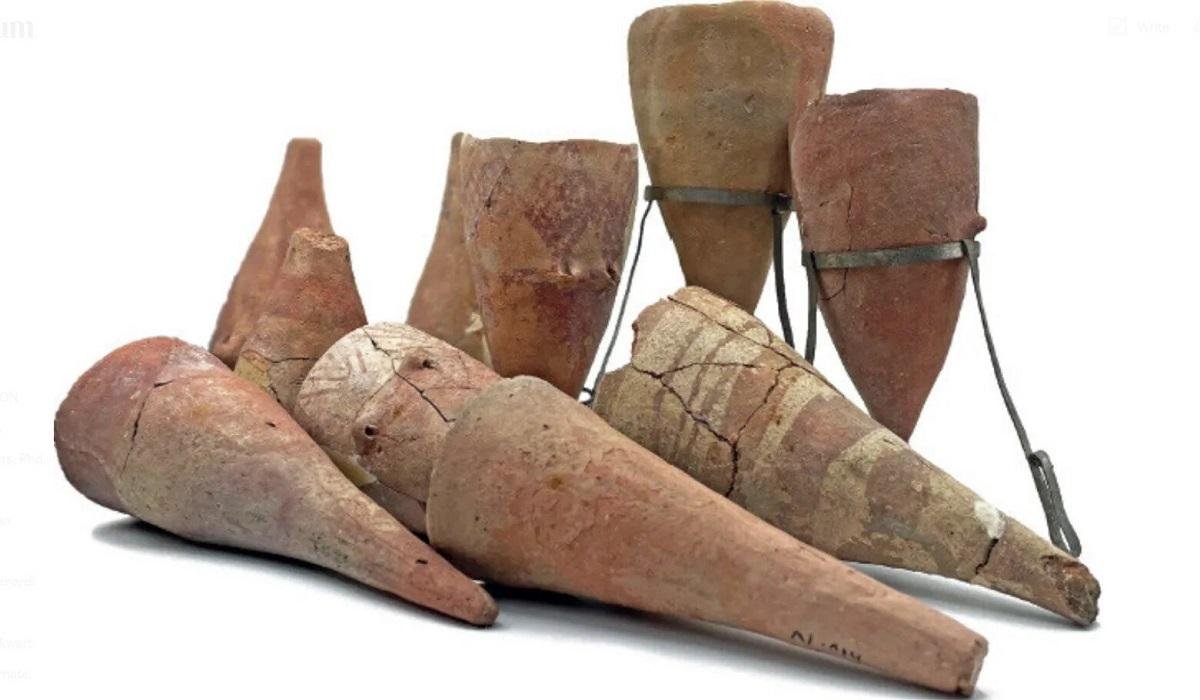
A new study offers the first systematic analysis of Chalcolithic cornets from the site of Teleilat Ghassul in present-day Jordan. These small, cone-shaped ceramic vessels appear only during the Chalcolithic period and are absent in earlier and later pottery traditions. Archaeologists have long debated their purpose. The new research examines how they were made, where their raw materials came from, how they were used, and how they were discarded.
Chalcolithic cornets at Teleilat Ghassul reveal ritual lamp use in Jordan’s prehistoric communities
A collection of cornets. Credit: photo by S. Zuhovitzky, courtesy of the PBI / Zuhovitzky, S., Waiman-Barak, P., & Gadot, Y., Tel Aviv (2025); (This image is used under the terms of the CC BY-NC-ND license for non-commercial, educational, and informational purposes. If you are the copyright holder and have any concerns regarding its use, please contact us for prompt removal.)

Cornets are known from several Chalcolithic sites, including Ashkelon, ʿEn Gedi, Abu Hof, and Grar, where they often appear in large concentrations. At other sites such as Safadi, Abu Matar, and Shiqmim, they are rare or absent. Many examples come from contexts interpreted as cultic storage areas. The vessels are typically coated with a light or red slip, and some have two or four small handles. Their shapes and finishes vary, and no shared classification system has been applied across sites.

The team focused on the large assemblage excavated at Teleilat Ghassul by the Pontifical Biblical Institute between 1929 and 1999. The collection includes 35 complete vessels and about 550 fragments, most of which belong to the pointed bases. Researchers examined each piece visually and used 3D scanning to define recurring forms. Petrographic analysis helped identify the clay sources. Microscopic inspection and experimental replication clarified the shaping process.

The analysis identified four main types. Most were produced from local clays, which indicates local manufacture. Type 3 vessels stand out for their uniform form and higher level of workmanship, which suggests production by skilled potters. These examples form only a small portion of the assemblage. The majority show variation in shape and finish, and their production did not require advanced technical skill.
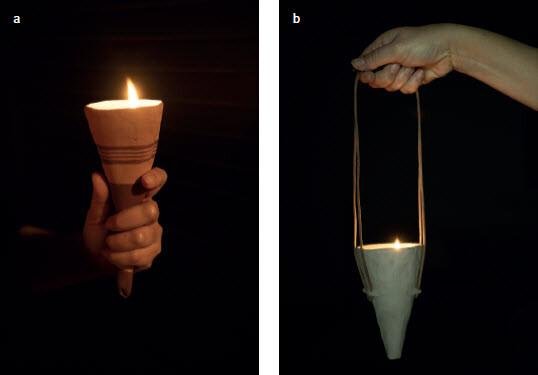
Chalcolithic cornets at Teleilat Ghassul reveal ritual lamp use in Jordan’s prehistoric communities
Using the cornets as lamps; a) cornets with elongated bases are convenient for holding; b) cornets with four handles can be used as hanging lamps. Credit: Zuhovitzky, S., Waiman-Barak, P., & Gadot, Y., Tel Aviv (2025); (This image is used under the terms of the CC BY-NC-ND license for non-commercial, educational, and informational purposes. If you are the copyright holder and have any concerns regarding its use, please contact us for prompt removal.)

Experiments indicate that each vessel could be formed from a single lump of clay in about ten minutes. A round-cut stick inserted lengthwise shaped the interior, while the base was pulled by hand into a cone. This simple method matches traces observed on the archaeological examples. The limited time investment supports the idea that many participants in ritual events could have produced their own cornets as part of ceremonial preparation.

The question of function has generated several theories. Some scholars linked cornets to dairy processing. Others suggested a role in copper metallurgy because beeswax residue has been associated with lost-wax casting. A further proposal argued that they served as beeswax lamps, though critics pointed to the absence of soot in many specimens.

The new study revisits the lamp hypothesis. Researchers documented soot traces inside some vessels from Teleilat Ghassul. They then tested replicas filled with beeswax. In controlled experiments, a cornet filled halfway with modern beeswax burned for up to nine hours. Placing clay at the bottom before adding wax reduced the amount of wax needed and raised the flame within the vessel. The results show that the shape supports stable, long-lasting light.

Teleilat Ghassul is known for wall paintings depicting processions, masked figures, and animals. Cornets were found in areas associated with these ritual spaces. Many fragments show breakage patterns consistent with deliberate destruction. The combination of lighting capacity, cultic context, and discard patterns points to use during night ceremonies or vigil events, after which the vessels were broken and left behind.

The life cycle reconstructed in this study differs from standard categories of Chalcolithic pottery. These vessels were neither typical domestic wares nor highly standardized prestige items. Most were locally made, varied in appearance, and required limited skill. Their distribution suggests gatherings that included participants from surrounding villages. Some may have traveled from farther away and obtained clay near the site to prepare for the ceremony.

By tracing the production, use, and disposal of the cornets at Teleilat Ghassul, the study proposes that these objects served as ritual lamps. Their concentrated presence at certain sites, absence at others, and consistent association with ceremonial settings support this interpretation. The findings provide a clearer picture of how communities organized collective events and managed materials such as beeswax during the Chalcolithic period.

More information: Zuhovitzky, S., Waiman-Barak, P., & Gadot, Y. (2025). The cornets of teleilat ghassul as a vigil object. Tel Aviv, 52(2), 159–185. doi:10.1080/03344355.2025.2546274

Share:

Share on Facebook Share on X (Twitter) Share on LinkedIn Share on Pinterest Share on WhatsApp Share on Email

You May Also Like...

Rare funerary cache discovered at ancient Heliopolis site
Archaeology

Rare funerary cache discovered at ancient Heliopolis site

June 2, 2026
Archaeologists find Queen Elisenda’s remains among 25 medieval skeletons, including individuals with unexplained stab wounds
Anthropology

Archaeologists find Queen Elisenda’s remains among 25 medieval skeletons, including individuals with unexplained stab wounds

June 1, 2026
Copper Age children in Spain suffered widespread respiratory disease, skeletal study suggests
Anthropology

Copper Age children in Spain suffered widespread respiratory disease, skeletal study suggests

June 1, 2026
Unknown World War II mass grave with 14 German soldiers uncovered at quarry site in Poland
Anthropology

Unknown World War II mass grave with 14 German soldiers uncovered at quarry site in Poland

May 31, 2026
Volunteers restore England’s mysterious Cerne Abbas Giant as climate and erosion threaten ancient landmark
Archaeology

Volunteers restore England’s mysterious Cerne Abbas Giant as climate and erosion threaten ancient landmark

May 31, 2026
Buried church bell found in Poland after decades hidden beneath roadside
Archaeology

Buried church bell found in Poland after decades hidden beneath roadside

May 31, 2026

Comments 0

  1. Editorial Team says:
    1 second ago

    Disclaimer: This website is a science-focused magazine that welcomes both academic and non-academic audiences. Comments are written by users and may include personal opinions or unverified claims. They do not necessarily reflect the views of our editorial team or rely on scientific evidence.

    Comment Policy: We kindly ask all commenters to engage respectfully. Comments that contain offensive, insulting, degrading, discriminatory, or racist content will be automatically removed.

    Reply

Leave a Reply Cancel reply

Your email address will not be published. Required fields are marked *

Follow us


Instagram
242K

Facebook
117K

Threads
47K

LinkedIn
15K

Twitter
6K

YouTube
1K

Archaeology News online magazine

Archaeology News is an international online magazine that covers all aspects of archaeology.


Categories

  • Academics
    • Books
    • Conferences
    • Universities
  • Articles
  • Download
  • Game
  • News
    • Anthropology
    • Archaeology
    • Paleontology
  • Quiz
  • Tours

Subscribe to our newsletter

© 2024 - Archaeology News Online Magazine. All Rights Reserved.

  • About
  • Privacy Policy
  • Terms of Use
  • Donation
  • Contact

Manage Consent
To provide the best experiences, we use technologies like cookies to store and/or access device information. Consenting to these technologies will allow us to process data such as browsing behavior or unique IDs on this site. Not consenting or withdrawing consent, may adversely affect certain features and functions.
Functional Always active
The technical storage or access is strictly necessary for the legitimate purpose of enabling the use of a specific service explicitly requested by the subscriber or user, or for the sole purpose of carrying out the transmission of a communication over an electronic communications network.
Preferences
The technical storage or access is necessary for the legitimate purpose of storing preferences that are not requested by the subscriber or user.
Statistics
The technical storage or access that is used exclusively for statistical purposes. The technical storage or access that is used exclusively for anonymous statistical purposes. Without a subpoena, voluntary compliance on the part of your Internet Service Provider, or additional records from a third party, information stored or retrieved for this purpose alone cannot usually be used to identify you.
Marketing
The technical storage or access is required to create user profiles to send advertising, or to track the user on a website or across several websites for similar marketing purposes.
  • Manage options
  • Manage services
  • Manage {vendor_count} vendors
  • Read more about these purposes
View preferences
  • {title}
  • {title}
  • {title}
  • Home
  • News
    • Archaeology
    • Anthropology
    • Paleontology
  • Academic
    • Books
    • Conferences
    • Universities
  • Articles
  • VR Tours
  • Quiz & Game
  • Download
  • Encyclopedia
  • Forum

About  .  Contact  .  Donation

© 2024 - Archaeology News Online Magazine. All Rights Reserved