
Workers installing new street lighting in eastern Poland uncovered an unexpected piece of local history when they found a buried church bell beneath a roadside verge in the village of Hostynne.
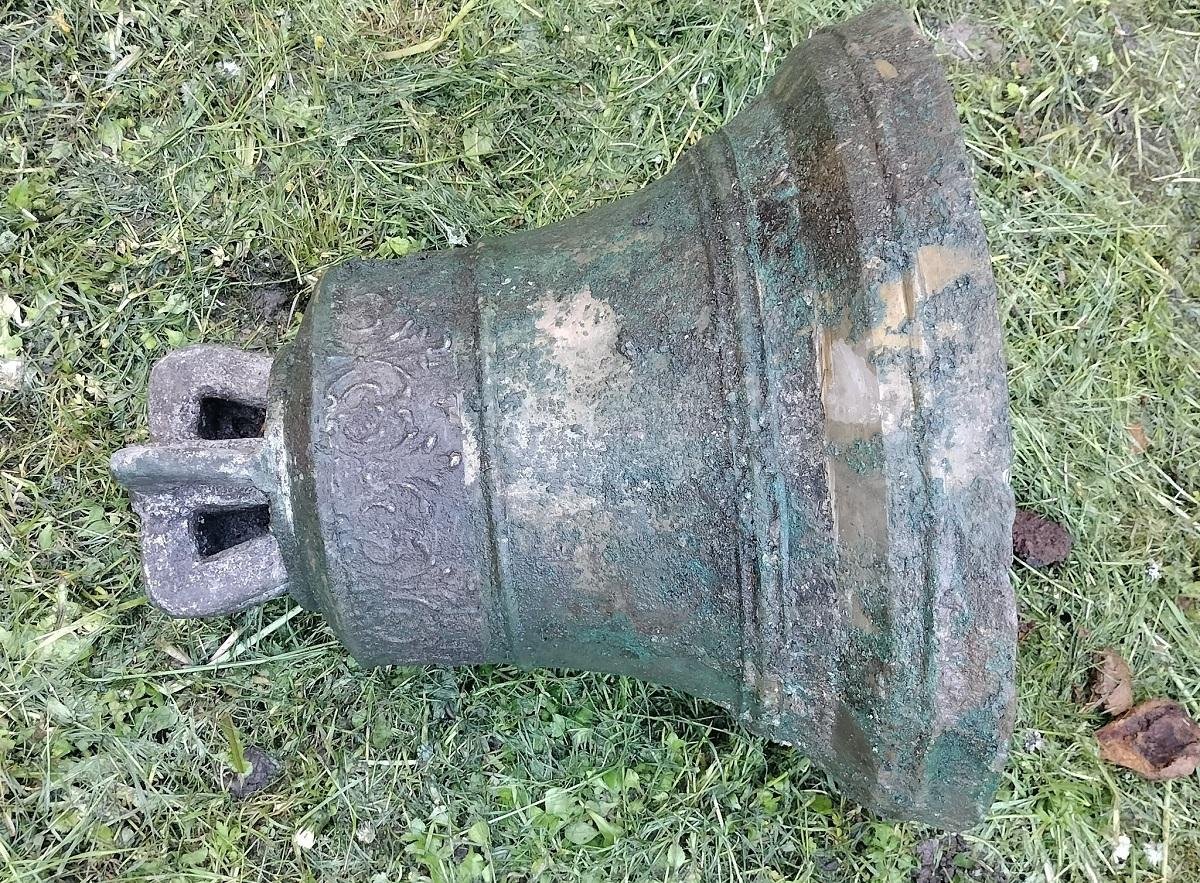
The find came to light on May 22, 2026, during construction work along Municipal Road No. 111324L in the Werbkowice commune. Contractors were digging a trench for electrical cables when they struck a metal object. Local authorities secured the bell and notified heritage officials from the Lublin Voivodeship Conservator of Monuments, who later inspected both the artifact and the location where workers found it.
The bell lay about 230 meters from Hostynne’s historic church, a building whose history reflects centuries of religious and political change in the region. Although construction and agricultural activity had taken place nearby in the past, nobody had reported the bell before.
Researchers found the object in good condition. Cast from brass, the bell stands 41 centimeters tall and measures 43 centimeters across at the mouth. An iron clapper remains inside, and no cracks or major damage are visible.
Decorative details survive despite years underground. A band of floral ornament circles the crown at the top of the bell. Raised rings and traces of additional decoration appear near the lower section. Corrosion covers part of the surface, making some details difficult to identify. Archaeologists hope cleaning and conservation work will reveal whether a casting date or other information survives within the ornamentation.
The interior offers few clues. Specialists have not identified any inscriptions, dates, or foundry marks. Even so, the bell still produces sound. Tests showed a clear, even tone, though contact with the ground softens the sound.
The discovery has renewed interest in Hostynne’s long history. Written records first mention the village in 1394. Documents from 1472 refer to a church in the settlement, likely a wooden structure. Historians believe Tatar raids destroyed that building during the early sixteenth century.
A new wooden church dedicated to St. George was built in 1732 with support from nobleman Jerzy Michał Sapieha. Religious changes during the nineteenth century transformed the church into an Orthodox place of worship in 1875. Builders replaced the wooden structure with a brick church between 1889 and 1890. Researchers suspect the newly recovered bell dates from this period, when churches often received new bells and furnishings.
Nobody knows exactly why the bell ended up underground. One possibility points to the First World War. In 1915, Austro-Hungarian forces occupied the area and seized bronze and brass objects for military use. Local residents may have hidden church property to protect valuable metal from confiscation.
Other periods of unrest offer alternative explanations. Campaigns against Orthodox churches took place between the 1920s and 1930s, while the Second World War brought further disruption to the region. Any of these events could explain why somebody buried the bell and never returned for it.
Stories about hidden church bells have circulated among local residents for generations. Those accounts became harder to verify after the Ukrainian population of Hostynne was displaced following the Second World War. Families who may have known the location of concealed objects left the area, taking many memories with them.
The church itself suffered heavy wartime damage. After the deportations of 1946, the Roman Catholic Church took control of the building, restored it, and reconsecrated it. Renovations carried out in 1964 removed several architectural features associated with Orthodox churches.
Officials plan to conserve the bell and place it on public display in Werbkowice. A specially designed shelter at the future Communal Crisis Management Centre will house the artifact, allowing residents to view a piece of local history that spent decades hidden beneath the soil.
More information: Lublin Voivodeship Conservator of Monuments



Disclaimer: This website is a science-focused magazine that welcomes both academic and non-academic audiences. Comments are written by users and may include personal opinions or unverified claims. They do not necessarily reflect the views of our editorial team or rely on scientific evidence.
Comment Policy: We kindly ask all commenters to engage respectfully. Comments that contain offensive, insulting, degrading, discriminatory, or racist content will be automatically removed.