• About
  • Privacy Policy
  • Terms of Use
  • Donation
  • Contact
No Result
View All Result
Archaeology News
  • Home
  • News
    • Archaeology
    • Anthropology
    • Paleontology
  • Academic
    • Books
    • Conferences
    • Universities
  • Articles
  • VR Tours
  • Quiz & Game
  • Download
  • Encyclopedia
  • Forum
Archaeology News
No Result
View All Result
Home News Paleontology

CT scanner captures woolly mammoth tusk

Dario Radley by Dario Radley
August 10, 2022
Share on FacebookShare on Linkedin.Share on RedditShare on Whatsapp

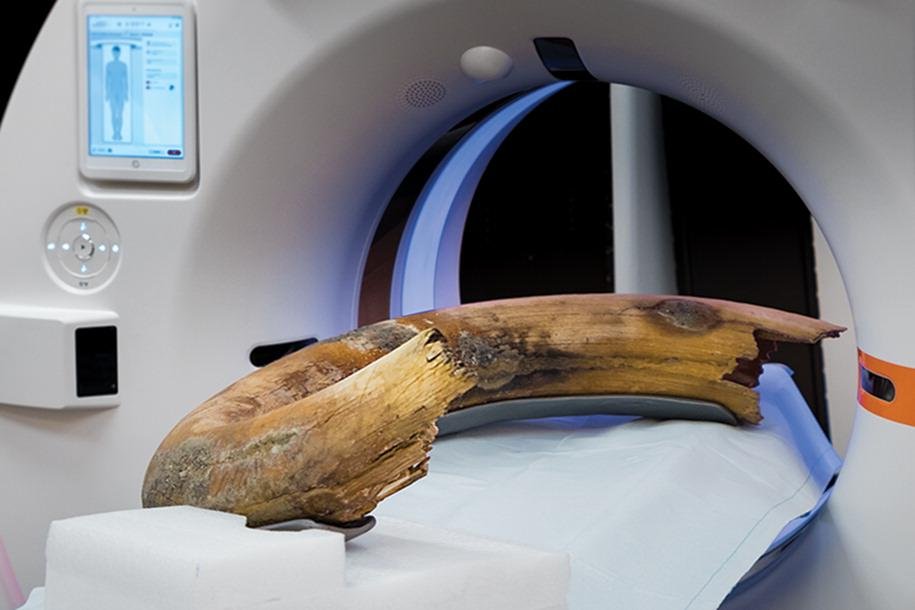
Researchers have successfully obtained full CT images of an entire woolly mammoth tusk, marking a historic milestone in the study of these ancient creatures. This remarkable feat was reported in an “Images in Radiology” article recently published in Radiology.
CT scanner captures woolly mammoth tusk
Photograph of the positioning of the woolly mammoth tusk in the scanner. The tusk was fixed in a fiberglass frame to guarantee transport and table-movement stability. There was 1 cm of clearance within the gantry bore. Credit: RSNA 2022.

The significance of this accomplishment lies in the utilization of advanced clinical CT scanning technology that enables the comprehensive imaging of mammoth tusks without the need for multiple partial scans. The mammoth tusk under examination was unearthed in central Switzerland and excavated by the heritage and archaeology office of Canton Zug.

The mammoth tusk’s impressive dimensions include a total length of 206 cm, a base diameter of 16 cm, and an overall object diameter of 80 cm, including its helical curvature, which translates to just over 2.5 feet.

Through the CT images, researchers unveiled a fascinating insight into the growth of dentin apposition from the central canal, which occurred on an annual basis. A meticulous count of 32 cones within the tusk provided a minimum age estimation of 32 years at the time of the mammoth’s demise. Notably, this estimate slightly falls short of the actual age at the time of death, mainly because the tusk’s tip is missing.

Proboscidean tusks are continuously growing maxillary lateral incisors. These tusks offer a valuable window into understanding the age and specific life-altering events in a mammoth’s existence through annual growth increment analysis.


RelatedStories

CT scans of ancient Egyptian mummies reveal lifespans, health, and daily life of priests

CT scans of ancient Egyptian mummies reveal lifespans, health, and daily life of priests

February 4, 2026
14,000-year-old Alaska campsite helps trace how the first people arrived in North America

14,000-year-old Alaska campsite helps trace how the first people arrived in North America

February 4, 2026

The senior author of the article, Tilo Niemann, MD, who also serves as the head of CT and heart and thoracic radiology at Kantonsspital Baden in Baden, Switzerland, acknowledged the complexities involved in working with precious fossils. He emphasized the need to avoid causing any harm or damage to these invaluable specimens.

Dr. Niemann stated, “Working with precious fossils is a challenge because it is important not to destroy or harm the specimen. Even if there exist various imaging techniques to evaluate the internal structure, it was not possible to scan a whole tusk in toto without the need for fragmentation or at least having to do multiple scans that then had to be painstakingly assembled.”

The woolly mammoth (Mammuthus primigenius), once roamed Eurasia and North America and was roughly the size of a modern African elephant. These magnificent creatures, characterized by their fur, small ears, and tails designed to prevent frostbite, sported tusks that served various purposes, including scraping bark from trees, foraging, and engaging in combat.

CT scanner captures woolly mammoth tusk
Credit: Archaeology News Online Magazine

The vast majority of woolly mammoths disappeared at the end of the last Ice Age, with the last of their kind living approximately 6,000 years ago. Woolly mammoths belong to the order Proboscidea, a group that encompasses present-day elephants and other extinct species like mastodons and gomphotheres.

Reflecting on the mammoth under examination, Dr. Niemann noted, “Our mammoth died about 17,000 years ago.” This new achievement offers invaluable information about the lives of these ancient giants.

More information: Huber, R., Reinhard, J., Rühli, F., Kubik-Huch, R. A., & Niemann, T. (2022). CT-based Age Estimation of a Mammoth Tusk. Radiology. https://doi.org/10.1148/radiol.220265


ShareTweetShareShareSend

You May Also Like...

Defensive ditch and dense Neolithic activity identified at Gawroniec Hill flint settlement in Poland
Archaeology

Defensive ditch and dense Neolithic activity identified at Gawroniec Hill flint settlement in Poland

February 10, 2026
Iron Age severed head ritual identified among new Iberian groups in Spain
Anthropology

Iron Age decapitation ritual identified among new Iberian groups in Spain

February 10, 2026
AI simulations reveal a Roman era board game in the Netherlands, pushing Europe’s blocking games back centuries
Archaeology

AI simulations reveal a Roman era board game in the Netherlands, pushing Europe’s blocking games back centuries

February 10, 2026
5,300 year old metal bow drill from Predynastic Egypt identified as earliest known rotary tool
Archaeology

5,300 year old metal bow drill found in Egypt is earliest known rotary tool

February 9, 2026
Arctic’s first inhabitants reached Greenland’s High Arctic by sea 4,500 years ago
Archaeology

Arctic’s first inhabitants reached Greenland’s High Arctic by sea 4,500 years ago

February 9, 2026
Oldest known sewn hide identified in Ice Age Oregon cave suggests early clothing
Archaeology

Oldest known sewn hide identified in Ice Age Oregon cave suggests early clothing

February 8, 2026

Follow us


Instagram
244K

Facebook
118K

Threads
45K

LinkedIn
14K

Twitter
6K

YouTube
1K
  • Trending
  • Comments
  • Latest
Shipwreck Salvage. Credit: rawpixel.com / Public Domain

2,000-year-old shipwreck discovered off Turkish coast with remarkably preserved stacked ceramics

July 2, 2025
Viking age DNA reveals 9,000-year-old HIV-resistant gene originating near the Black Sea

Viking age DNA reveals 9,000-year-old HIV-resistant gene originating near the Black Sea

May 18, 2025
A new study suggests the mysterious Voynich Manuscript may be a medieval cipher

A new study suggests the mysterious Voynich Manuscript may be a medieval cipher

January 3, 2026
Moses may be named in ancient Egyptian mine inscriptions, sparking debate over earliest biblical references

Moses may be named in ancient Egyptian mine inscriptions, sparking debate over earliest biblical references

July 31, 2025
Mystery of Armenia’s 6,000-year-old dragon stones solved

Mystery of Armenia’s 6,000-year-old dragon stones solved

September 23, 2025
3D analysis reveals Shroud of Turin image likely came from sculpture, not Jesus’ body

3D analysis reveals Shroud of Turin image likely came from sculpture, not Jesus’ body

Moses may be named in ancient Egyptian mine inscriptions, sparking debate over earliest biblical references

Moses may be named in ancient Egyptian mine inscriptions, sparking debate over earliest biblical references

$1 million prize offered to decipher 5,300-year-old Indus Valley script

$1 million prize offered to decipher 5,300-year-old Indus Valley script

Oldest ever genetic data from a human relative found in 2-million-year-old fossilized teeth

Oldest ever genetic data from a human relative found in 2-million-year-old fossilized teeth

Exceptionally large Roman shoes discovered at Magna fort near Hadrian’s Wall

Exceptionally large Roman shoes discovered at Magna fort near Hadrian’s Wall

Defensive ditch and dense Neolithic activity identified at Gawroniec Hill flint settlement in Poland

Defensive ditch and dense Neolithic activity identified at Gawroniec Hill flint settlement in Poland

February 10, 2026
Iron Age severed head ritual identified among new Iberian groups in Spain

Iron Age decapitation ritual identified among new Iberian groups in Spain

February 10, 2026
AI simulations reveal a Roman era board game in the Netherlands, pushing Europe’s blocking games back centuries

AI simulations reveal a Roman era board game in the Netherlands, pushing Europe’s blocking games back centuries

February 10, 2026
5,300 year old metal bow drill from Predynastic Egypt identified as earliest known rotary tool

5,300 year old metal bow drill found in Egypt is earliest known rotary tool

February 9, 2026
Arctic’s first inhabitants reached Greenland’s High Arctic by sea 4,500 years ago

Arctic’s first inhabitants reached Greenland’s High Arctic by sea 4,500 years ago

February 9, 2026

Archaeology News online magazine

Archaeology News is an international online magazine that covers all aspects of archaeology.


Categories

  • Academics
    • Books
    • Conferences
    • Universities
  • Articles
  • Download
  • Game
  • News
    • Anthropology
    • Archaeology
    • Paleontology
  • Quiz
  • Tours

Subscribe to our newsletter

© 2024 - Archaeology News Online Magazine. All Rights Reserved.

  • About
  • Privacy Policy
  • Terms of Use
  • Donation
  • Contact

Welcome Back!

Login to your account below

Forgotten Password? Sign Up

Create New Account!

Fill the forms below to register

All fields are required. Log In

Retrieve your password

Please enter your username or email address to reset your password.

Log In

Add New Playlist

Manage Consent
To provide the best experiences, we use technologies like cookies to store and/or access device information. Consenting to these technologies will allow us to process data such as browsing behavior or unique IDs on this site. Not consenting or withdrawing consent, may adversely affect certain features and functions.
Functional Always active
The technical storage or access is strictly necessary for the legitimate purpose of enabling the use of a specific service explicitly requested by the subscriber or user, or for the sole purpose of carrying out the transmission of a communication over an electronic communications network.
Preferences
The technical storage or access is necessary for the legitimate purpose of storing preferences that are not requested by the subscriber or user.
Statistics
The technical storage or access that is used exclusively for statistical purposes. The technical storage or access that is used exclusively for anonymous statistical purposes. Without a subpoena, voluntary compliance on the part of your Internet Service Provider, or additional records from a third party, information stored or retrieved for this purpose alone cannot usually be used to identify you.
Marketing
The technical storage or access is required to create user profiles to send advertising, or to track the user on a website or across several websites for similar marketing purposes.
  • Manage options
  • Manage services
  • Manage {vendor_count} vendors
  • Read more about these purposes
View preferences
  • {title}
  • {title}
  • {title}
  • Home
  • News
    • Archaeology
    • Anthropology
    • Paleontology
  • Academic
    • Books
    • Conferences
    • Universities
  • Articles
  • VR Tours
  • Quiz & Game
  • Download
  • Encyclopedia
  • Forum

About  .  Contact  .  Donation

© 2024 - Archaeology News Online Magazine. All Rights Reserved